

Talent acquisition trends in 2026 are being shaped by the growing adoption of AI, skills-first hiring, workforce analytics, and internal mobility strategies. Organizations are increasingly moving away from traditional recruitment models and adopting data-driven, technology-enabled hiring approaches to address evolving skill demands, talent shortages, and changing workforce expectations.
According to LinkedIn’s Future of Recruiting report, 73% of talent acquisition professionals agree that AI will change the way organizations hire, highlighting the rapid shift toward AI-powered recruitment and workforce intelligence.
As hiring becomes more strategic and skills-focused, businesses are prioritizing predictive workforce planning, inclusive hiring practices, and skills intelligence to improve hiring accuracy, workforce agility, and long-term talent planning.
In this blog, we’ll explore the top 10 talent acquisition trends shaping the future of hiring and how organizations are adapting their recruitment strategies to stay competitive.
Top 10 Talent Acquisition Trends
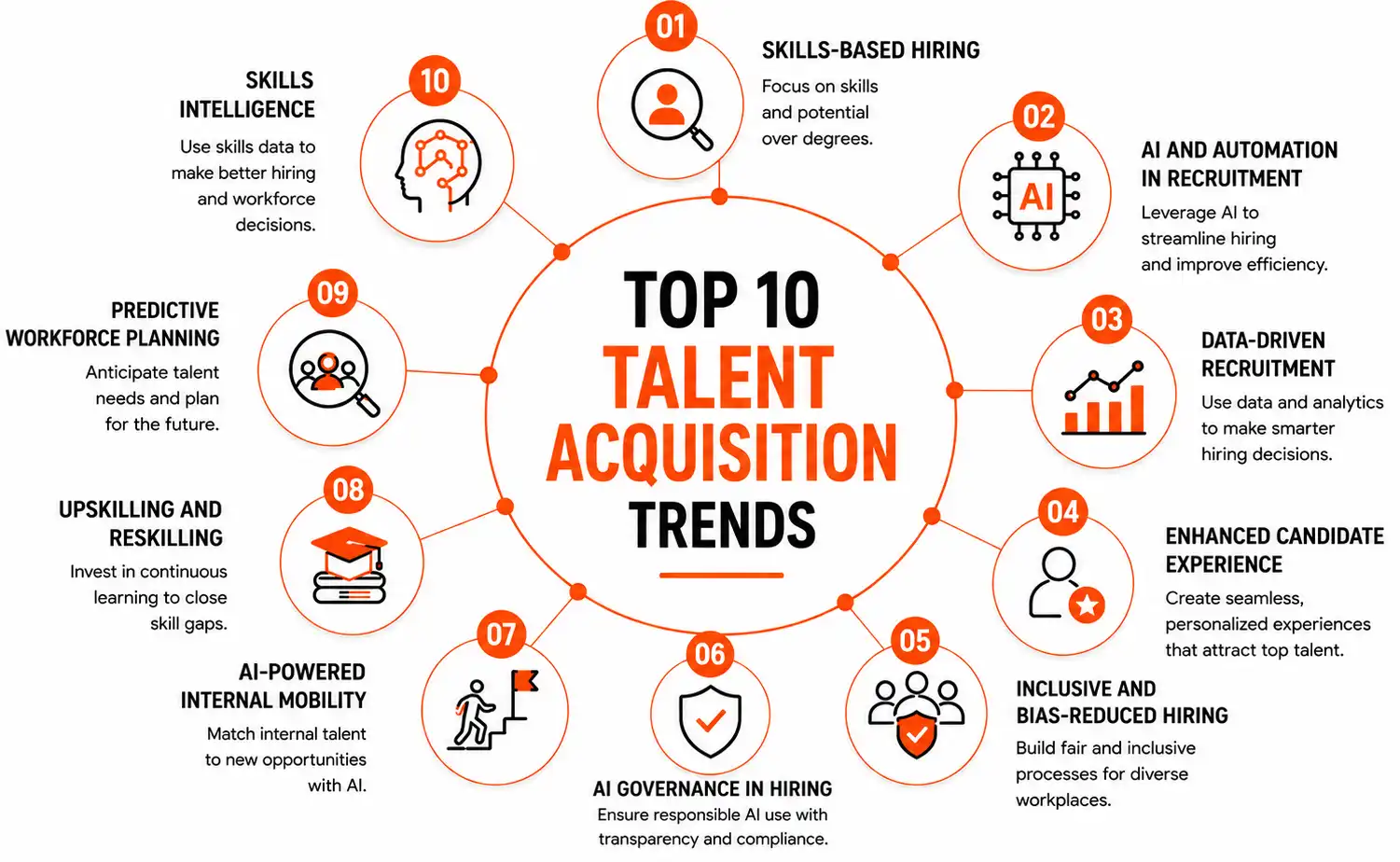
1. Skills-based Hiring
Skills-based hiring is transforming how organizations evaluate talent by shifting the focus from degrees and job titles to demonstrated skills and real-world capabilities. Companies are increasingly adopting skills assessments and competency-based evaluations to identify candidates who can perform effectively in dynamic roles.
Key Focus Areas
- Prioritizing skills and competencies over traditional credentials
- Expanding access to broader talent pools
- Improving hiring accuracy through skills validation
- Reducing bias in candidate evaluations
2. AI and Automation
AI and automation are reshaping talent acquisition by streamlining recruitment workflows and improving decision-making. From candidate screening and job matching to interview scheduling and communication, AI-powered tools are helping recruiters hire faster and more efficiently.
Key Focus Areas
- Automating repetitive recruitment tasks
- Enhancing candidate matching and screening
- Improving hiring efficiency and speed
- Enabling data-driven recruitment decisions
As the use of AI in HR expands, talent acquisition teams are increasingly adopting automation, predictive analytics, and AI-supported candidate evaluation.
3. Data-driven Recruitment
Data-driven recruitment is helping organizations make more informed and objective hiring decisions using workforce analytics, hiring metrics, and recruitment data. Companies are leveraging data insights to optimize sourcing strategies, improve hiring outcomes, and identify recruitment bottlenecks.
Key Focus Areas
- Using recruitment analytics to improve hiring strategies
- Tracking hiring performance and workforce trends
- Reducing inefficiencies in recruitment processes
- Supporting objective and evidence-based hiring decisions
4. Candidate Experience
Candidate experience continues to play a critical role in attracting and retaining top talent. Organizations are focusing on creating personalized, transparent, and efficient hiring journeys to improve engagement and strengthen employer perception throughout the recruitment process.
Key Focus Areas
- Personalizing candidate communication and engagement
- Improving hiring process transparency and responsiveness
- Streamlining application and interview experiences
- Strengthening employer perception and candidate trust
5. Inclusive & Bias-Reduced Hiring
Inclusive and bias-reduced hiring is becoming a key focus for organizations looking to build diverse, high-performing teams. Rather than relying solely on traditional qualifications or subjective evaluations, companies are adopting structured assessments, skills validation, and data-driven hiring methods to create fairer recruitment processes.
Key Focus Areas
- Promoting objective and skills-based candidate evaluations
- Expanding access to broader and more diverse talent pools
- Reducing unconscious bias in recruitment decisions
- Creating more equitable and transparent hiring processes
6. AI Governance in Hiring
As AI becomes deeply integrated into recruitment workflows, organizations are prioritizing responsible and transparent AI-driven hiring practices. From resume screening to candidate matching, AI tools are helping recruiters make faster decisions while also raising concerns around bias, fairness, compliance, and transparency in how AI-driven decisions are made.
Key Focus Areas
- Reducing bias in AI-assisted hiring decisions
- Improving transparency in recruitment workflows
- Ensuring compliance with evolving AI and employment regulations
- Building trust in AI-powered candidate screening and assessments
Explore our blog on the 20 best talent acquisition tools that enables smart and effective recruitment.
7. AI-Powered Internal Mobility
Organizations are increasingly investing in AI-powered internal mobility to identify and redeploy talent within the workforce. By mapping employee skills to business needs, companies can improve workforce agility, support career growth, and reduce dependency on external hiring.
Key Focus Areas
- Matching employees to internal opportunities using AI
- Improving workforce agility and talent utilization
- Supporting employee career growth and retention
- Reducing external hiring costs through internal mobility
8. Upskilling and Reskilling
Upskilling and reskilling are becoming essential talent acquisition and workforce development strategies as organizations adapt to evolving technologies and business demands. Companies are focusing on continuous learning initiatives to prepare employees for emerging roles and future skill requirements.
Key Focus Areas
- Addressing skill gaps through continuous learning
- Preparing employees for evolving job roles
- Supporting workforce adaptability and resilience
- Strengthening internal talent pipelines
9. Predictive Workforce Planning
Predictive workforce planning is becoming a critical talent acquisition strategy as organizations prepare for rapidly evolving business and skill demands. Instead of reacting to talent shortages after they emerge, companies are using AI, workforce analytics, and skills data to forecast future hiring needs and build proactive talent pipelines.
Key Focus Areas
- Forecasting future skill and hiring requirements
- Identifying workforce and capability gaps early
- Building proactive talent pipelines for critical roles
- Aligning hiring strategies with long-term business goals
10. Skills Intelligence
Skills intelligence is emerging as a foundational element of modern talent acquisition strategies. Organizations are moving beyond static resumes and job titles to gain deeper visibility into workforce capabilities, skill gaps, and future talent needs. AI-powered skills intelligence platforms help businesses make smarter hiring and workforce decisions through real-time skills insights.
Key Focus Areas
- Mapping skills across candidates and employees
- Identifying skill gaps and emerging capabilities
- Improving candidate-role matching accuracy
- Supporting workforce planning and internal mobility initiatives
Conclusion
Talent acquisition is becoming more strategic, skills-focused, and technology-driven as organizations adapt to evolving workforce demands and changing hiring expectations. From AI-powered recruitment and predictive workforce planning to skills intelligence and inclusive hiring, these trends are reshaping how businesses attract, assess, and retain top talent.
Organizations that embrace data-driven and skills-first hiring strategies will be better positioned to build agile, future-ready workforces and stay competitive in an increasingly dynamic talent landscape.
Dive into key talent acquisition best practices to turn emerging trends into actionable strategies that attract and retain top talent.
FAQs
How is AI transforming talent acquisition?
AI transforms talent acquisition by personalizing hiring processes, enhancing candidate matching, and automating repetitive tasks. Solutions like AI-generated job descriptions and skills-based assessments enhance hiring accuracy and speed, enabling data-driven decisions.
Why is skills-first hiring beneficial for organizations?
Skills-based hiring tool concentrates more on real competencies over traditional degrees, ensuring the candidate has the required expertise to handle the role and responsibilities. It promotes diversity, minimizes hiring bias, and fills roles effectively.
Through skills-first hiring, businesses enhance performance, encourage internal mobility, and develop adaptable workforces ready for future challenges.
What technologies should organizations use for talent acquisition?
Businesses can use key technologies for talent acquisition, including AI-driven platforms, such as iMocha, for skills matching, skills assessment tools, and more. It can streamline hiring, enhance decision-making, improve candidate experience, and support continuous learning.
How does a skill-based approach improve talent acquisition?
A skill-based approach assesses people on their capabilities, decreasing the chances of hiring mismatches. It allows businesses to ensure precise role-fit, improves objectivity, and supports workforce planning.
How can iMocha help with hiring strategies?
iMocha provides AI-powered solutions, such as skills matching, skills assessments, and more, helping optimize hiring. It helps discover skill gaps, enhance internal mobility, and improve candidate evaluation. With iMocha’s tools, businesses can make smart hiring decisions.

