

Data-driven recruitment is not a reporting upgrade. In large enterprises, it is a decision-quality and governance requirement. Hiring teams operate across geographies, business units, and role families, often using multiple systems that do not share a consistent view of candidate capability, selection decisions, or post-hire outcomes.
When capability signals are fragmented across ATS notes, unstructured interviews, and inconsistent scorecards, enterprises introduce avoidable risk. That includes slower critical role coverage, higher redeployment friction during transformation, and reduced auditability for fairness and compliance reviews.
This guide outlines what data-driven recruitment looks like at enterprise scale, what breaks without it, and a practical roadmap to operationalize measurable, defensible hiring decisions in 2026.
What is data-driven recruitment?
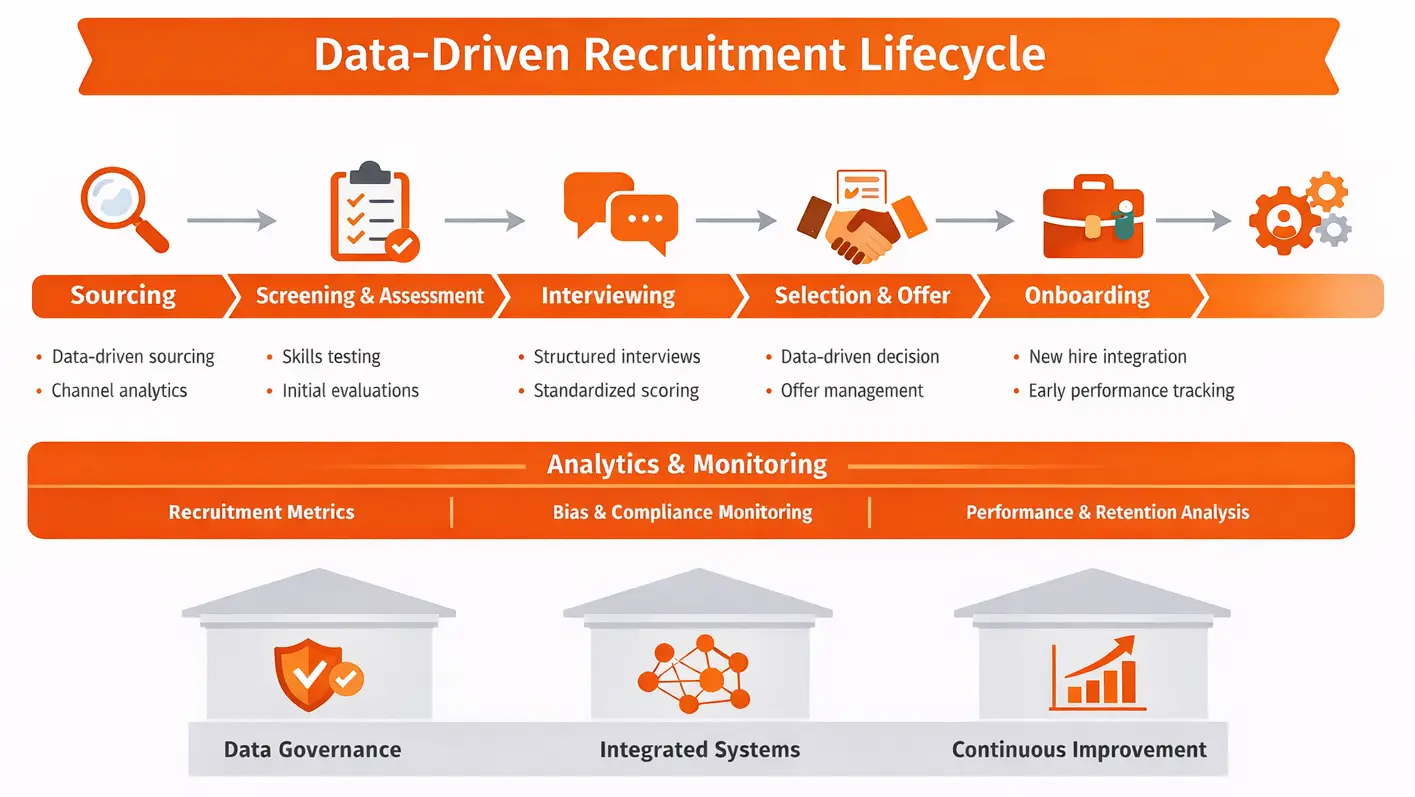
Data-driven recruitment is an enterprise hiring approach where decisions are guided by measurable, comparable signals rather than individual intuition. It involves collecting and analyzing data across the full recruitment lifecycle, including sourcing effectiveness, screening and assessment performance, interview evaluations, offer outcomes, and early performance indicators.
At enterprise scale, the objective is consistency and decision defensibility. That means establishing standardized signals for role readiness, maintaining an auditable trail from criteria to selection, and improving decision accuracy over time through continuous measurement.
Typical systems involved include:
- Applicant Tracking Systems (ATS) for workflow and requisition management
- Skills assessment platforms for validated capability signals
- Analytics layers or dashboards for outcome visibility and governance reporting
- HRIS and performance systems to connect hiring signals to post-hire outcomes
What breaks without data-driven recruitment at enterprise scale?
Even strong recruiting teams struggle when hiring signals are not governed. Common failure modes include:
- Inconsistent hiring bars across regions and teams: Different interviewers apply different standards, creating variance in selection outcomes for the same role family.
- Low confidence in capability signals: Resume screening and subjective interviews are difficult to compare across candidates and geographies, especially for high-volume roles.
- Limited auditability and higher bias risk: Without standardized rubrics, validated assessments, and decision trails, organizations struggle to demonstrate fairness and consistency.
- Weak linkage between hiring and business outcomes: If you cannot connect selection signals to performance and retention, you cannot improve quality of hire in a repeatable way.
- Sourcing investment is hard to optimize: Channel attribution becomes unreliable when data is siloed across agencies, platforms, and regional teams.
Benefits of data-driven recruitment for enterprises
A data-driven approach strengthens enterprise hiring outcomes by improving decision accuracy, reducing operational variability, and enabling governance. Key benefits include:
1) Higher decision consistency across geographies and role families
Standardized evaluation criteria and comparable capability signals reduce "interviewer drift" and make selection outcomes more reliable across business units.
2) Improved critical role coverage and business continuity
Enterprises can prioritize roles that protect delivery, customer outcomes, and transformation programs. This is especially important when hiring volumes and requisition complexity are high.
3) Better quality of hire through validated, job-relevant signals
When assessments and scorecards are tied to role requirements, selection decisions become more predictive of performance and time-to-productivity.
4) Reduced risk through auditability and bias monitoring
Structured data supports fairness reviews, adverse impact monitoring, and repeatable governance across the hiring lifecycle.
5) Stronger workforce planning inputs
Recruitment data becomes a strategic signal for capability readiness, skill supply constraints, and future hiring demand.
Enterprise metrics to track for data-driven recruitment
Avoid treating success as only "faster hiring." Enterprises should track metrics that reflect readiness, coverage, and decision quality.
Recommended metrics:
- Critical role coverage rate
- Time-to-productivity (by role family)
- Quality-of-hire proxy metrics (early performance signals, manager satisfaction, ramp milestones)
- Offer acceptance rate by role family and geography
- Assessment-to-performance correlation (where measurable)
- Stage conversion rates (application to screen, screen to interview, interview to offer)
- Candidate drop-off rate by stage and region
- Adverse impact indicators across selection stages
- Capability gap exposure tied to strategic initiatives
You can still monitor time-to-hire and cost-per-hire, but they should not be the primary measure of enterprise hiring health.
7 steps to implement data-driven recruitment in 2026
1) Define enterprise hiring outcomes and the operating model
Start with outcomes tied to business continuity, transformation, and delivery goals. Then define how decisions should work across teams.
Key actions:
- Align TA, HRBP, and business leaders on role families that matter most
- Define consistent selection criteria per role family
- Clarify decision rights and escalation paths across regions and functions
Deliverable: a shared enterprise hiring scorecard for priority role families.
2) Standardize role requirements and capability signals
Data-driven hiring fails when the "definition of readiness" varies by team.
Key actions:
- Build role profiles that specify core skills, proficiency expectations, and critical behaviors
- Use structured interview guides and consistent rating scales
- Establish comparable scoring across geographies, including calibration sessions
Deliverable: standardized evaluation kits for priority roles.
3) Implement validated assessments and structured evaluation
Enterprises need signals that are job-relevant, consistent, and defensible.
Key actions:
- Use assessments aligned to role requirements, not generic tests
- Standardize score interpretation across teams
- Define minimum thresholds and how they combine with interview ratings
This is where skills intelligence platforms can provide validated capability signals, especially when assessment results can be analyzed across roles, geographies, and hiring programs. iMocha, for example, supports validated skills assessments and analytics that help enterprises standardize and compare role readiness at scale.
Explore the top 15 Talent Intelligence Platforms and discover how AI-powered tools optimize hiring and enable data-driven talent decisions.
4) Integrate systems to create a reliable data layer
If data is split across ATS, assessments, and interview notes, reporting becomes inconsistent and governance becomes weak.
Key actions:
- Ensure clean handoffs between ATS, assessments, and interview scoring
- Consolidate key decision fields into a consistent dataset
- Define data definitions once, then enforce them across regions
Deliverable: a governed hiring dataset with consistent definitions.
5) Use analytics to identify bottlenecks and improve decision quality
Treat recruitment analytics as an improvement loop, not a quarterly report.
Key actions:
- Identify drop-off points by stage, geography, and role family
- Evaluate channel effectiveness using conversion and quality signals, not volume alone
- Track assessment-to-performance signals where possible
- Monitor exceptions, such as overrides to thresholds or inconsistent scoring patterns
Deliverable: a monthly hiring governance review with defined actions.
Discover Top 8 Talent Acquisition Metrics to track hiring effectiveness and enhance recruitment processes.
6) Add governance for fairness, auditability, and data quality
This is the differentiator between "data-aware hiring" and enterprise-grade data-driven hiring.
Key actions:
- Create a governance layer for skills data accuracy and validation standards
- Maintain audit trails for selection decisions and scoring
- Monitor adverse impact indicators across selection stages
- Define controls for AI-assisted sourcing or screening, including human oversight
- Build adoption governance, including training, calibration, and change management
Deliverable: a hiring governance framework with controls and ownership.
7) Operationalize continuous optimization and future readiness
Enterprise hiring environments change fast. Role needs shift, skill supply fluctuates, and transformation programs introduce new capability demands.
Key actions:
- Refresh role requirements and benchmarks every 6 to 12 months
- Create feedback loops between hiring outcomes and capability planning
- Build readiness views by role family to support workforce transformation roadmaps
If your skills intelligence layer connects hiring signals with validated capability data, recruitment becomes a strategic input into workforce planning. Platforms like iMocha can support this by combining assessment signals, analytics, and integration capabilities to help enterprises build more consistent, decision-ready hiring processes.
Conclusion
Data-driven recruitment helps enterprises improve decision consistency, reduce risk, and increase confidence in hiring outcomes. The goal is not simply faster hiring. It is defensible selection decisions, improved critical role coverage, and measurable capability readiness across business units and geographies.
Enterprises that operationalize a governed data layer, standardized evaluation signals, and continuous analytics can protect business continuity while building a workforce that can adapt to shifting capability demands in 2026 and beyond.
Discover how talent acquisition best practices can be enhanced through data-driven hiring to attract top candidates and improve hiring efficiency.
FAQs
How do enterprises govern hiring data across multiple HR systems?
Enterprises typically define a governance layer that standardizes data definitions and ownership across the ATS, assessment platforms, and reporting systems. This includes consistent scoring rubrics, validated capability signals, audit trails for decisions, and regular calibration to prevent regional variation in hiring bars.
What are the best enterprise KPIs for data-driven recruitment?
Beyond time-to-hire, enterprises should track critical role coverage, time-to-productivity, assessment-to-performance correlation, conversion rates by stage and geography, drop-off rates, offer acceptance by role family, and fairness indicators such as adverse impact across selection stages.
How do you reduce bias in a data-driven recruitment model?
Bias reduction comes from standardization and auditability. Use structured interviews, consistent rating scales, validated assessments aligned to job requirements, and monitored selection outcomes across demographic groups. Track adverse impact at each stage and establish governance controls for AI-assisted screening and decision overrides.
What should be implemented first: tools or process?
Process first. Define standardized role requirements and evaluation criteria, then select technology that supports consistent data capture and analysis. Tooling without a governed operating model usually increases fragmentation rather than improving decision quality.

