

Hiring accuracy directly impacts workforce productivity, delivery timelines, and transformation outcomes in large enterprises. As organizations scale across business units, geographies, and hiring volumes, candidate screening becomes a critical control point for workforce quality, compliance, and business continuity.
Without a structured and governed screening framework, enterprises face inconsistent hiring decisions, poor role readiness, longer time-to-productivity, and increased attrition in critical roles. Fragmented evaluation methods and unvalidated data further increase the risk of misaligned hiring decisions at scale.
Modern candidate screening combines validated skills assessments, structured interviews, simulations, AI-enabled evaluation workflows, and governance controls. These methods enable enterprises to make consistent, auditable, and data-backed hiring decisions aligned with business outcomes.
TL;DR
- Candidate screening enables enterprises to identify role-ready candidates while reducing hiring risk at scale
- Effective screening integrates validated assessments, structured workflows, and governance control
- The four stages include pre-screening, initial screening, in-depth screening, and final screening
- Leading methods include resume screening, application forms, skills assessments, simulations, structured interviews, and assessment centers
What is candidate screening?
Candidate screening is the structured evaluation of job applicants against defined role requirements before progressing them through the hiring process. It includes reviewing experience, validating skills, assessing behavioral alignment, and verifying credentials.
At enterprise scale, candidate screening functions as a decision infrastructure layer. It standardizes how candidates are evaluated across teams, ensures consistent application of criteria, and provides auditable data for hiring decisions.
Enterprises increasingly rely on screening systems that support:
- Validated assessment frameworks
- Standardized scoring models
- Audit trails for hiring decisions
- Cross-system integration with ATS and HCM platforms
Why candidate screening matters at enterprise scale
Reduces bad-hire risk across distributed hiring environments
At scale, even a small percentage of poor hiring decisions can significantly impact productivity and delivery. Structured screening ensures that only candidates who meet defined capability thresholds move forward, reducing downstream hiring risk.
Improves quality-of-hire through validated skills data
Enterprises must move beyond self-reported experience. Validated assessments and structured evaluations improve quality-of-hire, role readiness, and screening-to-performance correlation.
Standardizes hiring decisions across geographies
Inconsistent screening practices lead to uneven workforce quality. A unified screening framework ensures that candidates are evaluated using the same criteria across locations and business units.
Enables fair, auditable, and compliant hiring
Enterprises must demonstrate fairness and compliance in hiring. This requires standardized criteria, validated assessments, consistent scoring models, and documented decision trails that can be audited when needed.
Improves workforce readiness and business continuity
Candidates selected through structured screening are more likely to perform effectively from day one. This improves time-to-productivity, first-year retention, and critical role coverage.

Top 10 candidate screening methods for 2026
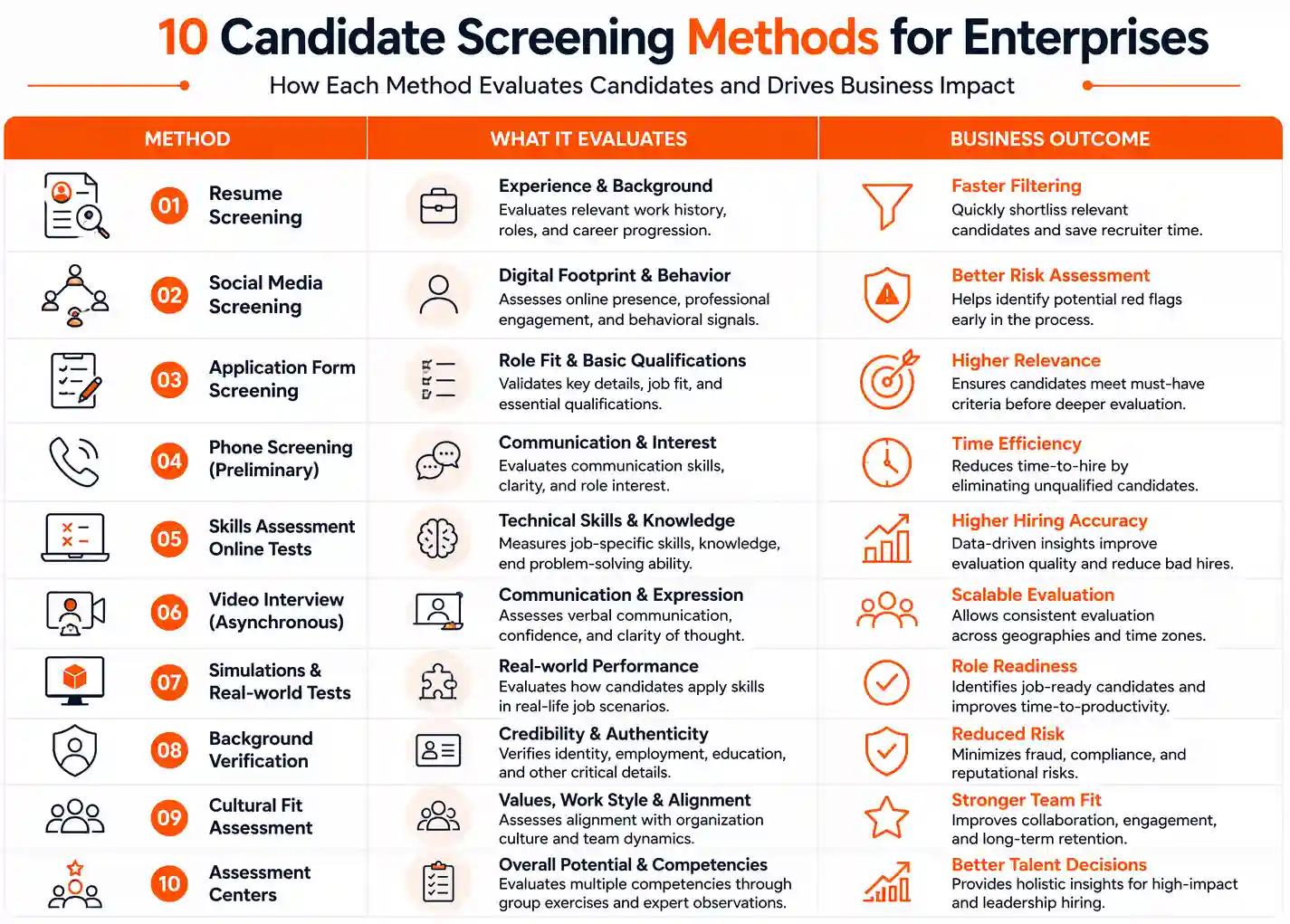
Pre-screening stage
1. Resume and CV screening
Resume screening remains the starting point for most hiring workflows. However, in enterprise environments with high application volumes, this method quickly becomes unreliable when used in isolation. Keyword-based filtering often overlooks transferable skills and adjacent capabilities, while inconsistent recruiter interpretation introduces variability in candidate selection.
Reflecting current AI hiring trends, leading enterprises use AI resume screening as a preliminary filter and combine it with structured criteria and skills assessments. It is typically supplemented with structured criteria and downstream validation methods such as skills assessments. This approach reduces false positives, improves screening accuracy, and ensures that candidate progression is based on capability rather than keyword alignment alone.
2. Social media screening
Professional platforms can provide additional context around candidate experience, industry participation, and professional credibility. At scale, however, unstructured use of social data introduces risk, particularly when evaluation criteria are not clearly defined.
Enterprises address this by restricting social media screening to job-relevant signals and embedding it within governed hiring workflows. When applied consistently and transparently, this method supports verification without compromising fairness or compliance.
3. Online application forms
Standardized application forms play a critical role in enterprise hiring by structuring candidate data at the point of entry. Unlike resumes, which vary in format and content, application forms ensure that essential information such as eligibility, experience, and role alignment is captured consistently.
This structured input enables better downstream automation, improves data quality, and supports more accurate early-stage filtering across large candidate pools.
Initial screening stage
4. Phone screening
Phone screening helps validate candidate intent, communication ability, and baseline alignment with the role. While effective in smaller hiring environments, it can become inconsistent at scale when different recruiters apply varying questioning styles and evaluation criteria.
Enterprises address this by standardizing phone screening through predefined scripts and scoring frameworks. This ensures that all candidates are evaluated on comparable parameters, improving consistency and reducing subjective decision-making in early-stage screening.
In-depth screening stage
5. Skills assessments
Skills assessments have become central to enterprise hiring because they provide objective evidence of candidate capability. Unlike resumes or interviews, they measure whether a candidate can perform role-specific tasks under defined conditions.
Enterprises rely on validated, role-aligned assessments with benchmarking and standardized scoring models to ensure consistency across hiring programs. This reduces reliance on subjective judgment and improves predictive accuracy.
Skills intelligence platforms provide enterprises with continuous visibility into candidate capabilities. iMocha delivers this through 3,00 validated skills assessments, AI-driven skills inference, and analytics that support consistent and data-backed screening decisions.
This approach enables measurement of key indicators such as skill readiness index, screening accuracy, and capability alignment.
6. Video interviews
Video interviews have become essential for distributed hiring models, enabling organizations to evaluate candidates across geographies without scheduling constraints. However, without structure, they can replicate inconsistencies found in traditional interviews.
Enterprises improve effectiveness by standardizing interview questions, applying consistent scoring frameworks, and maintaining recorded evaluations for auditability. This creates a scalable and transparent evaluation process while reducing interviewer bias and operational delays.
iMocha’s AI Interviewer, Tara, supports structured, on-demand candidate evaluations with predefined question sets, consistent scoring logic, and recorded responses, helping enterprises ensure consistency and auditability at scale.
7. Job simulations and work assignments
Job simulations provide one of the most reliable indicators of role readiness because they assess how candidates perform in real-world scenarios. Traditional interviews often fail to capture applied capability, especially for complex or technical roles.
By incorporating simulations such as coding challenges, case studies, and role-based exercises, enterprises gain deeper insight into execution ability. This reduces hiring uncertainty and improves alignment between candidate capability and job requirements, directly impacting post-hire performance.
Final screening stage
8. Reference and background checks
Verification processes are critical for ensuring the accuracy of candidate information and maintaining compliance, particularly in regulated industries or roles involving sensitive data.
Enterprises implement standardized workflows that include credential validation, employment history checks, and compliance-aligned background screening. This strengthens hiring integrity and reduces the likelihood of fraudulent claims.
9. Cultural alignment assessments
Cultural alignment should be evaluated through structured, job-relevant criteria rather than subjective judgment. Unstructured “fit” decisions introduce bias and reduce consistency across hiring teams.
Enterprises increasingly use structured behavioral assessments and defined evaluation frameworks to measure alignment with operating models, collaboration expectations, and leadership styles. This ensures that hiring decisions remain objective while still considering long-term integration and performance.
10. Assessment centers
Assessment centers are widely used for leadership and high-stakes hiring because they provide a comprehensive view of candidate capability across multiple dimensions. Relying on a single evaluation method often limits visibility into decision-making ability, collaboration, and strategic thinking.
By combining simulations, group exercises, presentations, and structured scoring, assessment centers enable enterprises to evaluate candidates in a controlled and multi-context environment. This improves decision confidence and reduces risk in critical hiring scenarios.
Discover the pre-employment testing pros and cons to make your candidate screening process more efficient and accurate.
Key factors enterprises should consider when screening candidates
Enterprise screening decisions should balance skills, role readiness, governance, and business outcomes. Key factors include:
- Relevant skills and experience: Validate whether the candidate has the technical, functional, and behavioral skills required for the role.
- Role readiness: Assess whether the candidate can contribute quickly without extensive ramp-up time.
- Career progression: Review growth, stability, adaptability, and evidence of continuous learning.
- Communication and collaboration: Evaluate whether the candidate can work effectively across teams, stakeholders, and geographies.
- Adaptability and learning potential: Identify candidates who can respond to changing business needs and evolving skill requirements.
- Governance and compliance: Ensure screening criteria are standardized, auditable, and consistently applied.
Save time and streamline hiring with our curated list of top candidate screening software for accurate shortlisting.
Conclusion
Candidate screening in enterprise environments must evolve into a structured, governed, and data-driven system. It is no longer a recruiter-led activity but a strategic capability that influences workforce quality, transformation readiness, and business performance.
Enterprises that invest in validated screening frameworks, standardized workflows, and skills intelligence gain stronger visibility into talent, reduce hiring risk, and improve long-term workforce outcomes.
Skills intelligence platforms such as iMocha act as a foundational layer in this ecosystem, enabling enterprises to validate capabilities, standardize screening decisions, and align hiring with business objectives at scale.
Check out 10 key talent acquisition best practices to optimize your screening process and build a stronger, more diverse talent pipeline.
FAQs
1. How do enterprises ensure candidate screening is compliant and auditable?
Enterprises implement standardized evaluation frameworks, maintain audit trails, use validated assessments, and ensure that all screening decisions are documented and consistently applied across hiring teams.
2. What metrics define effective candidate screening in enterprises?
Key metrics include quality-of-hire, skill readiness index, screening accuracy rate, time-to-productivity, critical role coverage, and screening-to-performance correlation.
3. How do skills intelligence platforms improve screening decisions?
They provide validated assessments, continuous skills visibility, and analytics that help enterprises evaluate candidates objectively and consistently across roles and geographies.
4. How can enterprises reduce bias in screening?
By using standardized criteria, validated assessments, structured interviews, and audit mechanisms that ensure fairness and consistency in evaluation.
5. Why are job simulations important for enterprise hiring?
Simulations assess applied capability in real-world scenarios, improving role readiness and reducing the risk of performance gaps after hiring.

