

AI workforce management uses artificial intelligence to automate repetitive tasks such as scheduling, payroll, and workforce planning while analyzing workforce data to predict future staffing needs and optimize business operations. It also helps organizations personalize employee engagement, identify skill gaps, improve productivity, and make faster, data-driven talent decisions.
By combining automation, workforce analytics, and skills intelligence, AI workforce management enables enterprises to build a more agile, efficient, and future-ready workforce capable of adapting to rapidly evolving business demands.
According to a Gartner survey conducted in March 2025, 37% of teams using traditional AI reported high productivity gains, while teams leveraging generative AI achieved slightly lower results at 34%, highlighting that AI is already delivering measurable productivity improvements across enterprise workforce operations.
In this blog, we’ll explore the top AI workforce management use cases, benefits, and strategies helping enterprises improve workforce planning, employee productivity, talent management, and operational efficiency in 2026.
TL;DR
- AI workforce management integrates data, automation, and skills analytics to manage talent more intelligently.
- It helps organizations forecast workforce needs, reduce hiring time, and boost employee engagement.
- AI systems identify skill gaps, personalize learning, and improve retention across global teams.
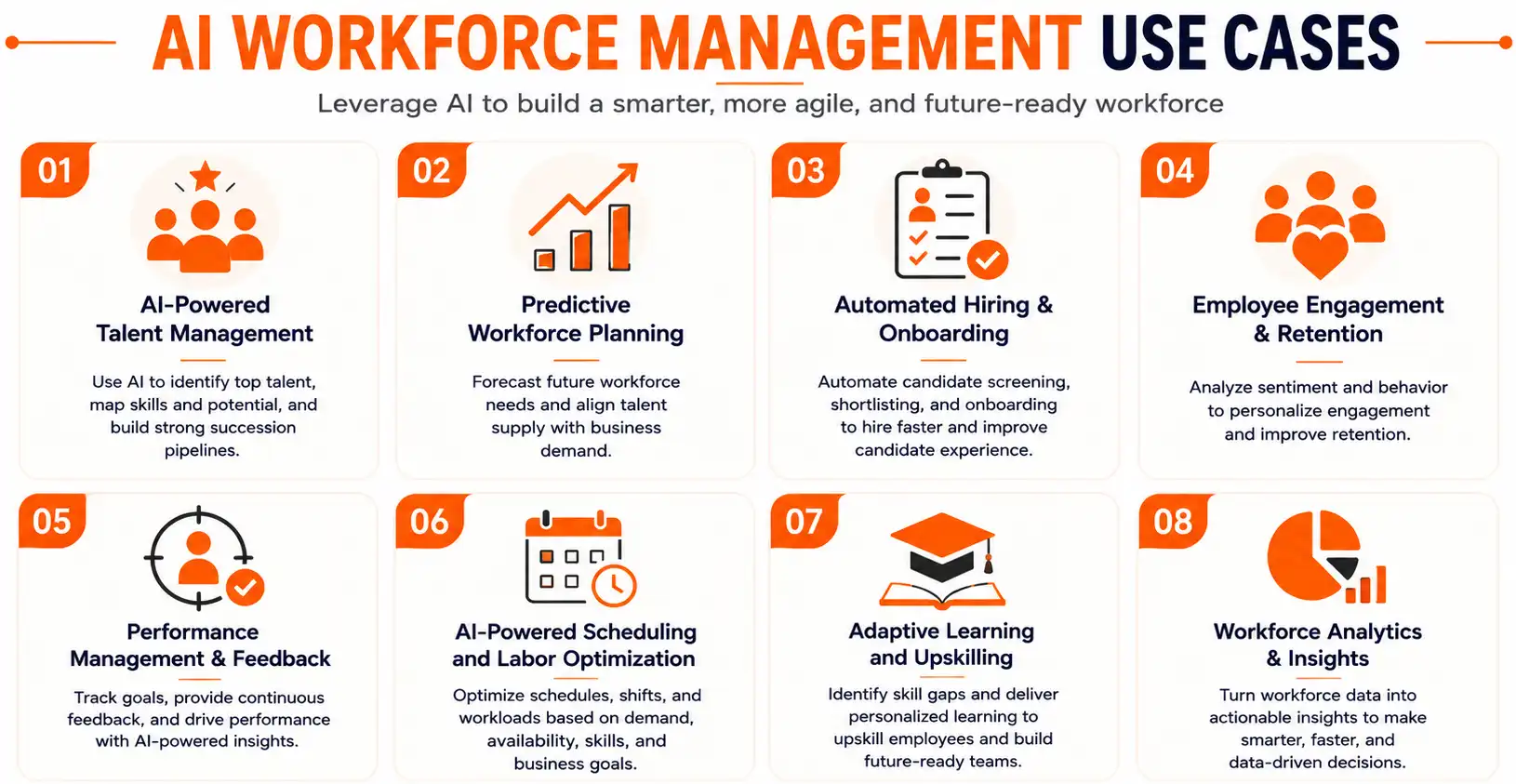
- The top 8 AI workforce management use cases include talent management, predictive planning, automated hiring, engagement, performance tracking, scheduling, upskilling, and analytics.
Why AI Matters in Workforce Management
AI is redefining how large organizations manage people, performance, and potential. Beyond automating routine tasks, it delivers deeper insights into skills, capacity, and employee behavior, enabling leaders to make more informed and proactive decisions.
For enterprises managing thousands of employees, AI workforce management ensures agility, fairness, and scalability across every stage of the employee lifecycle.
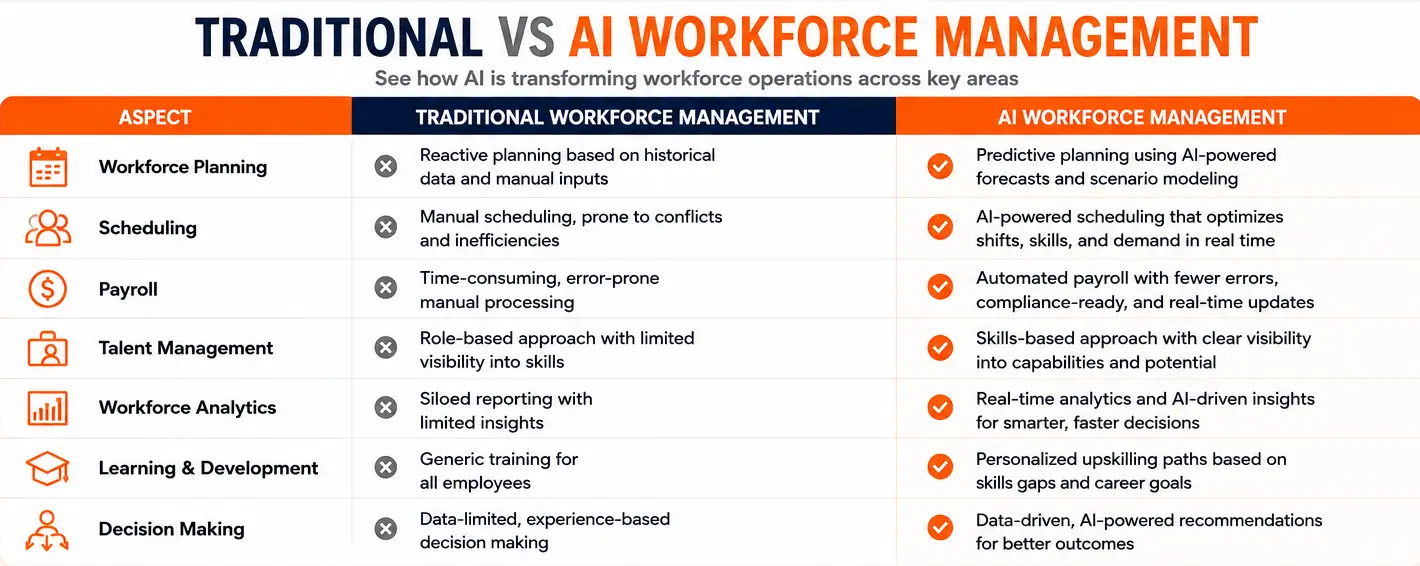
Benefits of Using AI in Workforce Management
AI enhances efficiency and strategic decision-making in workforce management. Here are five key benefits:
- Better Forecasting: Anticipates workforce needs using historical and real-time data.
- Increased Productivity: Automates manual HR processes to boost efficiency and free up time for strategy.
- Improved Decision-Making: Provides data-driven insights for smarter workforce planning and performance tracking.
- Higher Employee Engagement and Satisfaction: Monitors sentiment, delivers personalized feedback, and fosters a positive workplace culture.
- Cost efficiency: Optimizes staffing levels, reduces overtime, and minimizes recruitment expenses.
Now, let’s look at the 8 most impactful AI use cases shaping workforce management in 2026.
Key Use Cases of AI in Workforce Management
1. AI-Powered Talent Management
AI in talent management helps organizations identify skills, predict future capabilities, and personalize employee development. By mapping competencies and aligning them with business goals, enterprises can close critical skill gaps and build a more agile, future-ready workforce.
These systems often:
- Use natural language processing (NLP) to look through job posts & employee info, sorting skills accurately
- Rely on graph neural networks to see how skills connect & what might be coming up next
- Utilize reinforcement learning to keep improving paths for skill growth
iMocha has a great AI-powered Skills Intelligence Cloud that shows this off well. Their platform breaks down jobs into specific skills, mapping out what your company needs.
2. Predictive Workforce Planning
Predictive workforce planning uses AI and advanced analytics to forecast staffing needs, turnover, and demand shifts 30–90 days ahead. This helps enterprises optimize budgets, prevent talent shortages, and maintain agility when responding to market or seasonal changes.
Some key bits involve:
- Time series analysis plus outside data (like economic signs or industry trends) for better predictions
- Anomaly detection tools catching potential problems before they hit
- Scenario modeling using Monte Carlo simulations for smart strategic choices
3. Automated Hiring & Onboarding
AI in hiring and onboarding automates candidate screening, skills evaluation, and culture-fit analysis. Tools powered by language models and adaptive assessments cut time-to-hire, reduce bias, and ensure every new employee is ready to contribute faster.
- Analyze resumes smartly using advanced language models, making it easier to match candidates and jobs
- Hold automated video interviews that use emotion recognition tech for clues on soft skills & fit
- Use tests that change question difficulty on the go, giving a clearer idea of candidate abilities
On top of these, iMocha's assessment solution utilizes AI inference instead of resume parsing to provide a complete skills and proficiency picture, boosting recruiting automation like never before. Also, discover how online workforce management enables AI powered teams to respond faster to changing workforce demands.
4. AI-Driven Engagement and Retention
AI workforce engagement systems monitor sentiment, predict attrition, and deliver real-time feedback to managers. By using machine-learning models for mood and behavior analysis, enterprises can raise retention, improve employee satisfaction, and foster long-term loyalty.
- Sentiment analysis checks messages across the company to capture real-time feedback from employees.
- Predictive churn models calculating lots of factors to pinpoint at-risk employees nearly perfectly
- Reinforcement learning optimizing unique engagement tactics over time
5. AI-Guided Performance Management
AI-based performance management enables continuous feedback and objective evaluation. It aggregates peer reviews, project data, and KPIs to provide coaching insights, helping managers with competency tracking, identifying top performers early, and supporting consistent professional growth across the organization.
What’s new?
- Feedback gathering from multiple sources keeping things balanced and fair using NLP
- Real-time performance insights powered by IoT gadgets or wearables if appropriate
- Personalized coaches offering actionable advice based on individual progress
6. AI Scheduling and Labor Optimization
AI scheduling tools automatically balance business priorities with employee preferences. They use reinforcement learning to adapt to demand changes, ensuring optimal shift coverage, lower overtime costs, and fair workload distribution.
Key capabilities include:
- Smart optimization algorithms balance costs alongside employee preferences and team diversity.
- Reinforcement learning adjusting schedules based on seasons or sudden changes
- Linking up with demand forecasting so staffing falls right into place when needed
Uncover the top 15 staffing management software that integrate AI to enhance staffing accuracy, workforce forecasting, and decision-making.
7. Adaptive Learning and Upskilling
AI workforce learning platforms personalize training using knowledge graphs and behavior analytics. They recommend tailored courses, simulate real scenarios, and track learning outcomes to accelerate upskilling and reskilling while aligning workforce development with organizational strategy.
- Knowledge graphs recommending content based on skill connections
- Learning paths tailored just right thanks to Bayesian optimization
- VR & AR training options backed by performance analytics
iMocha uses these technologies aiming for quick adjustments matching individual aspirations as well as overall company goals!
Discover how the top Contingent Workforce Management Software help improve compliance, reduce risk, and manage contractors efficiently.
8. Workforce Analytics and Decision Intelligence
AI workforce analytics converts raw HR and performance data into actionable insights. Through causal inference and anomaly detection, leaders can uncover productivity drivers, predict workforce trends, and make evidence-based decisions that fuel enterprise growth.
- Causal inference figuring out why certain outcomes show up
- Anomaly detection snagging issues before they blowup
- Natural language generation (NLG) crafting stories from stats automatically
Explore our curated list of top 15 workforce analytics software to strengthen AI driven workforce decisions.
Conclusion
AI workforce management helps organizations transform workforce planning, hiring, employee engagement, and performance management through automation and data-driven decision-making. By leveraging AI-powered insights, enterprises can improve productivity, optimize workforce operations, and address evolving skill demands more effectively.
As businesses continue to embrace digital transformation, AI-driven workforce management will play a critical role in building agile, efficient, and future-ready organizations. Companies that adopt AI strategically will be better positioned to improve workforce adaptability, operational efficiency, and long-term business growth.
Discover the top Enterprise Workforce Management Software to improve operational efficiency and support workforce planning.
FAQs
1. What are workforce management strategies?
Workforce management strategies focus on optimizing employee scheduling, forecasting talent needs, managing performance, and improving engagement. Effective strategies balance business goals with workforce capacity, ensuring the right people with the right skills are available at the right time.
2. How can AI help overcome workforce management challenges?
AI helps organizations overcome workforce management challenges by automating repetitive tasks, improving demand forecasting, and providing data-driven insights. It identifies skill gaps, predicts turnover risks, and enables faster, smarter decisions that enhance efficiency and employee satisfaction.
3. How does AI scheduling reduce labor costs?
AI scheduling tools analyze demand patterns, employee availability, and operational data to create optimal shift plans. By minimizing overstaffing, reducing idle time, and ensuring compliance with labor laws, organizations can significantly lower labor costs while maintaining productivity.
4. What KPIs prove ROI of AI in workforce management?
Key performance indicators include reduced time-to-hire, lower turnover rates, improved employee engagement scores, higher forecast accuracy, and increased labor productivity. Tracking these KPIs helps quantify how AI-driven systems improve efficiency and deliver measurable ROI.

