

The way businesses operate has changed. Today’s workforce is more fluid, distributed, and always on, which makes workforce management harder than ever. Teams now span time zones, rely on a mix of full-time, contingent, and gig talent, and face rising compliance complexity across regions. At the same time, new technologies like AI are accelerating role changes and widening skill gaps.
To stay productive and resilient, organizations need workforce management strategies that combine proven practices with modern data and technology. In this guide, we break down the top 10 workforce management strategies for 2026 to help you improve planning, reduce risk, and build a future-ready workforce.
What Are Workforce Management Strategies?
Workforce management strategies are structured approaches organizations use to plan, deploy, monitor, and optimize their workforce to meet business objectives efficiently. They integrate workforce planning, scheduling, skills management, performance tracking, and analytics to ensure the right people with the right skills are in the right roles at the right time.
Benefits of Strategic Workforce Management
1. Smarter Talent Allocation
Strategic workforce management ensures that talent deployment is guided by actual skill readiness rather than assumptions based on roles or past experience. Through workforce segmentation, organizations can differentiate employees by skills, capacity, and readiness, aligning workforce capabilities with business demands effectively.
2. Future-Ready Planning
With access to real-time skills inventories and benchmarking, HR teams can anticipate future needs and plan proactively. This helps reduce disruption during tech shifts, reorganizations, or business expansion.
3. Personalized Upskilling Paths
Instead of generic training programs, workforce management tools now enable customized learning journeys aligned with job roles and individual development goals. This increases learning ROI and employee satisfaction.
4. Lower Hiring Costs and Faster Redeployment
When internal capabilities are visible and validated, it becomes easier to fill roles through internal mobility. This reduces external hiring costs and accelerates time-to-productivity for new roles.
5. Data-Driven Development and Retention
By combining skill assessments, self-ratings, and manager feedback, companies can build accurate employee profiles. These profiles guide career pathing, identify high-potential talent, and foster long-term engagement.
Discover the top 15 staffing management tools that align with workforce strategies and help optimize talent allocation.
Top 10 Workforce Management Strategies
The following ten strategies provide a structured approach to improving workforce planning, productivity, and long-term business resilience.
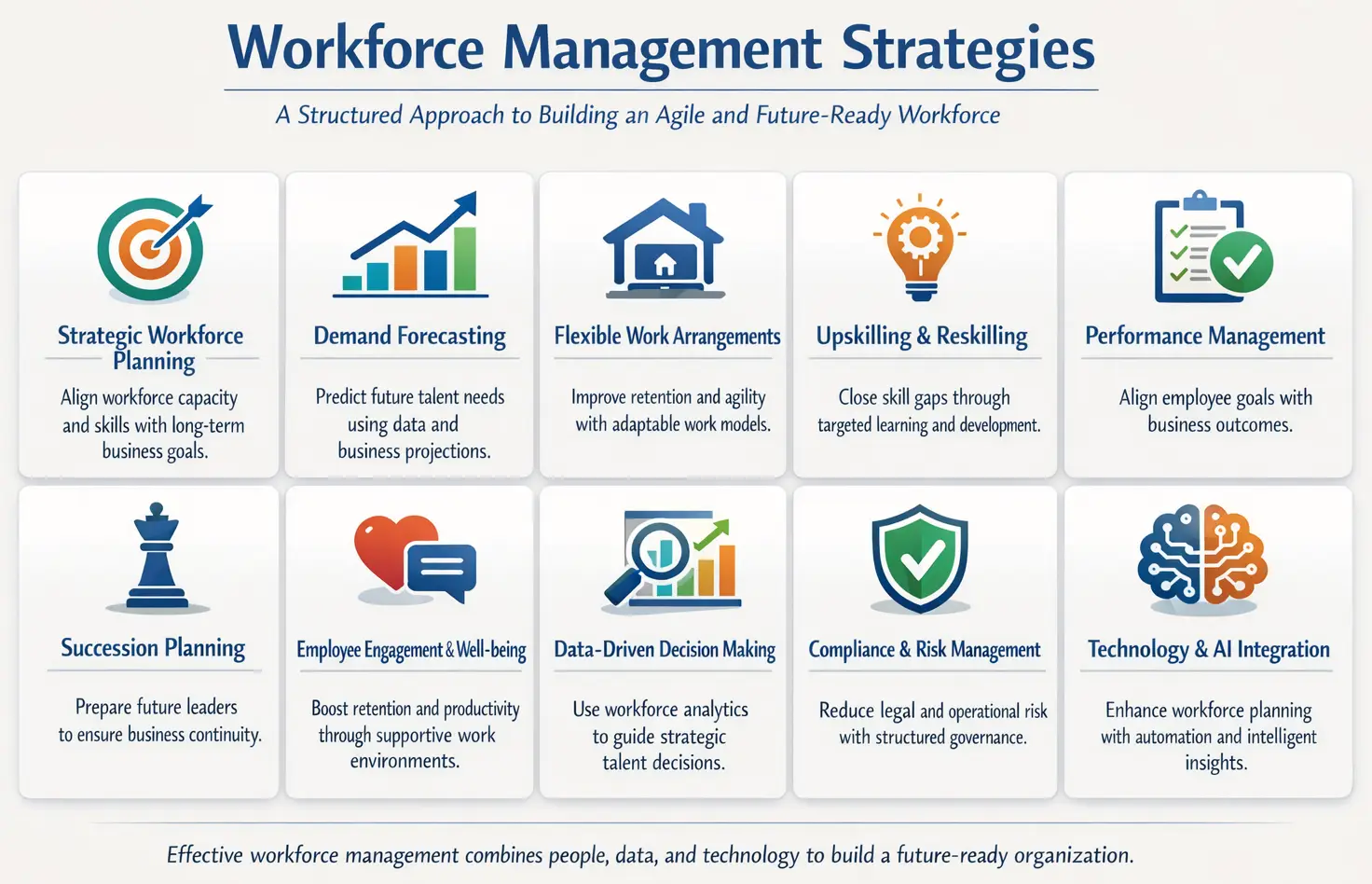
1. Strategic Workforce Planning (SWP)
Strategic Workforce Planning ensures organizations have the right people and skills to meet future business needs. It involves reviewing current talent, identifying skill gaps, and preparing for changes such as digital growth, regulatory updates, or service expansion.
This approach reduces hiring risks through proactive planning. Organizations assess existing skills, forecast future requirements, identify gaps, and address them through hiring, training, or internal mobility. For example, a technology company expanding into AI upskilled employees with related skills instead of relying heavily on external hiring.
2. Demand Forecasting
Demand forecasting helps organizations predict future workforce needs based on business growth, market trends, seasonal demand, and upcoming projects. It ensures companies understand how many employees and what skills will be required to meet expected workload changes.
This approach reduces overstaffing and sudden talent shortages. Organizations implement it by analyzing historical data, business plans, industry trends, and attrition patterns to estimate future workforce requirements. For example, an insurance company anticipating higher claim volumes during peak seasons used past claims data to
3. Flexible Work Arrangements
Flexible work arrangements allow employees to work remotely, in hybrid models, or with flexible hours. This strategy helps organizations adapt to changing workforce expectations while maintaining productivity and continuity.
It improves retention and operational resilience when supported by clear policies and measurable performance goals. For example, an IT services firm introduced hybrid work for delivery teams and maintained project timelines while reducing employee turnover.
4. Upskilling and Reskilling
Upskilling and reskilling help companies develop employees’ skills to meet changing business and technology needs. Upskilling strengthens current capabilities, while reskilling prepares employees for new roles as priorities shift.
This strategy reduces skill gaps and lowers dependence on external hiring. Companies implement it by identifying critical skills, aligning training with business goals, and offering focused learning programs. For example, an IT company adopting cloud technologies trained its existing infrastructure team in cloud and DevOps skills instead of hiring a new team.
Check out top 16 workforce planning software that enhance employee development through targeted assessments.
5. Performance Management
Performance management ensures employees’ goals and outputs align with business objectives. It involves setting clear expectations, tracking progress, and providing regular feedback to improve productivity and accountability.
This strategy helps improve workforce performance and identify high-potential talent. Companies implement it by defining measurable goals, conducting regular reviews, and linking performance outcomes to development plans. For example, an insurance company introduced quarterly performance reviews tied to customer service metrics, resulting in improved claims processing efficiency and faster resolution times.
6. Succession Planning
Succession planning ensures business continuity by identifying and preparing employees to take on critical roles in the future. It focuses on developing leadership pipelines and reducing the risk of disruption when key employees leave or retire.
This strategy strengthens long-term stability and internal mobility. Companies implement it by identifying high-potential employees, assessing readiness for key roles, and creating targeted development plans. For example, a banking company identified future branch leaders early and provided leadership training to ensure smooth transitions when senior managers moved into regional roles.
7. Employee Engagement and Well-being
Employee engagement and well-being focus on creating a work environment where employees feel motivated, supported, and valued. This includes clear communication, recognition programs, manageable workloads, and access to wellness resources.
This strategy improves retention, productivity, and overall workforce stability. Companies implement it by conducting regular feedback surveys, promoting work-life balance, and recognizing performance. For example, an IT company introduced quarterly engagement surveys and flexible wellness initiatives, leading to improved employee satisfaction and lower attrition.
8. Data-Driven Decision Making
Data-driven decision making uses workforce data and analytics to guide talent strategies and operational planning. It involves analyzing metrics such as productivity, attrition, skill gaps, and capacity to make informed workforce decisions instead of relying on assumptions.
This strategy improves accuracy and reduces risk in workforce planning. Companies implement it by integrating HR systems, tracking key workforce data, and using dashboards to monitor trends. For example, an insurance company analyzed attrition and performance data to identify high-risk roles and adjusted hiring and retention strategies accordingly.
9. Compliance and Risk Management
Compliance and risk management ensures workforce practices align with labor laws, industry regulations, and internal governance standards. It helps companies avoid legal penalties, reputational damage, and operational disruptions.
This strategy strengthens organizational stability and reduces regulatory risk. Companies implement it by regularly reviewing policies, conducting compliance audits, training managers on labor regulations, and using systems to track workforce documentation. For example, a banking company updated its workforce policies and monitoring systems to meet new regulatory requirements, reducing compliance risks and avoiding penalties.
10. Technology and AI Integration
Technology and AI integration involves using digital tools, automation, and artificial intelligence to improve workforce planning and management. This includes workforce management systems, analytics platforms, AI-based forecasting, and automation tools that streamline scheduling, performance tracking, and talent deployment.
This strategy increases efficiency, accuracy, and agility in workforce decisions. Companies implement it by integrating HR systems, adopting AI-powered analytics, and automating routine processes. For example, an IT company used AI-driven workforce analytics to predict project demand and automatically match employees to projects based on skills, improving resource utilization and delivery timelines.
Explore how AI workforce management enhances scheduling, optimizes resource allocation, and boosts team productivity.
Paired with best practices these strategies can do wonders for your workforce. Here are some of the best practices that will improve the productivity of your workforce:
- Invest in integrated talent management tools: Look for solutions that offer seamless integration across recruitment, skills assessment, performance management, and learning and development.
- Prioritize skills-based approaches: From hiring to development, focus on skills as the currency of your workforce strategy.
- Foster a culture of continuous learning: Encourage employees to upskill and reskill by providing accessible, personalized learning opportunities.
- Embrace flexibility: Design policies and systems that accommodate diverse work arrangements and employee needs.
- Prioritize employee experience: Ensure that your workforce management strategies enhance, rather than hinder, the employee experience.
Dive into our blog on the top Enterprise Workforce Management Software to optimize workforce and boost engagement.
Key Workforce Management Metrics and KPIs
Tracking the right metrics helps organizations measure efficiency, identify risks, and align workforce strategy with business goals.
Operational Metrics
- Utilization Rate: Percentage of available employee time spent on productive work.
- Overtime Costs: Additional labor expenses incurred beyond regular working hours.
- Absenteeism Rate: Frequency of unplanned employee absences.
- Scheduling Accuracy: Degree to which planned schedules match actual staffing needs.
Strategic Metrics
- Skill Coverage Ratio: Extent to which existing workforce skills meet current and future business requirements.
- Internal Mobility Rate: Percentage of roles filled by existing employees.
- Attrition by Skill Segment: Turnover rate within specific skill groups.
- Workforce Productivity Index: Overall measure of workforce output and efficiency.
Discover workforce planning strategies that support better resource allocation, workforce agility, and long term operational efficiency.
Conclusion
Effective workforce management is no longer just about scheduling or headcount control. It requires a structured, forward-looking approach that aligns people, skills, data, and technology with business priorities. Organizations that invest in strategic planning, skills development, analytics, and modern workforce tools are better equipped to manage change and maintain performance.
By implementing these workforce management strategies, companies can reduce risk, improve productivity, strengthen internal mobility, and build a more agile workforce. The goal is not just to manage employees efficiently, but to create a resilient organization prepared for long-term growth and transformation.
FAQs
Why is workforce management important for businesses?
Workforce management helps businesses optimize employee productivity and reduce costs. It ensures the right people are working the right jobs at the right times, leading to improved efficiency and customer satisfaction.
What are the benefits of using workforce management software?
Workforce management software automates scheduling, time tracking, and performance monitoring. This saves time, reduces errors, improves forecasting, and provides data-driven insights to make better staffing decisions and boost productivity.
What can be achieved through implementing effective workforce management strategies?
Effective workforce management can lead to increased productivity, reduced labor costs, improved employee satisfaction, better compliance with labor laws, enhanced customer service, and more informed business decision-making based on workforce data and trends.

