

As companies try to navigate through quick technological advancements and changing labor markets, efficient workforce planning has become more important than ever. While 70% of employers plan to hire people with new skill sets, 85% concentrate on upskilling initiatives to address skill gaps.
Despite this, merely 33% of businesses successfully use data for capacity and workforce planning, pinpointing a substantial scope for improvement. Creating a structured workforce planning framework allows companies to address the lack of talent, improve productivity, and align talent with objectives.
In this blog, we’ll explore what a workforce planning framework is, its key components and benefits, and six essential steps to create one effectively.
Key Takeaways
- A workforce planning framework helps organizations align their workforce with current and future business goals.
- Effective workforce planning involves assessing current talent, forecasting future needs, identifying gaps, and implementing targeted workforce strategies.
- Key components include workforce analysis, demand forecasting, gap analysis, and continuous performance monitoring.
- Strategic workforce planning enables organizations to address skill shortages, improve workforce agility, and strengthen business resilience.
- Leveraging workforce analytics and skills intelligence helps organizations make data-driven talent decisions and build a future-ready workforce.
What is a workforce planning framework?
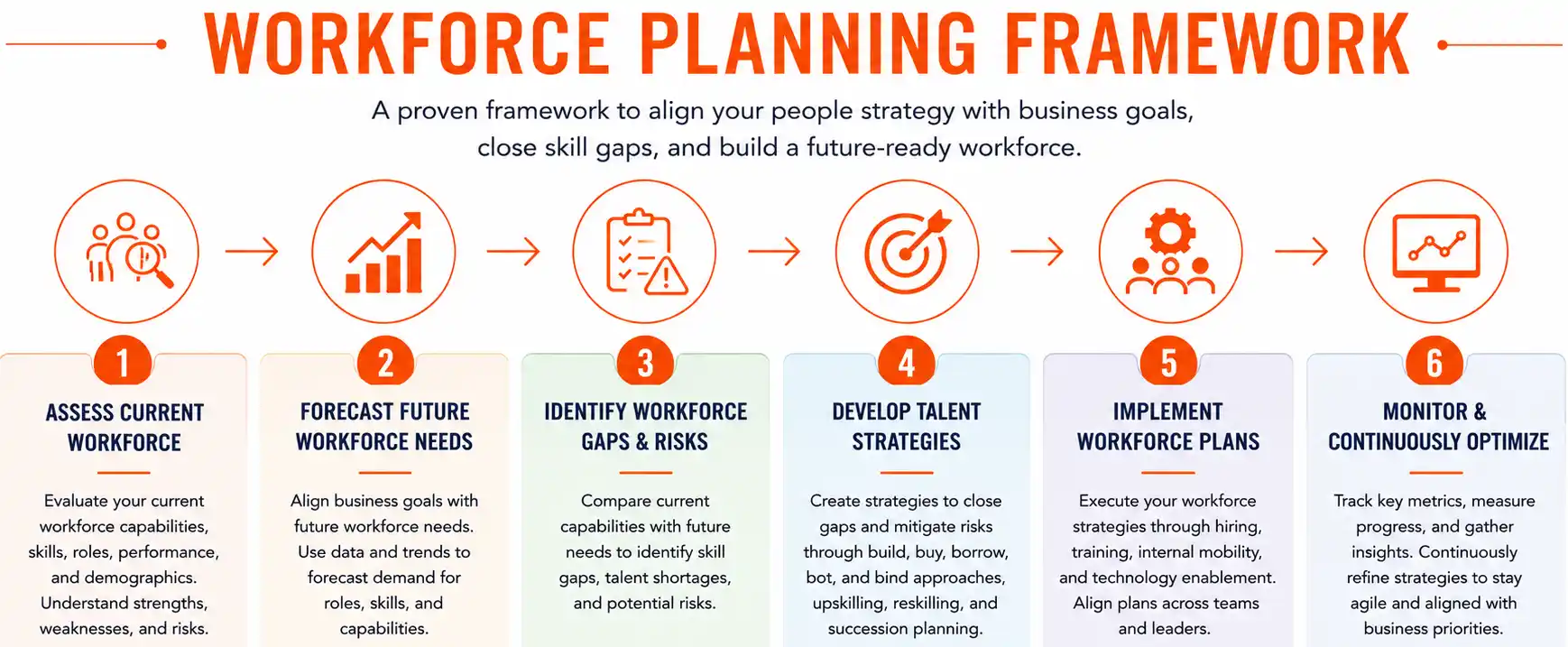
A workforce planning model is a systematic process that enables companies to align their workforce with business objectives. It comprises measuring existing talent, projecting future requirements, determining skill shortages, and executing recruitment, upskilling, or redeployment strategies. When deployed with appropriate workforce planning tools, a workforce planning framework helps businesses place the right people in the right roles at the right time.
Benefits of a Workforce Planning Framework
- Improved Talent Alignment: Ensures the right people are in the right roles, aligned with both current operations and long-term strategic goals.
- Cost Optimization: Reduces recruitment expenses by enhancing internal mobility and minimizing the need for reactive or last-minute hiring.
- Proactive Skill Development: Identifies skill gaps early and supports targeted upskilling and reskilling initiatives to prepare the workforce for future demands.
- Data-Driven Decisions: Uses workforce analytics to inform strategic planning, improve resource allocation, and monitor performance trends.
- Greater Organizational Resilience: Equips companies to adapt quickly to market shifts, economic changes, and technological disruptions by building a flexible, future-ready talent pipeline.
Key Components of a Strategic Workforce Planning Framework
Strategic Alignment
Organizational goals must align with the workforce planning to support overall talent growth. This comprises comprehending objectives, workforce priorities, and industry trends to create a roadmap.
Workforce Analysis
A deep glance into the existing workforce helps evaluate performance metrics, employee skills, and demographics. This analysis is further strengthened through workforce segmentation, enabling clearer visibility into capability clusters, workforce readiness, and areas requiring targeted intervention.
Demand and Supply Forecasting
By forecasting future workforce requirements and measuring external and internal labor situations, organizations can prepare their teams for changes. This includes evaluating upcoming skill requirements, retirements, and market trends.
Workforce Gap Analysis
Comparing workforce supply with expected demand helps discover skill deficiencies, succession risks, and talent surpluses. This data is important for onboarding, reskilling, and talent restructuring.
Workforce Planning Strategies
Companies integrate personalized strategies, like strategic hiring, talent mobility, upskilling, and automation, to close gaps and keep employees agile.
Explore the best workforce planning strategies for 2026. Optimize talent, bridge skill gaps, and future-proof your organization.
6 Steps in a Workforce Planning Framework
1. Assess Current Workforce
A solid analysis of the current workforce is the basis for successful workforce planning. The primary steps are:
- Demographic Analysis: Analyze employee tenure, gender, age, and other demographic variables to determine workforce formation and predict possible turnover or retirements.
- Skills Inventory: Document existing employee skills and abilities to determine strengths and areas requiring improvement.
- Performance Metrics: Measure productivity, work quality, and other performance metrics to determine workforce effectiveness.
- Turnover Rates: Review historical turnover rates to determine patterns or areas of concern.
Creating this baseline allows businesses to identify existing gaps and develop personalized interventions.
2. Forecast Future Workforce Needs
The World Economic Forum estimates that 44% of employees' skills will be disrupted over the next five years, highlighting the importance of organizations taking proactive steps to bridge skills gaps through upskilling and reskilling. Projecting future workforce needs is crucial for future planning. This comprises:
- Industry Trend Analysis: Track market trends, regulatory updates, and technological developments that can shape workforce needs.
- Business Growth Projections: Integrate workforce planning with organizational growth plans, including expansion into new markets or product launches.
- Technological Impact Assessment: Assess how new technologies, such as Artificial Intelligence (AI), can change job functions or create new jobs.
- Demographic Changes: Consider factors such as an aging population or shifting labor market dynamics that may impact talent supply.
3. Identify Workforce Gaps & Risks
Through comparison of the existing workforce evaluation with future requirements, organizations can determine the following:
- Skill Gaps: Where existing employee skills fall short of anticipated demands.
- Succession Risks: Key positions without immediate successors, creating continuity issues.
- Recruitment Challenges: Positions that could be challenging to recruit for because of excessive demand or highly specialized skill sets.
- Geographical Constraints: Talent availability restrictions are present in some geographic regions.
Identifying such gaps facilitates the implementation of personalized strategies to contain possible risks.
4. Developing Talent Strategies
To respond to gaps discovered, companies must implement comprehensive talent strategies, such as:
- Recruitment Plans: Create specialized hiring programs with external and internal recruits that bring in needed talent.
- Upskilling and Reskilling Programs: Invest in training and development to align existing employees' skills with future demands.
- Workforce Mobility Initiatives: Promote internal relocations and job changes to maximize talent use.
- Flexible Workforce Models: Add part-time staff, freelancers, or gig workers to respond to varying demands.
- Diversity and Inclusion Efforts: Create a diverse workforce to encourage innovation and mirror market demographics.
Implementing these initiatives makes companies flexible and capable of addressing changing business challenges.
5. Implementing Workforce Plans
Successful workforce strategies' execution necessitates:
- Policy and Process Updates: Update HR policies to back new workforce plans, such as flexible work schemes or renewed performance assessment measures.
- Technology Integration: Use cutting-edge HR technology for talent management, workforce analytics, and training.
- Change Management: Create communications strategies to navigate workers through change, managing worries and promoting engagement.
- Cross-Departmental Collaboration: Align HR, finance, operations, and other departments to enable collective implementation.
A comprehensive implementation approach helps ease transitions and increase acceptance of workforce initiatives.
Explore our curated list of top15 workforce analytics software to improve forecasting and long term workforce planning.
6. Monitoring and Continuous Improvement
Regular review and enhancement are essential for long-term workforce effectiveness. This includes:
- Key Performance Indicators (KPIs): Monitor measures like training completion rates, employee turnover, and time-to-fill to evaluate the effectiveness of workforce strategies.
- Feedback Mechanisms: Periodically seek feedback from employees and managers to determine where improvement is needed.
- Adaptation to Changes: Respond to outside forces such as economic changes, technological advancements, and competitive forces.
- Continuous Learning Culture: Create a culture that supports continuous development and flexibility.
Regular reviewing guarantees that workforce plans are consistent with organizational objectives and can respond to new challenges.
Scenario Planning in Workforce Planning
Scenario planning helps organizations prepare for different workforce challenges and future business needs. Instead of relying on a single forecast, organizations evaluate multiple scenarios to build a more resilient workforce strategy.
Common workforce planning scenarios include:
- Business Growth: Identifying talent needs to support expansion and new initiatives.
- Technology Adoption: Preparing employees for changing skill requirements driven by AI and automation.
- Retirement Risk: Developing succession plans for critical roles and leadership positions.
- Economic Uncertainty: Optimizing workforce costs while retaining essential capabilities.
By incorporating scenario planning into workforce planning, organizations can proactively address talent gaps, reduce risks, and remain agile in a rapidly changing business environment.
Uncover key workforce planning metrics to analyze trends and drive informed decisions for your organization.
Conclusion
A robust workforce planning framework is no longer optional. It is a strategic imperative for organizations navigating today’s dynamic market landscape. By systematically assessing current talent, forecasting future needs, and bridging workforce gaps with targeted strategies, businesses can build a future-ready, agile, and skilled workforce.
iMocha’s AI-powered skills intelligence platform helps businesses take workforce planning to the next level. From evaluating skills to predicting future demands and tracking real-time progress, iMocha empowers HR and business leaders to make smarter, faster, and more aligned talent decisions.
Discover the advantages of workforce planning, from enhanced talent acquisition to cost savings. Learn how aligning talent with strategy fuels business success.
FAQs
What are the 7 Rs of strategic workforce planning?
The 7 Rs are Right People, Right Skills, Right Role, Right Time, Right Cost, Right Location, and Right Future. Together, they ensure your workforce is aligned, agile, and prepared to meet business goals efficiently and effectively.
What are the 5 B’s of workforce planning?
The 5 B’s of workforce planning are Buy, Build, Borrow, Bot, and Bind. Buy refers to hiring externally, Build focuses on developing internal talent, Borrow involves leveraging temporary or contract workers, Bot means automating tasks, and Bind emphasizes retaining and engaging existing employees.
How can iMocha support strategic workforce planning?
iMocha offers an AI-powered skills intelligence platform that provides real-time insights into workforce capabilities. It helps identify skill gaps, evaluate employee strengths, predict future talent needs, and match individuals to the right roles. This empowers HR teams to make data-driven, future-ready decisions.

