

Widening skill gaps remain one of the biggest workforce challenges organizations face today. According to recent research, nine in ten organizations struggle to fill critical skill gaps, with entry-level roles accounting for 32% of the shortage.
A well-defined skills framework provides a structured approach to identifying, organizing, and developing the capabilities required for each role. By clearly defining skills, establishing proficiency levels, and mapping them to job functions, companies can align talent with business goals and build a future-ready workforce.
In this guide, we’ll explore the definition of a skills framework, its key components and benefits, and outline 7 practical steps to build and implement one effectively in your organization.
What is a Skills Framework?
A skills framework is an organized system that assists companies in discovering, evaluating, and developing the skills required for diverse job roles. It offers a structured method for defining and managing skills. With this, businesses can ensure that their workforce aligns well with organizational objectives.
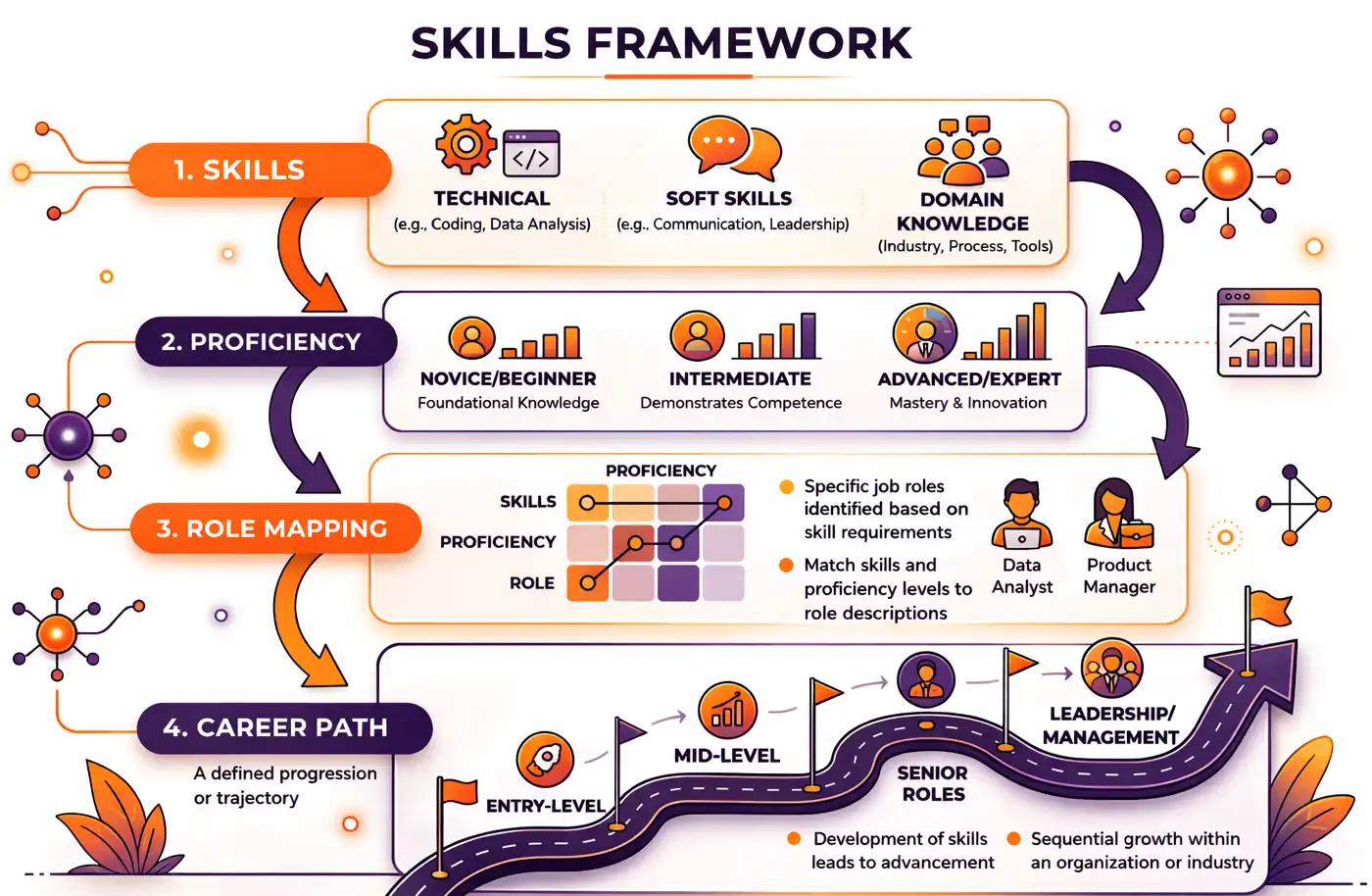
Components of an Effective Skills Framework
To build a practical and scalable framework, organizations must incorporate the following five key components:
1. Skill Definition
Clearly defining each skill is the foundation of a reliable framework. Definitions should be concise, actionable, and aligned with industry terminology. This ensures consistency in understanding and helps eliminate ambiguity across departments and teams.
2. Proficiency Levels
Standardized proficiency levels such as beginner, intermediate, advanced, and expert allow organizations to assess skill depth objectively. These levels support clear expectations, learning path design, and employee development tracking.
3. Skill Descriptions
Skill descriptions provide context to each proficiency level. They explain what specific behaviors, knowledge, or outcomes are expected at each level of mastery. This granularity ensures consistency during performance evaluations and helps personalize development plans.
4. Job Role Mapping
Mapping skills to job roles clarifies what is required to succeed in each position. It enables targeted hiring, simplifies career progression planning, and provides transparency around expectations. Job role mapping also supports internal mobility by revealing adjacent roles that share similar skill requirements.
5. Learning & Development
A strong skills framework should connect directly to learning initiatives. Organizations can use skills data to guide personalized training, fill gaps, and continuously build relevant capabilities.
Benefits of a Skills Framework
- Increase Organizational Agility: Helps businesses quickly respond to market changes and shifting priorities. Keeps talent strategies aligned with broader innovation and growth goals, thus helping develop a skills-based organization.
- Workforce Agility: Offers clear visibility into current and emerging skills across teams. Enables faster role transitions, project assignments, and internal mobility.
- Improved Talent Retention: Defined career paths and development opportunities boost employee engagement. This leads to greater job satisfaction and reduced turnover.
- Enhance Transparency: Clearly outlines role expectations and required competencies. Builds trust and consistency across hiring, evaluations, and promotions.
- Informed Decision-Making: Empowers leaders with data to make targeted hiring, training, and planning decisions. Enhances efficiency and aligns talent with strategic needs.
7 Steps to Implement Skills Framework
Curating a well-structured framework requires a strategic approach to discover, evaluate, and develop skills needed to accomplish objectives. Here are seven detailed steps:
Step 1: Identifying Key Skills and Roles
The first step is to evaluate the objectives of the company and the roles required to accomplish them. Next, important skills for each role should be determined after a thorough discussion with stakeholders from different departments.
For example, if the organization wishes to improve its digital presence, roles like Data Analyst and Digital Marketing Specialist become important. The employee(s) should possess skills like data interpretation, content creation, and Search Engine Optimization (SEO).
Step 2: Map Skills to Job Functions, Roles, and Career Paths
Once skills have been identified, the next step is to align them with specific job functions and map possible career paths. Using a skills inventory template makes this process more efficient, while also helping clarify expectations and guide employees in their careers.
For instance, to get a promotion to the senior level, a junior software developer may need to be proficient in problem-solving skills and programming languages. Additionally, they might also require project management and leadership skills.
Step 3: Create a Skills Taxonomy Tailored to Your Industry
Next, place skills into a structured category and organize them accordingly. These could be leadership skills, soft skills, technical skills, or more. Once done, define the competency levels required for these skills, such as beginner, intermediate, or advanced, to standardize evaluation.
Explore top 8 skills taxonomy software that assists in building a robust skills framework tailored to your organization's needs.
Step 4: Using AI-powered Skill Assessments for Benchmarking
Fairly evaluate the workforce's current skill levels using AI-powered tools. These evaluations offer data-driven insights into team and individual skills. This helps with the development of targeted upskilling and reskilling plans.
Step 5: Analyze Skills Gaps and Benchmark
82% of organizations investing in employee development showed enhanced retention rates. This highlights the importance of addressing skills gaps. After completing the skills assessment, companies must compare the results with suitable competency levels to discover gaps.
Next, a benchmark for these findings should be set according to the industry standards to comprehend where the company stands in the competition. This analysis will help create targeted training initiatives.
Step 6: Integrate the Skills Framework with Learning & Development
Moving forward, now is the time to create training programs that align with discovered skill gaps. Simply offering mentoring programs can personalize skill development. Since mentors will be providing customized guidance, this will efficiently address individual learning requirements.
Integrate an array of learning methods, such as:
- Mentoring
- Online courses
- Workshops
Companies must ensure that their learning goals correspond with the skills and competencies highlighted in the framework.
Step 7: Continuously Update the Framework with Emerging Skills
Lastly, consistently reviewing and updating the framework allows the incorporation of emerging and new skills. This ensures the framework is aligned with changing industry trends and business objectives, keeping the workforce competitive and relevant.
Automate skill validation at scale with iMocha’s AI-powered Skills Inference - everaging resumes, projects, LMS, and certifications for smarter workforce decisions.
How Skill Frameworks are Used in Organizations
A well-structured skills framework plays a vital role in several key HR and business functions:
- Recruitment: Streamlines job descriptions, helps assess candidates based on required competencies, and reduces time-to-hire by ensuring better fit.
- Talent Management: Enables accurate talent identification, succession planning, and role readiness assessments.
- Strategic Workforce Planning: Assists in aligning talent with future business goals and identifying gaps in critical roles.
- Career Pathing: Provides employees with clarity on skills required for advancement, supporting transparent and motivating growth paths.
- Employee Development: Informs training needs, supports personalized learning, and aligns development efforts with both employee aspirations and business objectives.
Conclusion
A structured skills framework is essential for businesses to stay competitive. Organizations can close skill gaps by discovering crucial skills, mapping them to job roles, conducting AI-driven assessments, and integrating consistent learning while improving workforce agility.
iMocha, an AI-powered skills intelligence platform, helps streamline this implementation through its 3,000+ skills assessments, skills taxonomy and mapping, real-time analytics, and personalized learning recommendations. This platform allows businesses to make data-driven decisions, ensuring employees are future-ready.
FAQs
How does iMocha help implement a Skills Framework?
iMocha provides AI-powered tools to build and manage skill frameworks. This includes pre-built and customizable taxonomies, over 3,000 skills assessments, real-time analytics, and skills benchmarking.
How does a skills framework support internal mobility?
By mapping skills to roles, it reveals adjacent or stretch roles employees may qualify for. This encourages cross-functional movement and helps retain talent.
What is the difference between a skills framework and a competency model?
A skills framework focuses on specific, measurable abilities, while a competency model includes broader traits like behavior and mindset. Both can be complementary depending on business needs.

