

From leadership pipeline development to workforce restructuring, HR has a crucial role in acclimating and acting on the different business changes brought about by any economic downturn. HR, in short, acts as a catalyst in reducing the impact caused by these economic hurdles.
A recession is such a financial constraint that impacts businesses and individuals equally. As part of moving past these tricky waters, the company’s HR department must work on recession-proofing its talent strategy.
TL;DR
- A recession can be an economic downturn and has an adverse global impact.
- Recession-proofing the business with multiple streams of revenue, budgeting, networking, and other factors is essential.
- Strategize upskilling and reskilling opportunities for the existing workforce to reduce layoffs.
- Key L&D program focus areas include goal-aligned development, cross-skilling initiatives, performance-driven culture, and impact evaluation.
This article will discuss recession, recession-proofing, and how HR can contribute to recession-proofing the company. Most importantly, we will delve into the role played by upskilling and reskilling during such a downturn.
What is a recession?
A recession refers to a contraction in economic activities with a decline in the real GDP for two consecutive financial quarters. As of now, there have been 14 official recessions in the US, and the gravest among them include:
- The Great Recession between 1929 and 1941 was due to the stock market crash
- The Great Recession, which lasted for 18 months with a 10% unemployment rate, happened between December 2007 and June 2009
Apart from this, several other recessions have impacted the global economy adversely, including the COVID-19 recession between February 2020 and April 2020.
However, as we approach the end of 2022, there are concerns like soaring interest rates and inflation, and increasing recession risk. Similarly, the National Bureau of Economic Research has stated that there has been negative economic growth in the previous two quarters of 2022.
Although the American economy is cyclic, economists and researchers state that the above-mentioned concerns might contribute to a recession. As per Sean Snaith, the director of the University of Central Florida's Institute for Economic Forecasting, the impending recession would be a “pasta bowl recession.” This means that it would be long but shallow.
Similarly, a renowned industry expert, Josh Bersin, mentioned in his recent podcast that the 2023 recession would be an economic slowdown or a soft landing. He doesn't consider it equivalent to other recessions faced so far.
What is meant by recession-proofing your business?
When a company remains economically resistant during a recession because of its assets or industry, it is known as a recession-proof business. Generally, there are some recession-resistant services, products, and industries. For instance, healthcare and education are two seemingly recession-proof industries.
Even if the company doesn’t fall under the “recession-proof” categories, one can adopt different strategies or measures to assist their business in staying strong during any low period.
Thus, one can recession-proof their company by evaluating these factors and making necessary changes. Among these initiatives, one of the crucial components to consider is the HR functionalities, as they closely relate to the organization's people.

How can HR recession-proof your company’s talent strategy?
The HR department in the organization has to analyze, prepare, and take the correct measures beforehand in case of an economic slump that might happen anytime soon.
Remember, there is no secret formula or magic potion available for HR leaders and professionals to navigate through these challenging times. However, with proper planning and usage of correct data, the HR professionals can recession-proof the company and its talent strategy.

Let us understand how it can be performed:
By Focusing on the Metrics
As part of recession-proofing the talent strategy, the HR professionals must investigate their employees’ data, productivity, return on investment, compensation, training, and effectiveness.
These data points must be aligned with the company’s business goals and requirements. However, performing these tasks manually can be challenging, and investing in a skills intelligence platform is the best way to perform these activities.
By considering these factors, the HR team can:
- Identify underperforming employees and create targeted training programs for them.
- Understand the efficacy of different training programs.
- Find out things to eliminate, automate, and outsource.
By Considering Internal Mobility
Internal mobility, also known as talent mobility, can help organizations, especially during recessions. It can be an alternative measure for layoffs and assist in filling job vacancies in the company.
Besides, it is an effective way to improve employee retention rates and build future-ready teams.
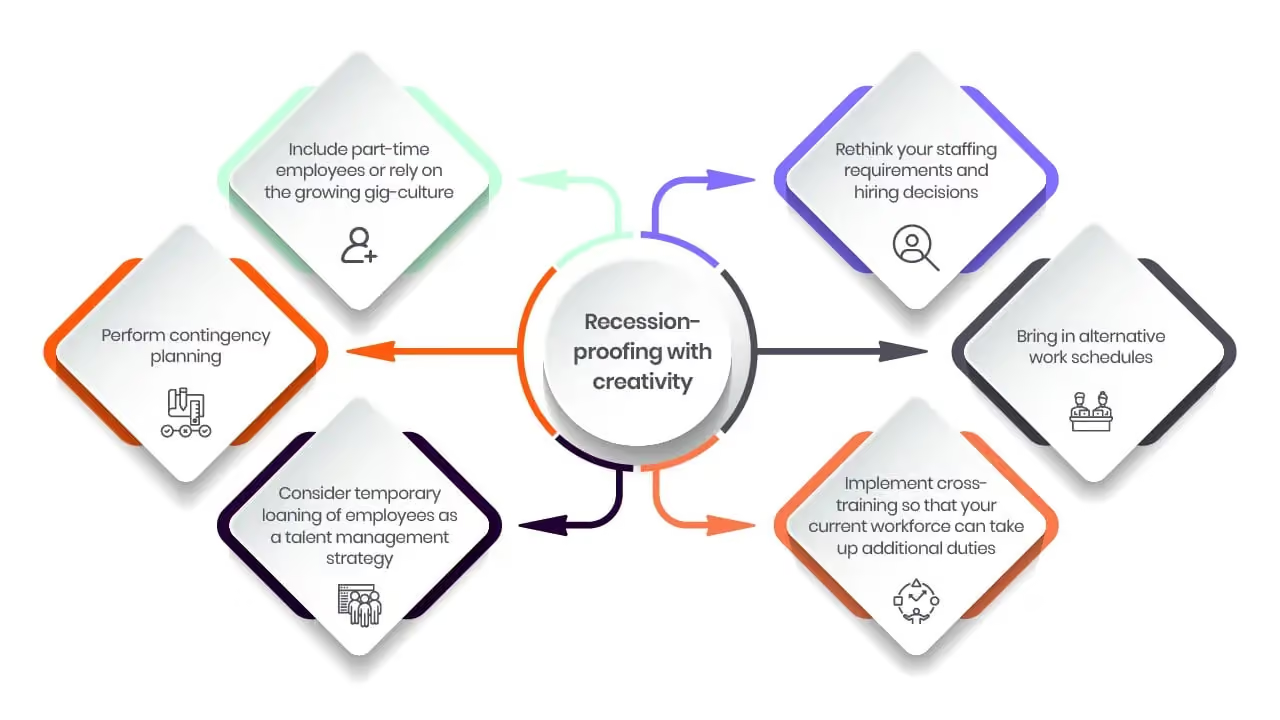
By Bringing in Creativity
Being creative is an integral quality for an HR professional, especially in striving through these difficult times.
However, remember that each organization and its industry are different. Therefore, there is no straightjacket rule for dealing with the organization's problems during a recession. So, the HR professionals must think creatively and work around the issues by analyzing them properly.
By Prioritizing to Improve Employees’ Mental Health
The last couple of years of uncertainty have shown us that employees now expect their organization to provide a personal safety net, not just a professional one. Over the years, it has been reflected in mental health programs, scheduled time-offs, and more. But now, with the recession, expectations from employers will increase.
During such difficult times, the employees would face lay-off anxieties, fear of being jobless, financial constraints, etc. These factors would hamper their mental health, leading to stress, anxiety, and other problems.

Performing the activities within the image can improve the employees' mental health, morale, and productivity.
By Giving Importance to Developing a Healthy Company Culture
Developing a healthy company culture from the very start is crucial. It helps build trust and belongingness in the organization. Even during difficult times, it is essential to ensure that a healthy company culture prevails in the organization on different levels.
Enhancing employee engagement and creating a high-performance culture within the company is a value-driven method of building a robust organization with loyal employees.
By Investing in Learning and Development Initiatives
In most cases, when a recession hits, the first thing that gets cut off is the Learning and Development budget. For instance, during the Great Recession in 2007-2009, companies laid off approximately 1.5 million employees and cut L&D activities. There was a 30% reduction in L&D budgets in the UK, and in the US, there was a double-digit cut-down.
This underinvestment in L&D activities has directly or indirectly created the current skills gap. Therefore, by learning from the previous recessions, organizations must focus on investing in their L&D activities to stay relevant during such challenging economic climates.
Unlock the top 8 workforce forecasting software to future-proof your talent strategy and navigate shifting economic conditions.
Upskilling/reskilling and recession-proofing: An overview

The upskilling and reskilling imperative is becoming much more apparent with an impending recession in the rearview.
As per the Future of Work report, 40% of workers will have to undergo at least six months of reskilling to remain job-fit for their organization. Therefore, companies have to upscale their L&D activities. The shortening of the upskilling and reskilling window, the decrease in the shelf life of skills, and the probable cut in L&D budgets during recessions exacerbate the situation.
Organizations will have to invest in upskilling and reskilling activities to stand the test of time and succeed during this possible recession. Companies might sink if they remain stagnant without moving forward with the changing waters. The best example is 50% of Fortune 500 companies have perished since 2000 because they failed to upgrade their workforce with the upshot in the technological landscape.
Companies will have to equip their employees with a wide range of skills, including, but not limited to, analytical thinking, learning strategy, resilience, emotional intelligence, troubleshooting, user experience, and service orientation, etc. Other vital skills include big data, cloud computing, encryption, cybersecurity, the Internet of Things (IOT), etc.
Besides, many people are transitioning occupations and job clusters to accelerate career growth, and most are shifting their gears toward data, artificial intelligence, computing, and so forth.
The digital blur would further widen because of the exponential digital transformations that would continue even when the recession hits. Besides, there would be an asymmetric economy, where on the one hand, there will be an increase in layoffs in some sectors. On the other hand, skilled candidates will be unavailable to fill open positions.
One way to reduce layoffs and concerns with staffing shortages is to provide upskilling and reskilling opportunities for the existing workforce. It can be a much better alternative as it has a lower price tag and is an efficient way of working with fewer resources.
Things to focus on while recession-proofing the talent strategy with Learning and Development measures
For recession-proofing the talent strategy, you must give impetus to the Learning and Development activities. Some things one must focus on, primarily during an economic downturn, are as follows:

Have L&D initiatives aligning with the business goals
Investing thousands of dollars without a proper L&D strategy is like a shot in the dark, where one would fail to gain any measurable ROI, such as productivity, revenue generation, or knowledge retention.
Therefore, the L&D department would have to re-strategize its L&D initiatives to create a recession-proofing talent strategy. This has to align them with the business goals by duly considering the impediments that a recession would bring.
An organization can facilitate hands-on learning experiences and include gamification, virtual reality, and simulators to enhance its experience.
It will be highly beneficial if the HR tech architecture has a skills intelligence platform while restructuring the L&D initiatives. It would reduce time, offer cost-effectiveness, and help identify the skills required for the company to attain a competitive advantage.
In short, this would be a win-win situation for the employees and the company.
Evaluate and measure the L&D initiatives
Conducting upskilling and reskilling activities within the organization won’t alone bring forth behavioral change in employees or create a business impact. When employees apply their learnings, they can contribute to a business change.
Measuring and evaluating these L&D activities, especially during a recession, can provide data on the efficiency of the funds allocated.
For that purpose, one can integrate skills assessments before and after the upskilling programs to measure the knowledge gained. Along with this, incorporating L&D activities into projects can assist in understanding the ROIs better.
Additionally, with a skills intelligence platform, one can gain much more clarity on the skills proficiency of the employees and learn whether the L&D activities have paid off or not.
Prioritize cross-skilling activities
During difficult times, a company must manage with fewer resources, and due to budget cuts, hiring new employees might not be a viable option in most cases.
Similarly, as per recent research by the Financial Services Skills Commission and PwC consultancy, reskilling existing employees can save £49,000 per employee.
Therefore, organizations can use a skills intelligence platform to identify adjacent skills and cross-skilling opportunities and conduct such programs. Through this, the company can reduce layoffs and save costs in the long run.
Build a high-performance work culture
Many employees are opting for side hustles, and many others are quitting their jobs in search of better opportunities as they fear financial constraints. Therefore, organizations must create a high-performance work culture that will make the employees feel valued.
As part of forming this culture, it is integral to give impetus to facilitating learning opportunities for the employees. This would enhance their faith in the organization and help them overcome the fear of lacking growth opportunities.
According to a recent survey by Gallup, half of the millennials who participated in the study are planning to switch jobs as they don’t see a future in their current organization. Most cite a lack of engagement and growth opportunities in the workplace as a cause for this decision. Organizations can curtail these issues by creating a high-performance work culture, stressing L&D activities.
Conclusion
In a nutshell, the organization has to build strategies that can help recession-proof its business and talent strategy to be relevant during and after a recession. One must invest in upskilling and reskilling initiatives to maximize employee engagement, morale, productivity, and revenue generation, and build a recession-proof organizational structure.
FAQs
How to align data points/metrics as per the company's goals?
Start by identifying key business objectives and mapping HR metrics like productivity, training ROI, and skill gaps to these targets. Using a skills intelligence platform makes this alignment more accurate and actionable.
How can an organization assess and take care of the mental health of employees?
Organizations can conduct regular well-being surveys and track absenteeism or burnout indicators. Initiatives like scheduled time-offs, access to mental health professionals, and stress-reduction programs help maintain psychological safety.
Which alterations in an L&D program might lead to improvement, and how can such improvements be recognized?
Shifting to hands-on, gamified, and role-aligned learning improves engagement and knowledge retention. Measuring learning impact through pre- and post-training assessments and performance changes helps recognize what’s working.
Which practices consistently shape the culture, making it company and employee-fit?
Practices like transparent communication, recognition programs, continuous learning, and inclusive leadership foster a resilient and engaging culture. Aligning these with employee needs ensures a culture that drives both loyalty and performance.
Which fund allocation practices might help the organization strategize better?
Allocate L&D budgets toward high-impact skill areas aligned with business priorities and measure ROI regularly. Investing in cross-skilling and internal mobility yields long-term savings and reduces redundancy costs.
.avif)
