

Globally, many enterprises struggle to prepare their workforce for the future as skill requirements are evolving faster than traditional HR, L&D, and workforce planning systems can respond. Most departments have distinct systems that store data differently, causing silos and data inconsistencies.
When learning data and skills data are stored distinctly by teams, it leads to fragmented, unstructured data. This further creates outdated learning models, unclear future skill needs, and weakens visibility into existing talent. According to Springboard, 70% of leaders cite a skills gap and an underskilled workforce as the primary reasons for minimal growth and no innovation.
To enhance workforce planning and create a future-ready workforce, skills intelligence is vital. When organizations implement a layer of intelligence and promote digital transformation through AI-driven upskilling, performing skills gap analysis becomes easier, and talent mobility accelerates.
In this article, we’ll have a glance at how talent intelligence enhances workforce transformation and the ways organizations can enhance their skills-first approach.
Key Takeaways
- Evolving skills and dynamic environments need organizations to stay adaptive with distinct workforce systems.
- Poor skills visibility and fragmented data make workforce readiness harder to achieve.
- Course completion provides learning data insufficient to prove capability, thus delaying strategic decisions.
- Skills intelligence helps identify gaps, facilitate skills gap analysis, and guide targeted upskilling.
What Does It Mean to Equip the Workforce for the Future of Work?
Equipping the workforce for the future of work means assisting employees in building the skills, adaptability, and role readiness needed to succeed as jobs, technologies, and business models change. While organizations proceed with their skills-first approach, the challenge is translating skills development into measurable workforce capability and business impact.
A future-ready workforce must be upskilled with all relevant skills. Training and completing a course/skill is not equivalent to building the workforce’s capability; the practical application of those skills is what delivers ultimate productivity. Future readiness is not limited to upskilling in the same domain; it’s an employee/candidate's expansion of a skillset that includes technical, digital, cognitive, behavioral, and leadership skills.
In the coming years, market trends will normalize the integration of AI and automation, reshaping skill needs. Digital transformation will be vital, and its adaptation would be crucial, enlightening why readiness cannot be solely measured by learning progress but by skill proficiency.
Why Are Enterprises Struggling to Prepare Their Workforce?
The major setback that enterprises face is preparing their workforce for future endeavors. Most of them often lack clear visibility into current skills, future role requirements, and whether learning programs are closing real capability gaps.
The following are major setbacks preventing organizations from scaling their operations:
1. Future Skill Needs Are Harder to Predict
As AI automation changes roles and tasks, job requirements and future skill needs are evolving much faster. Roles no longer fit the earlier job descriptions and learning catalogs. Skill irrelevance and issue anticipating future skills requirements are some major concerns slowing down operations.
2. Enterprises Lack Real-Time Skills Visibility
Many organizations have not structured their skills data, as their skills profiles are outdated or self-reported, creating a lapse in judgment. Employee capabilities may change from projects, certifications, assessments, or learning programs, but no systems to update them in real time. With no skills visibility, leaders cannot assess talent or comprehend employee readiness, thus widening the skills gap.
3. Learning Programs Not Linked to Business Needs
Most employees complete training, but if the course completed cannot be mapped to business-critical skills, it leads to no profitable returns. Learning catalogs become outdated, as job requirements and transformation keep the roles evolving constantly, as per market trends. This reduces L&D teams’ skills visibility, delaying their assessment of critical skill gaps.
4. Capability Is Not Validated Consistently
Organizations mistake completion data for participation, neglecting practical skill application critical for business productivity. Self-reported skills may not reflect actual proficiency; manager feedback might be biased, either subjective or inconsistent, causing judgment errors. Future readiness requires assessments, simulations, work samples, project evidence, and proficiency validation.
5. Internal Mobility Is Not Built Into Workforce Planning
Enterprises often identify skill gaps but do not think of internal mobility. Many employees possessing valid adjacent skills might be hidden for future roles. Many talent teams follow the traditional methods as they still rely on job titles, manager nominations, or experience. Without skills-based mobility, companies hire externally even when internal talent can be reskilled, increasing hiring costs.
6. Managers Are Not Equipped to Drive Skill Development
Managers lack predictive analytics and are unaware of the skills their teams require. With no actual systems deployed providing structured skills data, managers lose access to skill gap insights or assessment data. Here’s when recommending the right learning paths becomes tough, making skill development inconsistent across teams.
Why Traditional Workforce Planning no Longer Works?
Enterprises need to drastically transition from traditional role-based planning methods to modern skills-based planning. Earlier planning always thrived on roles, headcount, and annual forecasts as scaling strategies; however, the future workforce skills plan will only focus on continuously driven talent intelligence.
The current situation clarifies how the roles, with the dynamic nature of market trends, are evolving at a high pace. If not acted upon critically, enterprises might have to face slower growth and productivity, reducing their market value. The priority must be shifting the focus from job titles to comprehending the relevant and required skills.
Static organizational charts cannot identify critical capabilities or transferable/adjacent skills. Additionally, there is no structured system providing real-time skills data, reducing skills visibility. Plans are formed annually instead of quicker adaptation quarterly. This can cause major delays in upskilling and digital transformation.
What is the Business Impact of an Unprepared Workforce?
An unprepared workforce affects business performance by slowing transformation, increasing hiring costs, weakening productivity, and making it harder to respond to market change. Skills gap can cause critical business consequences, which, if not addressed, widen the skill gaps and decline business growth and efficiency.
Let us get an in-depth insight into how businesses get impacted due to an unprepared workforce.
1. Strategic execution risk
With no employee skills visibility, leaders struggle to execute AI adoption, digital transformation, expansion, or new operating models. As a result, reduced skills transparency and increased skills gap weaken workforce transformation.
For example: A bank has adapted an AI risk management tool, but analysts aren’t skilled to use it for their projects, delaying strategic execution and causing competitors to excel.
2. Lower productivity
Performing new tasks or adopting new technologies without the right skills becomes difficult with no proper and structured skills data in place, leading to lower productivity and business growth.
For example: A retail chain upgrades its inventory system, but employees who are not familiar with the right skills are unable to utilize it.
3. Slower innovation
When organizations face skill gaps, it limits their ability to build new products, adopt AI, or enter new markets. This makes innovation slower and delays critical skill adaptation, making business operations inefficient.
For example: A healthcare company must make vital medicines, but skill gaps prevent them from hiring externally, as internal mobilization was not performed when necessary.
4. Higher recruitment costs
When internal skills are invisible or underdeveloped, companies may rely more on external hiring. With no structured skills data, there can be no internal talent mobilization, which thereby increases external hiring and operational costs.
For example: A company provides higher remuneration to a single employee hired externally, while internal mobilization would’ve helped it reduce operational costs and enhance employee growth simultaneously.
5. Reduced transformation speed
Most employees have adaptation issues since many are comfortable with manual processes. As digital transformation and AI adoption demand upskilling with technical and critical thinking skills, employees avoid adopting new tools due to their familiarity with old processes, causing an AI skills gap that slows down transformation.
For example: a logistics firm deploys AI route optimization. AI adoption stops midway as managers lack the proper knowledge to utilize the AI tools.
6. Lower employee confidence
Employees may feel uncertain about their future if they do not see clear development paths. As most organizations have no precise career trajectories outlined for them to internally mobilize, it lowers their confidence as static learning pathways restrict their growth.
For example: A customer success manager could’ve transitioned to sales enablement manager/director, but no career pathing system deployed within organizations restricts them to a static learning pathway.
7. Weaker retention
Lack of learning, career mobility, and future-ready growth opportunities can increase disengagement. Many employees are provided with generic and linear upskilling pathways, leading to minimal growth and weaker retention.
For example: A Front-end Developer was restricted to their domain rather than getting transitioned to Product Designer despite adjacent skills like UI/UX, as organizations didn’t deploy any career pathing systems for it.
Common Mistakes That Keep Enterprises from Building a Future-Ready Workforce
Enterprises often fail to build a future-ready workforce because they focus on training volume before fixing skills visibility, data quality, and business alignment.
The mistakes that organizations should avoid to facilitate proper workforce transformation:
1. Measuring Learning Instead of Capability
Course completions and training hours are the data useful for L&D departments, but without the practical application of skills at work or mapping them to the required business objectives, the learning holds no worth.
2. Treating Upskilling as an L&D-Only Responsibility
Upskilling is not only the responsibility of L&D teams, as future workforce readiness also requires HR, L&D, business leaders, managers, and employees to adopt the same skills strategy. A skills intelligence platform unifying all teams & their data increases skills visibility and transparency within organizations, building future-ready teams.
3. Using Outdated Skills Taxonomies
Taxonomies that update in real time with evolving/emerging skills accelerate strategic decision-making. Static and outdated skills frameworks cannot keep pace with AI, automation, and changing/evolving role requirements, weakening workforce transformation.
4. Ignoring Adjacent Skills
Organizations mostly do not give the deserved significance to internal mobilization. It might happen that employees may already have transferable, adjacent capabilities that can help them move into future roles faster. However, ignoring them might result in fetching external talent and increasing costs.
5. Not Validating Proficiency
Without assessments or work-based evidence, organizations cannot know whether upskilling is improving role readiness. Learning data signals training completion, but without skills being implemented or evaluated by skills assessments, proficiencies cannot be validated.
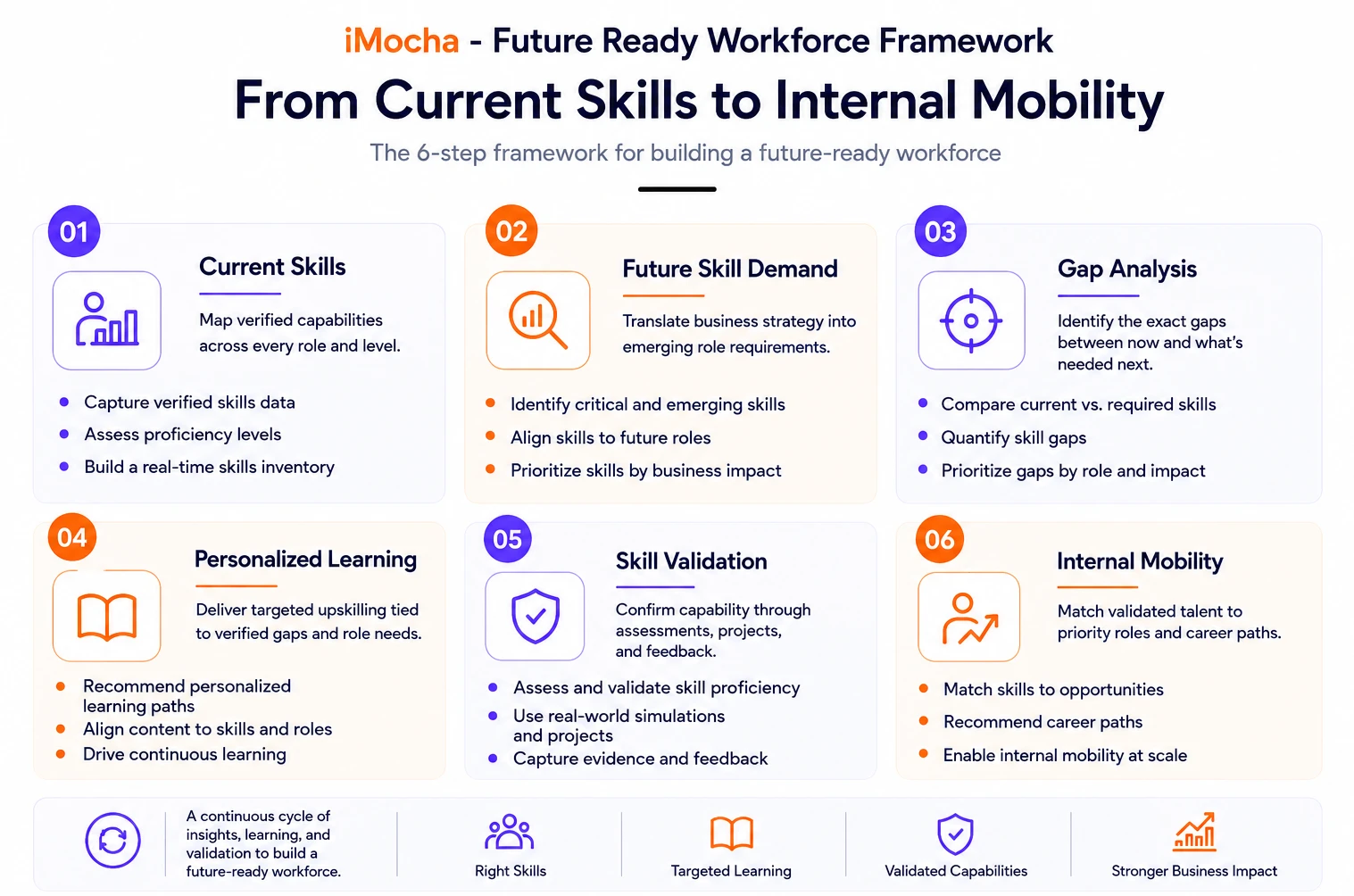
The Future-Ready Workforce Framework
The future-ready workforce planning framework ensures that employees are validated for every relevant skill present in the market. It is a continuous cycle of identifying critical skills, comprehending the gaps, and bridging them by upskilling and reskilling the internal talent/workforce, validating the skills learned by employees, and then deploying them.
Future readiness demands sharpening of the following skills:
- AI skills: Prompt engineering, pattern recognition, and model interpretation
- Digital skills: Data fluency, cloud tools, and cybersecurity awareness
- Functional skills: Role understanding
- Leadership skills: Strategic decision-making, change management, and cross-functional influence
- Role-based learning pathways: Matching the right role to the right skill helps create role-based learning pathways, replacing linear, static career journeys with flexible, cross-functional skills implementation.
Let us dive into detail on how the workforce can be made future-ready.
1. Reinforce Learning Through Validation
Validating skills through skills assessments, projects, manager feedback, and real application helps validate proficiencies with accurate analytics, which later assist with strategic workforce planning. Skill assessments majorly assess employees on distinct skills such as functional, cognitive, technical, and soft skills.
While simulations test real-time situational understanding of employees without any real risk, project-based validation evaluates employees by assessing their actual work output on a project. The last input of manager feedback plays as contextual evidence, ensuring everything is delivered in a valid framework.
After completing all these steps, post-learning proficiency checks whether the standard benchmarks have been achieved or not. This clearly defines a fully validated process of reinforcing learning stepwise.
2. Redeploy Talent into Priority Roles
Moving employees into internal roles, projects, or career paths where their skills can create business value highly benefits. Internal mobility allows cross-functional talent deployment, allowing relevant talent to perform critical tasks. Additionally, succession planning helps create talent pipelines, keeping talent ready to fulfill critical roles when required.
Project staffing can help deploy talent using skills data to assign the correct roles. Role readiness scores provide leaders with accurate data on prepared employees to take up necessary roles. All these methods combined facilitate workforce transformation planning, helping redeploy talent as per business requirements.
How Skills Intelligence Helps Enterprises Equip the Workforce for the Future?
Skills intelligence (SI) helps enterprises prepare for the future of work by creating a connected view of employee skills, role requirements, learning needs, and workforce readiness.
Let us comprehend how Skills Intelligence enhances an organization’s operational scalability.
- Unified skills visibility: The SI platform provides data on the current skills, where they sit, and where exactly the gaps are emerging.
- Dynamic skills taxonomy: Organizations get real-time, unified, and structured skill frameworks that update as roles and technologies evolve.
- Skill gap analysis: It helps leaders identify the difference between the current capabilities and future business requirements, accelerating their ability to find critical gaps.
- Personalized upskilling: With skills intelligence deployed, executives/managers can easily recommend learning based on verified gaps, role needs, and career goals. Learning that differs from generic recommendations allows employees to learn as per experience.
- Proficiency validation: Implementing the SI platform provides analytics of essential gaps discovered, upon which organizations can leverage the skills assessment platform to perform employee assessment and gather evidence to validate whether employees have gained the required skills.
- Internal mobility: iMocha’s SI platform helps match employees to roles, projects, and career paths based on skills and adjacencies. It facilitates cross-functional skill implementation that breaks the traditional linear career journey patterns, helping with retention successfully.
Where Platforms Like iMocha Fit?
Platforms like iMocha help enterprises assess workforce skills, identify skill gaps, and align upskilling programs with verified capability needs. This helps HR and L&D teams move from training activity to workforce readiness by connecting assessments, skills intelligence, and targeted development decisions. It assesses employee skills and performs essential gap analysis early, easing workforce transformation planning.
Conclusion
In today’s landscape, the skill needs are evolving very rapidly. Training is not the usual procedure that helps create workforce readiness; it is rather proven capabilities and validated proficiencies. However, distinct systems storing skills data and learning data make it unstructured and fragmented.
One major goal organizations must critically have is to implement an intelligence layer that unifies the data, making it easier for leaders to identify and address skill gaps. iMocha’s Skills Intelligence personalizes learning recommendations, facilitates cross-functional skill implementation, and comprehends challenges earlier with real-time updates, building out the best future-ready workforce.
FAQs
Why do enterprises struggle to equip their workforce for the future of work?
Enterprises often lack clear visibility into existing skills, future skill requirements, and workforce readiness. Fragmented data across HR, L&D, and workforce planning systems makes it difficult to identify and address critical capability gaps. As technology and business needs evolve rapidly, traditional approaches struggle to keep pace.
What skills are needed for the future of work?
The future workforce requires a combination of AI, digital, technical, cognitive, behavioral, and leadership skills. Employees must also develop adaptability, critical thinking, problem-solving, and continuous learning capabilities. These skills help organizations stay competitive in a rapidly changing business environment.
Why isn’t upskilling alone enough to build a future-ready workforce?
Completing training programs does not necessarily prove that employees can apply skills effectively in real-world situations. Organizations need assessments, simulations, projects, and practical validation to measure true proficiency. Workforce readiness depends on demonstrated capability, not just learning activity.
How can HR and L&D teams improve workforce readiness?
HR and L&D teams can improve readiness by adopting a skills-first strategy that aligns learning with business priorities. Regular skill gap analysis, personalized learning paths, and proficiency validation help ensure employees develop the capabilities needed for future roles. Skills intelligence also provides better visibility for workforce planning decisions.
Why do traditional training programs fail to prepare employees for the future of work?
Traditional programs often focus on course completion, generic content, and annual learning plans rather than measurable skill outcomes. They frequently fail to adapt to changing role requirements and evolving technologies. As a result, organizations struggle to connect learning investments with business impact.
How can enterprises measure workforce readiness?
Workforce readiness should be measured through verified skill proficiency, role readiness, and the ability to meet future business requirements. Skills assessments, project-based evaluations, and performance data provide a more accurate picture than training completion metrics alone. Skills intelligence platforms help organizations continuously track and improve readiness levels.

