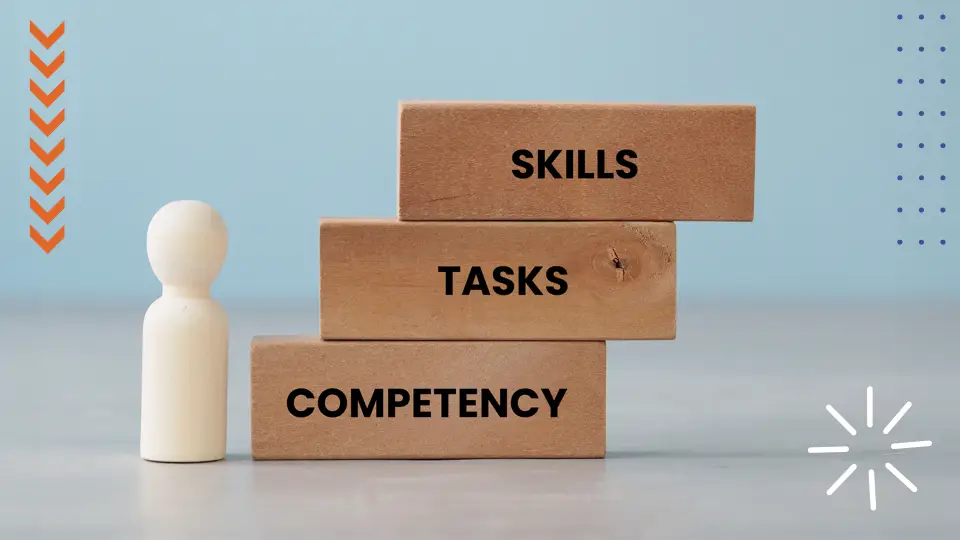
In today’s skills-first economy, many organizations are trying to modernize their talent strategy, but they’re building on shaky foundations. The reason is simple: most teams still use the terms “skills,” “tasks,” and “competencies” interchangeably.
A global insurance company we worked with faced the same challenge. Internal mobility was slow, career paths felt unclear, and learning investments weren’t translating into measurable capability growth.
Their turning point came when they redefined their talent architecture using three simple but powerful building blocks:
1. Tasks: The specific activities employees perform
Tasks are the concrete, observable actions that make up a job, such as writing a piece of code, running a customer escalation call, preparing a financial report, or deploying a cloud service.
They represent the “what actually gets done” on a day-to-day basis.
2. Skills: The learned abilities needed to perform tasks effectively
Skills are narrow, measurable abilities that can be taught, practised, and certified.
Examples include SQL querying, Python programming, facilitation, active listening, cloud architecture, Figma prototyping, and financial modelling.
Because they are specific and verifiable, skills are ideal for precise job–candidate matching and AI-driven talent platforms.
3. Competencies: Broader behavioural clusters that drive superior performance
Competencies combine related skills, knowledge, motivations, and behaviours into patterns that predict success across multiple roles and situations.
Examples include Analytical Thinking, Leadership, Customer Orientation, Strategic Thinking, and Influencing without Authority.
Competencies offer a holistic and predictive view of potential and are widely used for performance appraisals, leadership development, and succession planning.
How They Connect
- Tasks require skills.
- Skills roll up into competencies.
Work Intelligence connects these elements with role requirements, workflows, business priorities, and AI exposure to show how work is changing across the organization.
This hierarchy became the insurer’s new talent blueprint.
Skill-Based Matching + Competency-Level Insights = Real Impact
The organization adopted an AI-driven platform with a simple principle:
Use skills for matching. Use competencies for insights.
Internal Mobility Accelerated
The engine compared employee skills to the skills required for open roles, producing an objective match score.
Competency insights highlighted behavioural gaps, enabling confident redeployment decisions.
Result: More internal moves and reduced dependency on external hiring.
Career Pathing Became Transparent
Employees could instantly see which roles they were closest to, based on skills, not titles.
Competency dashboards clarified what they needed to strengthen for future growth.
Result: More meaningful and constructive career conversations.
Succession Planning Became Data-Driven
Validated skill evidence replaced subjective judgment
Competency insights helped assess leadership readiness and development needs
Result: Stronger and more objective leadership pipelines.
Learning Investments Became Targeted
AI identified exact skill gaps and recommended relevant courses.
Competency uplift could be monitored over time.
Result: Learning ROI became measurable and visible.
The Outcome: A More Agile, Skills-Powered Workforce
By defining tasks, skills and competencies correctly, and using a skills-first approach supported by competency insights, the insurer achieved:
- Higher workforce agility
- Better internal mobility
- Clearer career pathways
- Stronger succession planning
- More effective learning programs
In a world where job roles change faster than ever, skills are the operating system for talent, and competencies are the strategic lens that brings long-term performance into focus.