

Skills architecture is a structured framework used to identify, organize, validate, and manage workforce skills across an organization. It enables HR and business leaders to align workforce capabilities with business goals through strategic workforce planning, internal mobility, upskilling, reskilling, and skills-based hiring.
As organizations adapt to rapid digital transformation, AI adoption, and evolving workforce demands, having a clear understanding of employee skills has become critical. A well-designed skills architecture helps businesses identify skill gaps, improve talent decisions, support career development, and build a more agile, future-ready workforce.
In this guide, we’ll explore the key components of skills architecture, and the essential steps organizations can follow to build an effective and scalable skills framework in 2026.
What Is Skills Architecture?
Skills architecture is an organized framework that determines, structures and governs skills within an organization. It assists organizations in improving their skills maturity, basically to determine skills that exist in the company, skills they require, and how they can close the gap through skills assessments, learning, and planned workforce.
A well-established skills architecture generally consists of:
- Skills Taxonomy: A classification of the existing skills.
- Skills Assessments: Means to measure employee competencies.
- Skills Analytics: Insight into workforce capacity and skills gap based on data.
- Skills-Based Talent Management: Application of skills to help with hiring, learning, and career planning.
- Continuous Skills Validation: Periodic updates to ensure skills align with changing industry requirements.
Using a skills architecture, businesses can build a skills-based organization with a more responsive and future-proof workforce equipped to address business needs.
Skills Architecture Example
Here’s an example of how organizations can structure a skills architecture framework for software engineering roles. This framework maps skill categories to specific skills, proficiency levels, and validation methods, helping organizations standardize skill development, workforce planning, and talent management processes.
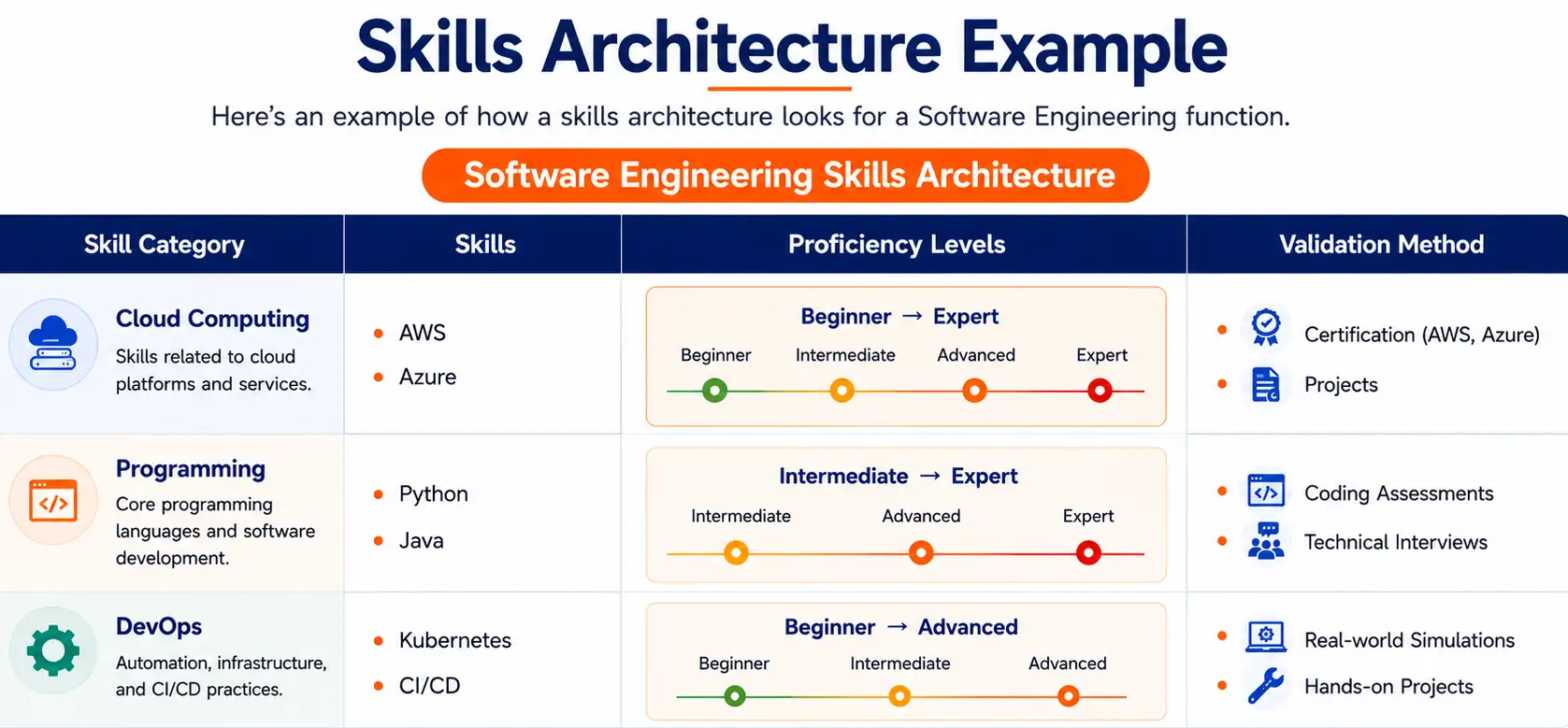
This example demonstrates how businesses can organize technical capabilities across key domains such as cloud computing, programming, and DevOps. By defining proficiency levels from beginner to expert, organizations can better assess employee readiness, identify skill gaps, and create targeted upskilling and reskilling initiatives.
A structured skills architecture also enables organizations to validate skills consistently through certifications, coding assessments, and real-world simulations, ensuring employees possess the competencies required for evolving business and technology needs.
Key Components of Skills Architecture
A well-organized skills architecture allows organizations to identify, measure, and manage workforce skills efficiently. The following is a breakdown of its major components:
1. Skills Taxonomy
A skills taxonomy is a hierarchical structure that classifies skills based on job functions, industries, and levels of expertise. For example, a software organization can group skills under:
- Programming (Java, C++)
- Cloud Computing (Azure, AWS)
- Data Analytics (Power BI, SQL)
Based on this classification, the distinction between existing and required skills can be figured out easily.
Discover leading skills taxonomy software that support the development of a comprehensive skills architecture, enhancing workforce planning and talent management.
2. Skill Proficiency Levels
Defining proficiency levels assists in quantifying employees’ level of expertise in a skill. The levels are usually from Beginner to Expert. This arrangement helps in career development and training.
For instance, a beginner in a customer service role may reflect the basic level of product know-how, but an expert speaks volumes about advanced problem-solving and leadership skills.
3. Skills-to-Job Mapping
This process ensures the right talent goes to the correct positions by connecting specific skills to job roles. It also assists with recruitment and workforce planning. For instance, the role of a data scientist may need machine learning, while a UX designer requires user research.
4. Skills Assessment & Validation
Frequent skills assessments ensure that the skills and competencies of employees align with business requirements. This can be done through:
- Peer Reviews
- Quizzes
- Case Studies
- Real-world Challenges
For instance, a cloud engineer may take the AWS certification exam to validate their skills for the job.
5. Skills Data Management
Effective management of skills data enables companies to monitor skill shortages, keep tabs on market trends, and tie learning initiatives to business objectives. Such activities can be automated using AI-driven skills intelligence platforms. iMocha enables businesses to analyze real-time skill trends and build customized learning paths.
Transform workforce intelligence with iMocha’s AI-powered Skills Inference-real-time skill validation from diverse data sources to power agile, skill-first talent decisions.
Benefits of Skills Architecture
1. Strengthens Workforce Planning
Skills architecture helps organizations gain a clear understanding of existing workforce capabilities, identify critical skill gaps, and prepare for future business and talent needs.
2. Enables Internal Mobility
By mapping employee skills to roles and career pathways, organizations can improve internal mobility and help employees discover growth opportunities within the company.
3. Supports Skills-Based Hiring
Organizations can make more informed hiring decisions by evaluating candidates based on validated skills and competencies instead of relying solely on degrees or job titles.
4. Improves Upskilling and Reskilling Initiatives
A structured skills framework helps businesses identify development needs and deliver targeted learning programs aligned with organizational goals.
5. Increases Workforce Visibility
Skills architecture provides centralized visibility into employee capabilities across departments, making it easier to track skills, assess readiness, and allocate talent effectively.
6. Enhances Organizational Agility
With better visibility into workforce skills, organizations can respond faster to changing technologies, market demands, and evolving business priorities.
Challenges of Skills Architecture
- Defining standardized skills: Organizations often struggle to create consistent skill definitions across departments and business functions.
- Maintaining accurate skills data: Skills evolve rapidly, requiring continuous updates, validation, and alignment with changing industry demands.
- Integrating multiple data sources: Combining HR systems, assessments, learning platforms, and workforce data can be complex and time-consuming.
- Measuring skill proficiency: Accurately evaluating real-world skill proficiency across employees remains a significant challenge for many organizations.
- Managing change and adoption: Employees and leadership teams may resist transitioning from traditional job-based models to skills-based workforce strategies.
- Establishing governance and ownership: Without clear ownership and governance, skills frameworks can become fragmented, inconsistent, and outdated over time.
Steps to Building an Effective Skills Architecture
Organizations must develop a defined, data-informed architecture of skills to remain competitive and align workforce capability with business goals. Here's how it can be done:
1. Assess Organizational Skill Needs
Assessing organizational skill needs involves performing a skills gap analysis to determine missing skills. This helps align workforce skills with business objectives.
For instance, upon examining workers' skills, if a multinational IT services firm finds a shortage in cloud computing skills, it can introduce AWS and Azure training to upskill the workforce, enhancing project efficiency.
2. Define and Standardize Skills
When defining and standardizing skills, organizations must develop an extensive skills taxonomy and clearly outline skill proficiency levels (e.g., beginner, intermediate, advanced, expert).
For example, a company can standardized risk analyst skills by defining proficiency levels in data modeling, risk assessment, and financial regulations. This helps ensure consistent assessment across teams.
3. Map Skills to Job Roles and Career Paths
Businesses are shifting significantly, and the ideology is changing from preferring academic qualifications to skills and competencies. Matching skills to career paths and job roles is all about it.
Organizations can strengthen this connection through task intelligence, which links workforce skills and role requirements to the specific tasks employees perform.
Transitioning to skills-based frameworks helps connect existing skills with competency models, ensuring employee career advancement. Organizations can align their skills with required competency by redefining occupations based on skills instead of titles, enhancing in-house mobility.
Discover top 10 career development tools that help build a strong and scalable skills architecture.
4. Implement Technology for Skills Management
Technology is advancing every passing day, streamlining the entire skills management process. Businesses should use AI-based skills assessment software like iMocha and incorporate it with talent management systems to monitor employee growth.
Implementing an AI-based skills assessment platform can help with various aspects, including discovering top performers for leadership positions, cutting recruitment expenses and enhancing retention.
5. Monitor and Update Skills Architecture
Regularly assessing workforce competencies, readjusting the skills architecture to the market's needs, and keeping up with new skills and industry developments help stay ahead of the competition.
A company incorporating a system of skills intelligence to monitor automation and AI trends can provide workers with constant reskilling and upskilling opportunities.
Conclusion
Developing a future-proof skills architecture is crucial for organizations to fill skill gaps, maximize talent management, and foster workforce agility. Companies can establish a systematic, data-based approach to skills development with these five steps.
iMocha's AI-powered skills intelligence platform streamlines this process through AI-powered skills assessments, taxonomy development, and real-time skills analytics. It enables organizations to detect skill gaps, map skills to roles, and monitor employee development-creating a skilled, responsive workforce.
FAQs
What role does AI play in skills architecture?
AI helps organizations analyze workforce skills, identify skill gaps, predict future skill demands, and automate skills mapping and validation processes. AI-powered skills intelligence platforms also support personalized learning and workforce planning initiatives.
What is the difference between skills architecture and a competency framework?
A competency framework focuses on behavioral traits, knowledge, and abilities required for specific roles. Skills architecture is a broader framework that organizes, validates, and manages skills across the workforce to support business and talent strategies.
How often should organizations update their skills architecture?
Organizations should review and update their skills architecture regularly to keep pace with evolving technologies, business priorities, and workforce demands. Many organizations conduct quarterly or annual skills reviews to maintain accuracy and relevance.
Who is responsible for managing skills architecture?
Skills architecture is typically managed collaboratively by HR leaders, talent management teams, workforce planning specialists, learning and development teams, and business leaders to ensure alignment with organizational goals.
How can organizations measure the success of skills architecture?
Organizations can measure success through metrics such as reduced skill gaps, improved internal mobility, increased employee engagement, faster hiring, better workforce readiness, and higher participation in upskilling programs.

