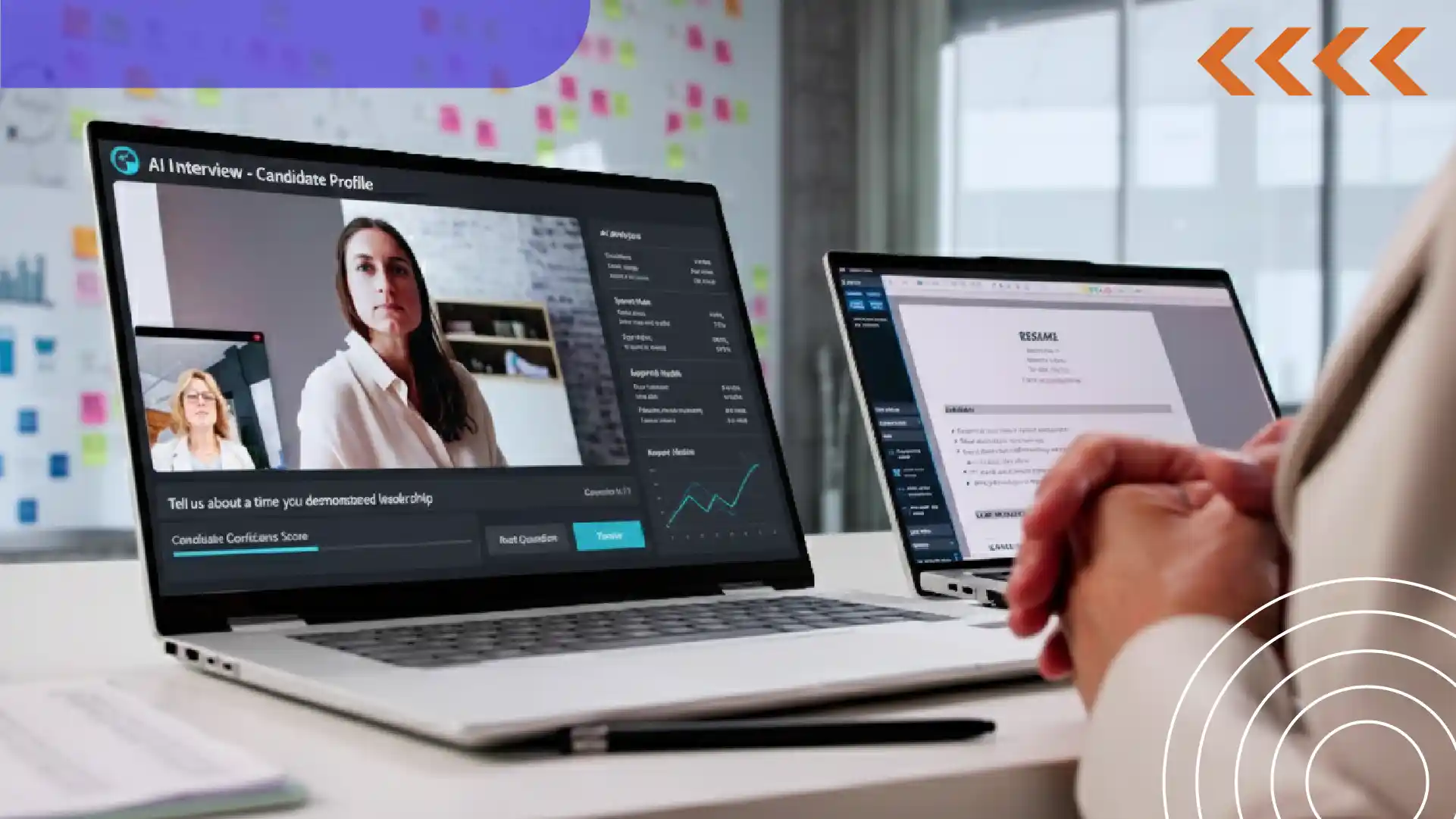
AI interviewing is the use of voice or text-based AI to conduct structured first-round interviews at scale, asking every candidate the same questions, scoring responses against defined competencies, and delivering results in minutes rather than days.
For HR and talent acquisition leaders managing high-volume hiring, it solves three persistent problems: recruiter burnout from repetitive screens, scheduling delays that cost you top candidates, and inconsistent evaluations that make it impossible to compare applicants fairly.
This guide explains how AI interviewing works, where it outperforms traditional phone screens, where human judgment stays essential, and how leading teams are combining both for faster, more defensible hiring decisions.
The Problem With Traditional Phone Screening
Most recruiter teams are running phone screens the same way they did a decade ago, and the cracks are showing.
Here are the five core failure points:
1. Inconsistency Across Interviewers
Different recruiters ask different questions, apply different standards, and bring different biases. When candidates go through different interviewers, your data simply isn't comparable.
2. Scale Limits
A recruiter doing quality screens tops out at 20–25 per day before fatigue degrades judgment. Candidates interviewed later in the day get a measurably worse experience and less careful evaluation.
3. Hidden Bias
Affinity bias, halo effects, and interview fatigue all influence hiring decisions in ways that are difficult to detect and nearly impossible to audit after the fact.
4. No Audit Trail
Most phone screens produce a brief note and a thumbs up or down. There's no documentation for legal defense, no structured data for process improvement, and no way to review decisions if a candidate challenges them.
5. Scheduling Bottlenecks
Coordinating calendars introduces 2–5 day delays at the very top of the funnel, before candidates have any engagement with your company.
How AI Interviewing Works
In an AI interview, a voice AI conducts a structured conversation with each candidate. The candidate speaks naturally; the AI listens, asks contextual follow-up questions, and scores responses against your predefined competency rubric.
Key distinction from async video screening: this is a real conversation, not recorded responses to pre-set questions. The AI adapts based on what the candidate says.
What every AI interview delivers:
- A consistent set of questions for every candidate, eliminating interviewer variance
- Competency-based scores applied against the same rubric across thousands of applicants
- Full transcripts of every interview, available immediately after completion
- 24/7 availability, candidates interview on their schedule, including evenings and weekends
- Results in minutes, enabling same-day progression for strong candidates
AI vs. Human Phone Screening: A Direct Comparison
Where AI Interviewing Delivers the Most Value
1. Consistency at Scale
Screening 500 candidates for the same role? AI delivers identical evaluation criteria for each one, no variance introduced by different interviewers, no degradation from fatigue on interview 400 vs. interview 4.
2. Speed and Candidate Access
Candidates complete interviews immediately after applying, on their schedule. Time-to-first-screen drops from several days to hours. In competitive talent markets, that speed alone can meaningfully improve offer acceptance rates.
3. Structured, Analyzable Data
Every interview generates rubric scores, full transcripts, and pass/fail rationale. HR leaders can analyze patterns across candidate pools, track adverse impact metrics, and continuously refine their screening criteria.
4. Recruiter Efficiency
Your team focuses their time on candidates who've already cleared a structured threshold, spending energy on depth of evaluation and relationship building rather than scheduling logistics.
Where Human Judgment Stays Essential
1. Senior and Complex Roles
Evaluating a VP of Engineering or Chief Revenue Officer requires assessing strategic thinking, leadership philosophy, and organizational fit in ways that can't be reduced to a rubric. Human expertise and judgment are the right tools for these conversations.
2. Building Candidate Relationships
In competitive talent markets, early candidate experience matters. Skilled recruiters build genuine rapport while assessing, they can read energy, respond to uncertainty, and make a candidate feel genuinely considered. AI cannot replicate this.
3. Nuanced, Real-Time Follow-Up
When a candidate reveals something unexpected, a unique background, a concern, a non-obvious strength, an experienced interviewer pivots and goes deep. AI follows its structure.
4. New or Poorly Defined Roles
If you don't have clear success criteria, you can't build a reliable scoring rubric. Human judgment is necessary to recognize what matters when a role is ambiguous or entirely new.
The Hybrid Model: How High-Performing Teams Are Combining Both
The most effective hiring teams aren't choosing between AI and humans, they're sequencing them.
Round 1: AI Interview (All Applicants)
- Structured behavioral questions tied to 3–5 core competencies
- Consistent scoring threshold applied to every candidate
- Full transcript and rubric scores delivered immediately
- Complete documentation for compliance and audit purposes
Round 2: Human Interview (Top 15–25%)
- Deeper evaluation informed by AI scores and transcripts
- Focus on role complexity, culture fit, and strategic thinking
- Relationship building and candidate experience
- Assessment of factors that don't reduce to a rubric
Division of Labor
- AI handles: Communication skills, baseline competency screening, role fundamentals, compliance documentation.
- Humans handle: Strategic thinking, leadership nuance, organizational fit, candidate experience, and final evaluation.
The result: faster hiring, better use of recruiter time, structured data informing every human conversation, and a defensible process with a complete audit trail.
Discover AI hiring trends shaping candidate assessment, from AI interviews and automated screening to skills-first evaluation.
Key Takeaways for HR Leaders
AI interviewing works best as a precision tool for structured, high-volume first-round screening, not as a replacement for human judgment.
The transformation happens when you design your process intentionally: AI handles consistent evaluation at scale, humans handle depth, complexity, and relationship. The result is faster decisions, better use of recruiter time, more defensible outcomes, and a candidate experience that scales without degrading.
If you're evaluating AI interviewing tool for your organization, start by defining the roles where consistent, rubric-based screening would deliver the most value, and build from there.
FAQs About AI Phone Screening
1. Does AI interviewing eliminate hiring bias?
No tool eliminates bias, AI changes the type. It removes interviewer fatigue and affinity bias but introduces different risks if rubric design is poor or if the competency model itself reflects historical biases. Effective AI interviewing requires careful rubric design, regular audits, and ongoing adverse impact monitoring.
2. Will AI replace recruiters?
No. AI is a first-round screening tool. Complex roles, relationship building, and strategic evaluation still require human judgment. The most effective use of AI interviewing is freeing recruiters to do more of the work only they can do.
3. What types of roles are best suited for AI interviewing?
High-volume positions with clear, definable success criteria: customer service, retail, logistics, call center, and entry-to-mid level professional roles. AI interviewing is not well-suited for senior executives, highly specialized technical roles, or any position where success criteria are ambiguous.
4. How do candidates respond to AI interviews?
Candidate reactions improve significantly with transparency. Tell candidates upfront what to expect, how scoring works, and what happens next. Framing it as a structured, bias-reducing process, rather than a cost-cutting measure, tends to land well.
5. What are the regulatory requirements?
Several jurisdictions, including Illinois, New York City, and Maryland, have enacted laws requiring transparency, bias audits, and candidate rights disclosures for AI hiring tools. Compliance requires documented job analysis, adverse impact monitoring, and candidate notification. Requirements vary by location and are evolving.
6. When does AI interviewing become cost-effective?
AI interviewing becomes cost-effective above approximately 500–1,000 screens per year. Setup requires meaningful upfront investment, competency modeling, rubric development, and compliance documentation, but the marginal cost per interview approaches zero at scale.