
The Context Layer for
Skills & Work Intelligence
Transform fragmented talent data into real-time, actionable context for smarter decisions and AI-driven execution.
Trusted by global enterprises to power skills-first workforce strategy








Look Beyond the Label
iMocha's context layer for skills & work intelligence turns fragmented talent data into sharp signals for every workforce decision.

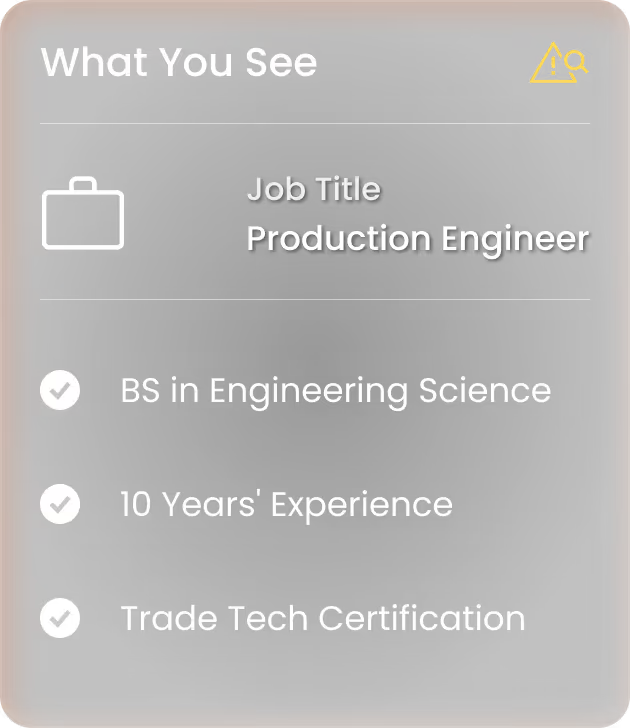
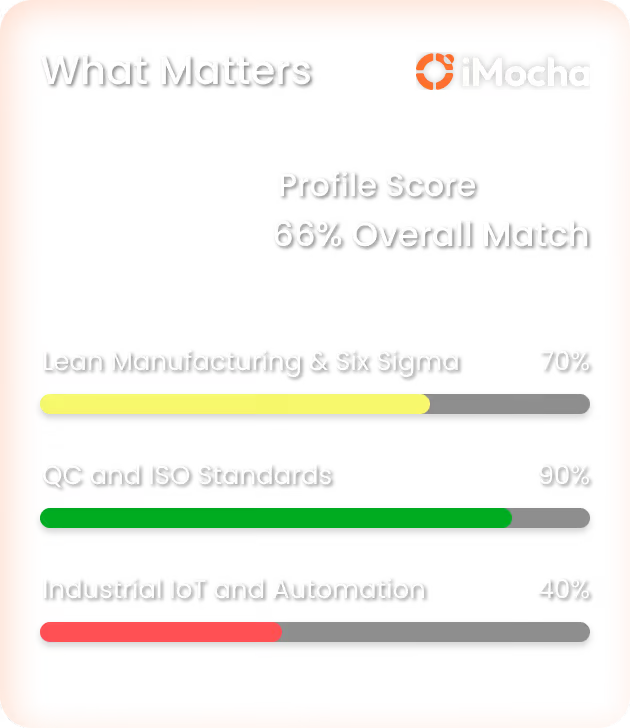
iMocha helped a manufacturing giant build validated skills intelligence for hundreds of employees.

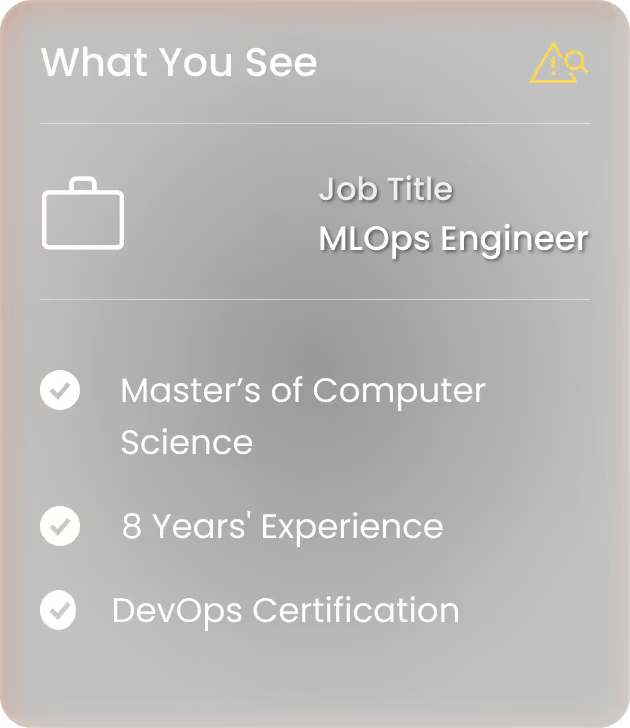
A global IT consulting leader turned course completions into measurable workforce readiness with iMocha.


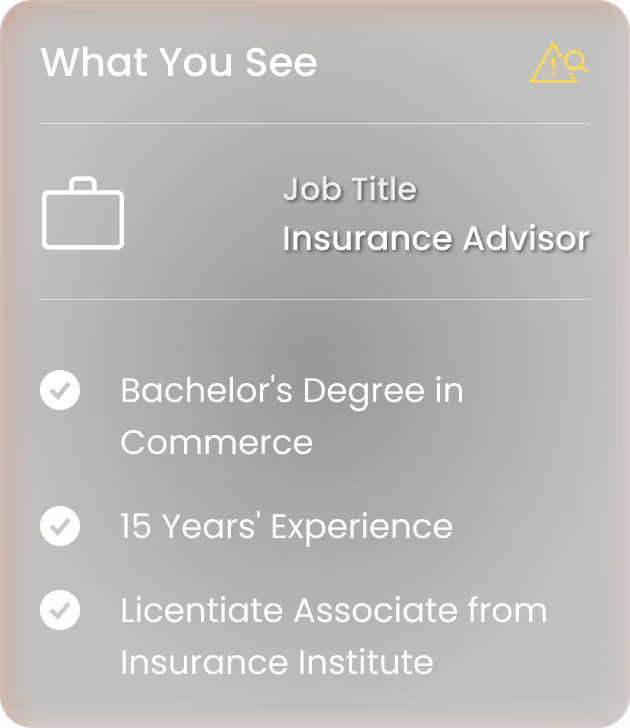
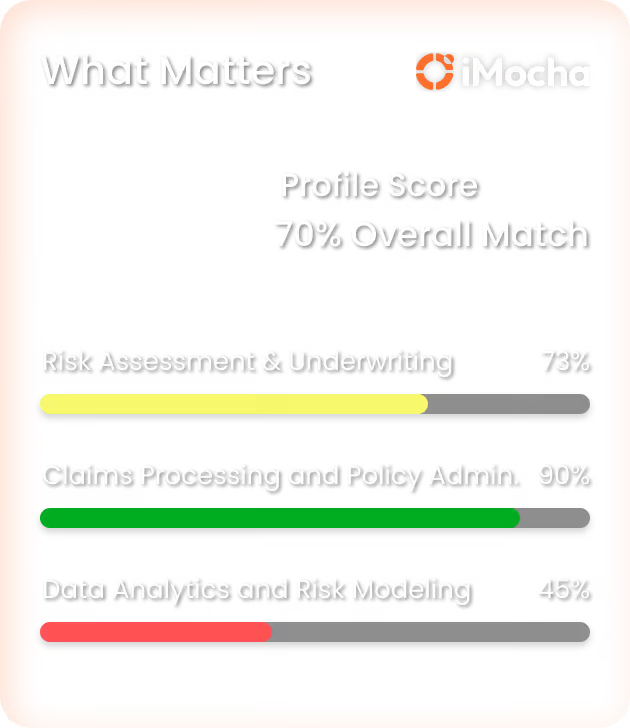
iMocha helped a Fortune 500 insurer save hundreds of jobs and redeploy talent.
Leader in Skills Intelligence,
The Analysts Have Ranked Us
The world's leading analyst firms have spoken. iMocha consistently earns top positioning across the reports that enterprise buyers trust most.
Major Contender & Star Performer - Skills Intelligence Platform

Major Player - Talent Intelligence

Gold in HCM Excellence - Technology Implementation
Two Intelligences,
One Defensible View of the Workforce
Work Intelligence reveals what gets done. Skills Intelligence reveals who can do it. Together they replace job titles and resumes with evidence enterprises can act on.

What is Work Intelligence?
Work Intelligence is the ability to understand how work is performed across an organization at the task level, and how AI will change that work over time.
It helps leaders move beyond job titles and role descriptions to see the actual tasks people perform, which tasks are critical to the business, which can be AI-led, which need AI assistance, and which must remain human-led.


What is Skills Intelligence?
Skills Intelligence is the ability of an organization to understand the skills it needs, the skills it has, and the actions required to close the gap between the two.
It gives enterprises a trusted, dynamic view of workforce capability by connecting skills demand, skills supply, and skills insights across the talent ecosystem. Instead of relying only on job titles, static job descriptions, resumes, or self-declared skills, Skills Intelligence helps organizations make evidence-based decisions about workforce planning, hiring, learning, mobility, redeployment, and transformation.

Every Talent Decision That Matters
Seven use cases. One source of truth for skills, proficiency, and workforce readiness — from hire to deploy to plan.


Identify Workforce Skill Gaps with Precision
iMocha helps organizations uncover skill gaps across employees, teams, roles, departments, and geographies. With validated skills signals and proficiency insights, leaders can see which skills are available, which are missing, and where focused development is needed.
Learn More

Turn Skill Gaps into Targeted Learning Journeys
iMocha connects skill gap insights with relevant learning recommendations, helping L&D teams move beyond generic training. Employees get focused development paths based on their current proficiency, target roles, and business-critical skills.
Learn More

Decode Career Growth from Within
iMocha enables skills-first internal mobility by identifying employee strengths, adjacent skills, and role readiness. Organizations can match people to open roles, projects, and career paths while improving retention and reducing dependency on external hiring.
Learn More

Build a Future-Ready Leadership Pipeline
iMocha helps organizations assess critical skills, leadership readiness, and role-specific capabilities for key positions. HR leaders can identify high-potential employees, close readiness gaps, and build a stronger succession pipeline with trusted skills intelligence.
Learn More

Plan Your Future Workforce with Skills Intelligence
iMocha gives HR and business leaders a clear view of current skills, future skill needs, and workforce readiness. This helps organizations plan hiring, reskilling, redeployment, and transformation strategies based on verified skills data rather than assumptions.
Learn More

Hire for Skills, Not Just Resumes
iMocha helps hiring teams evaluate candidates on actual skills, proficiency, and role fit. With role-based assessments, AI interviews, coding evaluations, communication tests, and proctoring, organizations can improve quality of hire and reduce time-to-interview.
Learn More

The Context Layer,
Connected to Your Tech Ecosystem
iMocha sits at the center of your tech stack - integrating with the platforms your teams already trust to deliver skills and work intelligence exactly where decisions get made.






The Unified System:
Skills & Work Intelligence
Connect skills to real work through tasks - unlocking an agentic intelligence layer that continuously aligns talent, execution, and outcomes at enterprise scale.


Trusted by 300+ Enterprises
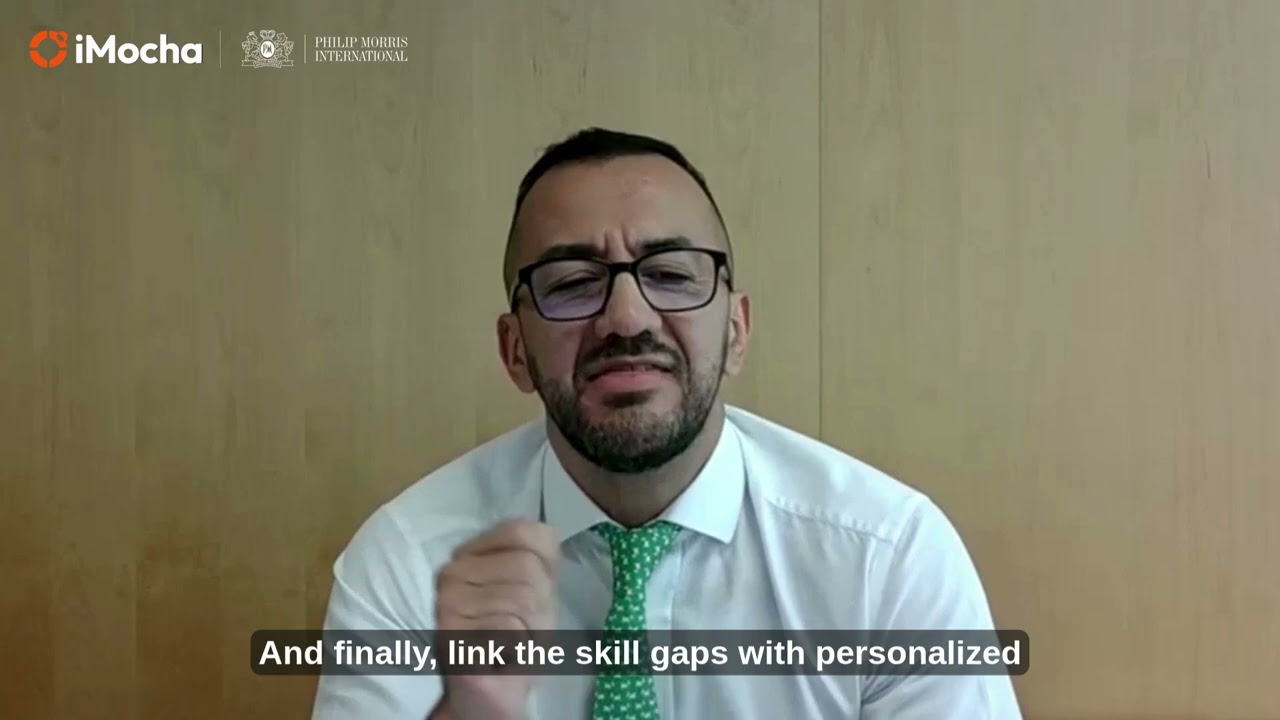
How PMI Built a Skills-First Talent Development Framework with iMocha
Read More"imocha has transformed how we assess, develop, and engage our teams. The platform is not only intuitive, but also strategic, bringing together assessment, learning, and talent readiness in one ecosystem.”

L’Oréal Transforms Talent Development by Uncovering Hidden Talent Potential
Read More"We turned to iMocha to gain real skills intelligence at scale. It’s helped us align development with business needs and empower data-driven career growth globally."

"iMocha enabled a skills-first approach by helping us accurately validate employee capabilities, tailor training to real needs, and meet industry standards—while saving time and reducing manual effort."


"We successfully scaled a tailored certification program – assessing niche technical competencies across 1,000+ employees—and exceeded industry benchmarks with the support of iMocha."


Meet the Purpose-built Agents
Behind the Intelligence.
The directory of purpose-built agents working silently across your talent ecosystem - inferring skills, matching roles, flagging gaps, and surfacing workforce insights in real time.
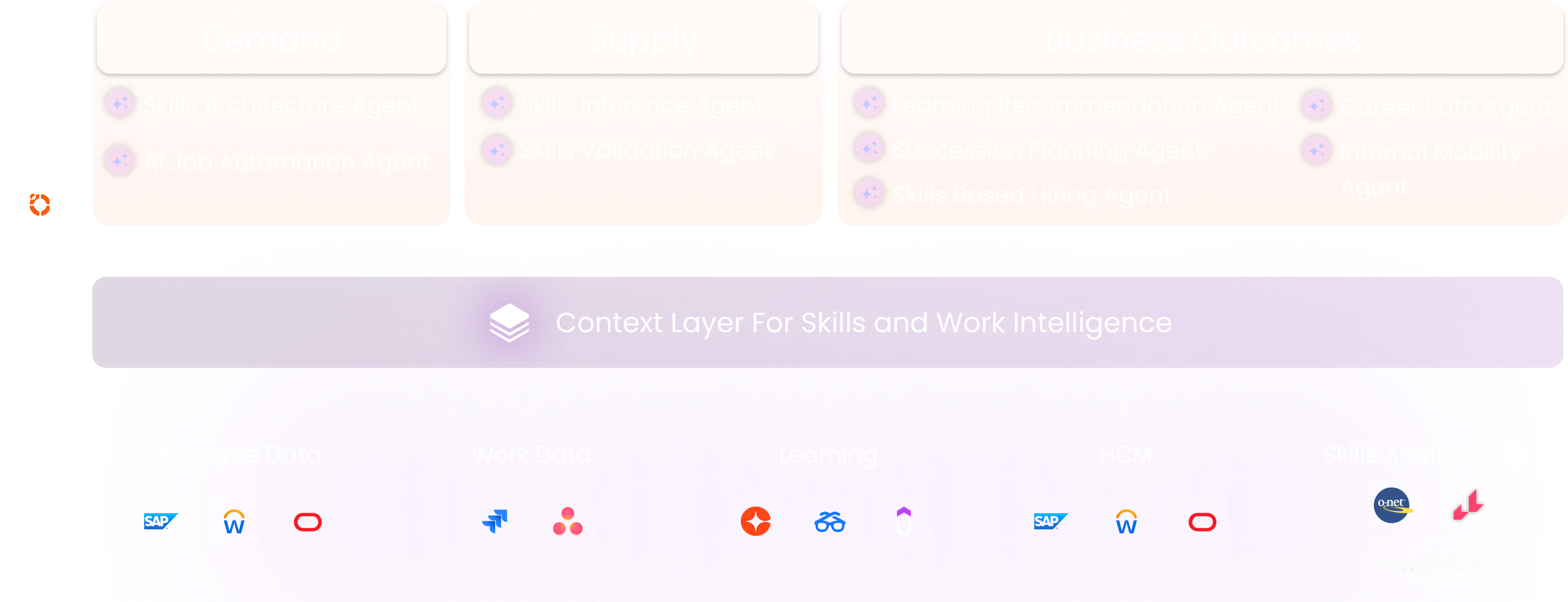
One Platform,
Built for Skills-First Enterprises
iMocha goes beyond assessments. It connects your entire talent ecosystem inferring, validating, and continuously refreshing skills data, so every workforce decision is grounded in evidence, not assumption.
Unified Skills Intelligence Layer
Connects employee, learning, performance, and HR data into one reliable skills view.
AI-Powered Inference & Validation
Infers and validates skills from resumes, certifications, work data, assessments, and AI interviews.
Continuously Accurate Skills Profiles
Builds real-time employee skills profiles for better workforce planning and talent decisions.
Enriched Taxonomies & Ontologies
Helps organizations move beyond static job roles with enriched skills taxonomies and ontologies.
Closed-Loop Skills System
Brings together skills demand, supply validation, and insights in one continuous system.
Seamless HR Tech Integration
Works within existing HCM, HRIS, Talent Management, and Learning systems without disruption.
Actionable Skills Analytics
Provides granular insights for hiring, mobility, upskilling, reskilling, and workforce readiness.
Built for Skills-First Transformation
Enables enterprises to improve skills visibility, talent agility, and business readiness at scale.
Unlock Your Workforce Potential
See how iMocha's Skills and Work Intelligence platform connects to your existing Workday, Oracle, or SAP SuccessFactors investment - and turns skill data into decisions, in a 30-minute live demo.
Frequently Asked Questions
Q1. How do I identify skill gaps across my entire workforce without relying on employee self-assessments?
Self-reported skill data is notoriously unreliable — employees either overstate confidence or underreport capabilities out of fear. A more effective approach is to infer and validate skills from multiple signals: role performance data, learning completions, certifications, project history, and structured assessments. When you layer these data sources together, you get a verified, multi-dimensional picture of where skills exist and where they don't — across teams, functions, geographies, and levels.
The shift from 'what do employees say they can do' to 'what can we verify they can do' is what enables accurate gap analysis at scale. Platforms like iMocha are built specifically for this — connecting validated assessment data with work signals to surface skill gaps with precision, so L&D and HR leaders can prioritize interventions that actually move the needle.
Q2. What is skills intelligence and how is it different from traditional talent management?
Traditional talent management relies heavily on job titles, static role descriptions, and periodic performance reviews. It tells you who holds what position — but not what that person can actually do, or whether your organization has the capabilities it needs to execute on strategy.
Skills intelligence flips this. It gives organizations a dynamic, evidence-based view of the skills they have, the skills they need, and the gap between the two — continuously updated rather than frozen in an annual review cycle. Instead of managing people by job category, you manage them by capability: who can build in Python, who is ready to lead a client engagement, who has the adjacent skills to move into a new role.
This shift matters because workforce decisions — hiring, reskilling, deployment, succession — become grounded in verified data rather than tenure, gut feel, or outdated org charts. iMocha's Skills Intelligence platform, for example, connects skill demand signals with validated employee capability data to give HR and business leaders a real-time, defensible view of workforce readiness.
Q2. What is skills intelligence and how is it different from traditional talent management?
Traditional talent management relies heavily on job titles, static role descriptions, and periodic performance reviews. It tells you who holds what position — but not what that person can actually do, or whether your organization has the capabilities it needs to execute on strategy.
Skills intelligence flips this. It gives organizations a dynamic, evidence-based view of the skills they have, the skills they need, and the gap between the two — continuously updated rather than frozen in an annual review cycle. Instead of managing people by job category, you manage them by capability: who can build in Python, who is ready to lead a client engagement, who has the adjacent skills to move into a new role.
This shift matters because workforce decisions — hiring, reskilling, deployment, succession — become grounded in verified data rather than tenure, gut feel, or outdated org charts. iMocha's Skills Intelligence platform, for example, connects skill demand signals with validated employee capability data to give HR and business leaders a real-time, defensible view of workforce readiness.
Q3. What is work intelligence and why should HR and business leaders pay attention to it?
Work intelligence is the organizational ability to understand how work actually gets done — at the task level — and how that work is changing due to technology, automation, and AI.
Most workforce planning still operates at the job level: we need more engineers, fewer analysts. But jobs are bundles of tasks, and those tasks are shifting at very different rates. Some tasks are being fully automated. Others require AI assistance. Some remain irreducibly human. Work intelligence helps leaders see this decomposition clearly — which tasks within a role are AI-susceptible, which are evolving, and which create the most business value.
For HR leaders, this matters because it shifts the planning question from 'how many of what role' to 'what tasks need to be done, by whom, and with what human-AI blend.' Organizations like iMocha are building work intelligence capabilities that map task-level work data to workforce strategy, giving leaders a more future-proof lens for workforce planning.
Q4. How can we move beyond resumes and job titles when making internal talent decisions?
Resumes capture where someone has been, not what they can do. Job titles reflect organizational hierarchy, not capability. For internal mobility, succession, and deployment decisions, both are poor proxies — they systematically hide potential and create bias toward tenure over talent.
Moving beyond them requires building a skills layer on top of your existing HR data: a continuously updated, validated profile of each employee's actual capabilities, proficiency levels, and growth trajectory. This means combining structured assessments, AI interviews, project contributions, learning completions, and manager inputs into one coherent view.
With this in place, talent decisions shift from 'who has held this role before' to 'who has the skills, proficiency, and adjacent capabilities to succeed in this opportunity.' Enterprises using platforms like iMocha report being able to identify internal candidates for roles they would have previously filled externally — improving retention, reducing hiring costs, and accelerating mobility.
Q5. How do I build a future-ready workforce when I can't predict which skills will matter in three years?
The honest answer is: you can't predict with certainty, but you can build the infrastructure to adapt faster than your competition.
Three principles help here. First, invest in understanding the skills you have today with high fidelity — you can't manage what you can't measure. Second, connect your skills data to market signals and business strategy so you can spot emerging skill needs before they become urgent gaps. Third, build workforce agility by developing adjacent skills and cross-functional capabilities that give your people flexibility to move as needs shift.
Strategic workforce planning platforms that combine skills intelligence with work intelligence — like iMocha — allow leaders to model 'what if' scenarios: if this technology disrupts this function, which of our people are closest to readiness? The goal isn't perfect prediction; it's shortening the time from 'skill needed' to 'skill available.'
Q6. How can L&D teams create truly personalized learning paths instead of one-size-fits-all training programs?
Generic training programs fail because they treat all employees at a given level as having the same starting point — which they never do. Personalization requires knowing where each employee actually is, proficiency-wise, relative to where they need to be for their current role, target role, or the organization's future direction.
Effective personalized learning starts with validated skills data: what can this person demonstrably do, at what level, and what specific gaps stand between them and their development goal. From that baseline, you can recommend focused interventions — not a full curriculum, but the specific modules, experiences, and assessments that close the actual gap.
iMocha connects skills gap data directly with learning recommendations, so L&D teams can move from 'everyone takes the same leadership program' to 'this employee needs targeted development in executive communication and stakeholder management specifically.'
Q7. How do I reduce my organization's dependency on external hiring by developing talent from within?
External hiring is expensive, slow, and carries significant onboarding risk. Most organizations already have more of the talent they need than they realize — it's simply invisible because there's no structured way to see it.
The shift to internal-first talent strategy requires three things: visibility into employee skills at a granular, validated level; a mapping of those skills to open roles, projects, and business needs; and a clear process for surfacing and advancing internal candidates before reaching for external pipelines.
Organizations that have made this shift report significant reductions in time-to-fill and cost-per-hire, alongside better retention — because employees who see internal growth pathways stay longer. Skills intelligence platforms like iMocha enable this by building the skills layer that makes internal talent visible, matchable, and actionable across the enterprise.
Q8. How do I make succession planning less subjective and more data-driven?
Traditional succession planning often relies on senior leader nominations, informal visibility, and gut feel — which means high-potential employees who lack sponsors or visibility get consistently overlooked. It's a process that systematically disadvantages diverse talent and rewards proximity to power over capability.
Data-driven succession planning replaces this with evidence. You define the critical skills, leadership competencies, and role-specific capabilities required for each key position. You then assess your employee population against those benchmarks — using structured assessments, validated proficiency data, and multi-channel inputs — and identify who is ready now, who is ready in 12-18 months with targeted development, and where your pipeline has dangerous gaps.
Platforms like iMocha bring assessment rigor and skills intelligence into the succession process, helping HR leaders build pipelines that are defensible to the board and genuinely representative of organizational capability — not just organizational visibility.
Q9. What does a skills-first organization actually look like in practice?
A skills-first organization is one where the primary unit of workforce management is capability — not job title, not years of experience, not educational credential. In practice, this manifests in several ways:
Hiring decisions are based on assessed skills and demonstrated ability, not resume pattern-matching. Internal mobility is driven by skills adjacency — employees are matched to opportunities based on what they can do, not what they've done before. Learning investment is targeted to close specific, validated gaps rather than deployed generically. Workforce planning models future capability needs, not just headcount.
Getting there requires the infrastructure to see skills clearly: a dynamic, validated skills taxonomy, continuously refreshed employee profiles, and the analytics to connect skills data to talent decisions. iMocha works with 300+ enterprises undergoing this transformation, providing the skills intelligence layer that makes skills-first strategy operationally real.
Q10. How do I measure workforce readiness for digital transformation?
Digital transformation readiness is not a sentiment survey — it's a skills question. The critical measurement is: do your people have the verified technical, analytical, and adaptive capabilities required to execute the transformation you're planning?
Measuring this requires going beyond learning completion rates or self-reported confidence scores. You need to assess actual proficiency in the skills that matter: data literacy, cloud platforms, agile working, AI-assisted workflows, cybersecurity awareness — and map that proficiency against the role-by-role requirements of the transformed organization.
The gap between current capability and required capability, measured at individual, team, and function level, gives you the readiness picture you need. It tells you where training investment will have the most impact, which teams are ready to move fast, and where transformation timelines need to flex. Platforms with validated skills assessment and analytics capabilities, like iMocha, give HR and business leaders this readiness view with the granularity needed to act on it.
Q11. Which roles and tasks in my organization are most at risk of AI displacement — and how do I plan for that?
AI displacement risk is not evenly distributed across roles — it's distributed across tasks. A single job may contain a mix of tasks: some highly automatable, some requiring human judgment, some requiring AI collaboration. The planning error most organizations make is treating entire roles as 'safe' or 'at risk' when the reality is far more granular.
Effective planning starts with task-level decomposition: map what your people actually do day-to-day, then assess each task's automation susceptibility based on current and near-future AI capability. This gives you a clearer picture of where workforce redeployment, reskilling, and role redesign are needed — and where AI will augment rather than replace.
Work intelligence tools — including iMocha's work intelligence capabilities and their publicly available Automation Index — help organizations run this kind of analysis, so workforce planning is grounded in evidence about AI's actual impact rather than speculation.
Q12. How do I integrate skills data into our existing HR tech stack — Workday, SAP SuccessFactors, or Oracle?
The challenge most organizations face isn't lack of skills data — it's fragmentation. Skills data lives in LMS completion records, performance systems, ATS pipelines, assessment platforms, and manager notes — none of it connected, none of it actionable in the systems where decisions actually happen.
The right integration philosophy is: bring skills intelligence to the decision point, not the other way around. That means a skills platform that connects into your existing HCM, HRIS, and talent management systems — surfacing validated skills context inside Workday, SuccessFactors, or Oracle workflows without requiring leaders to switch between systems.
iMocha is built for this integration model, with purpose-built connectors for Workday, SAP SuccessFactors, and other major enterprise platforms. The result is that hiring managers, L&D teams, and HR business partners get skills intelligence embedded in the systems they already use every day — removing friction and improving adoption.
Q13. How do organizations match employees to projects and client deployments based on skills rather than availability?
Availability-based staffing is a symptom of poor skills visibility — you assign who's free rather than who's best, because you don't have a reliable way to see the latter at speed.
Skills-based talent deployment flips this: it starts with what the project or client engagement actually requires — specific technical skills, proficiency levels, domain expertise, language capabilities — and then matches against a validated inventory of employee skills. This improves both deployment quality and employee engagement, since people are placed in roles where their skills are genuinely utilized.
For this to work at enterprise scale, you need skills profiles that are dynamic and validated — not last year's self-assessment or a static resume. iMocha builds exactly this: continuously refreshed, multi-channel validated skills profiles that enable organizations to deploy talent with speed and precision, improving utilization rates and client outcomes simultaneously.
Q14. How do I improve quality of hire beyond resume screening and keyword matching?
Resume screening and keyword matching are proxies — and poor ones at that. They filter for people who know how to write resumes, not people who can do the job. The result is systematic under-selection of non-traditional candidates who have the skills but not the pedigree, and over-selection of candidates who interview well but underperform in role.
Quality of hire improves when hiring decisions are grounded in direct evidence of job-relevant capability: structured skills assessments, role-specific simulations, and AI-assisted interviews that evaluate communication, problem-solving, and technical ability in a standardized way.
This approach surfaces candidates the resume filter would have missed, reduces interviewer bias, and gives hiring teams a consistent, comparable view of candidate capability. Platforms like iMocha offer the full stack — from pre-screening assessments and coding evaluations to AI interviews and proctoring — enabling organizations to hire for what matters: verified skills and demonstrated fit.
Q15. What is a skills taxonomy and does my organization need one?
A skills taxonomy is a structured, hierarchical framework that defines and organizes the skills relevant to your organization — from broad competency categories down to specific, measurable capabilities. Think of it as the common language your organization uses to describe what work requires and what employees can do.
Without a taxonomy, skills data becomes inconsistent and incomparable: one team calls it 'data analysis,' another calls it 'analytics,' another calls it 'business intelligence.' No meaningful aggregation or comparison is possible, and workforce strategy decisions end up being made in the dark.
With a well-maintained, enriched taxonomy — connected to market skill signals and role-specific requirements — you can reliably measure gap, track growth, plan hiring, and design learning. Building this from scratch is a significant undertaking. Organizations like iMocha offer pre-built, continuously enriched skills taxonomies and ontologies as part of their skills intelligence infrastructure, letting enterprises skip the years-long taxonomy build and go directly to insights.
Q16. How can HR business partners make more credible, evidence-based workforce planning recommendations to the business?
The biggest credibility challenge for HR in workforce planning is the data problem: business leaders make decisions based on revenue forecasts, pipeline data, and market signals — and HR often shows up with headcount history and engagement scores. The gap feels unbridgeable.
Closing it requires HR to speak the same evidentiary language as the business. That means coming to the table with: here are our current verified capabilities by function, here is the skills gap relative to our 18-month strategy, here is the cost of closing that gap through reskilling versus hiring, and here is the workforce readiness risk if we don't act.
This kind of strategic framing is only possible when HR has access to high-quality, validated skills data with the analytics layer to model scenarios. Skills intelligence platforms — iMocha among them — give HR business partners the data infrastructure to make recommendations that hold up to CFO scrutiny and earn a seat in strategic planning conversations.
Q17. How do I create meaningful career development paths for employees in a rapidly changing skills environment?
Career paths defined purely by functional ladder or years-to-promotion are losing relevance. In a fast-changing environment, employees need line of sight to growth that is skills-based — what capabilities do I need to develop, and what opportunities do they unlock?
Effective career development in this context requires three elements: a clear picture of an employee's current validated skills and proficiency, a skills-gap map against target roles or growth areas, and a curated set of learning, stretch assignment, and project experiences that close those gaps with evidence.
This is fundamentally different from giving someone a generic development plan. It's a personalized, skills-anchored growth trajectory that employees can see and trust. iMocha enables this by connecting validated skills profiles to role readiness maps and targeted learning paths — giving employees a transparent, skills-grounded view of their growth opportunities within the organization.
Q18. How can organizations accurately assess technical skills at scale during high-volume hiring?
High-volume technical hiring creates a measurement problem: you need to evaluate thousands of candidates on actual technical capability — not just stated expertise — without your hiring team drowning in manual reviews.
The answer is standardized, automated technical evaluation: role-specific coding assessments, domain simulations, and AI-assisted screening that assess real skills in real-world contexts at any volume. The key design principle is that assessments should reflect the actual job — not generic puzzles — so they predict on-the-job performance rather than test-taking ability.
Organizations that adopt this approach consistently report improvements in quality of hire, reduced time-to-screen, and lower interviewer burden. iMocha's skills assessment library spans 10,000+ validated assessments across coding, cognitive, domain, technical, and communication skills — enabling hiring teams to run high-fidelity evaluation at scale without compromising on assessment quality.
Q19. What data does an HR leader actually need to build a credible workforce strategy?
A credible workforce strategy rests on four data pillars: demand, supply, gap, and action.
Demand: what skills and capabilities will your business need over the planning horizon, driven by strategy, market shifts, and technology change. Supply: what skills and capabilities your workforce currently has, validated and proficiency-rated rather than self-reported. Gap: the delta between demand and supply — specific, measurable, and prioritized by business impact. Action: the modeled options for closing the gap — hire, build, borrow, or automate — with associated costs, timelines, and risks.
Most HR organizations have elements of this data scattered across disparate systems, but lack the unified, validated skills layer that connects them. Platforms that provide skills intelligence infrastructure — like iMocha — are designed to close this gap: connecting skills demand signals, validated employee profiles, and workforce analytics into the unified view that strategic planning requires.
Q20. How have other large enterprises successfully implemented a skills-first talent transformation — and what does it take?
Skills-first transformation is not a technology project — it's an organizational change program that happens to require technology. The enterprises that succeed share several patterns.
They start with a clear business problem — reducing hiring costs, improving deployment speed, managing AI disruption — rather than 'becoming skills-first' as an end in itself. They invest in building a reliable skills data foundation before trying to draw insights from it. They connect skills intelligence to the specific talent decisions that move the needle: who gets deployed, who gets developed, who is succession-ready. And they make skills visible to employees, not just HR — because transformation stalls without employee buy-in.
Global enterprises including L'Oréal, Capgemini, and Ericsson have undertaken this journey using iMocha's skills intelligence platform — building validated skills profiles at scale, connecting development to business-critical needs, and demonstrating measurable impact on talent outcomes. The common thread is treating skills data as organizational infrastructure, not an HR reporting metric.