
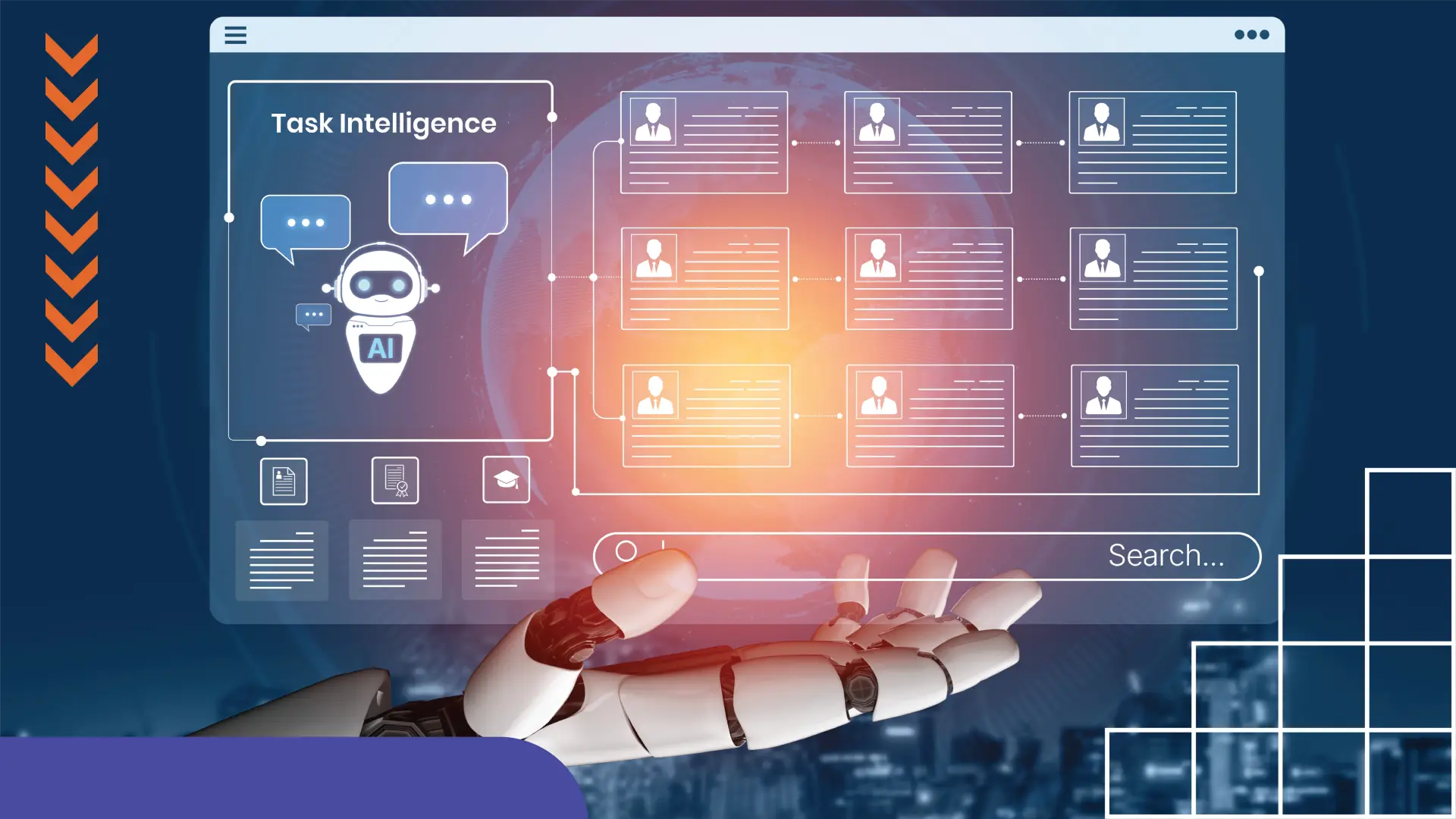
Work is changing faster than traditional job descriptions can keep up. As AI and automation reshape roles, organizations need a clearer way to understand the tasks employees perform and the skills required to complete them.
Gartner predicts that by 2026, 40% of enterprise applications will feature task-specific AI agents. This makes task-level visibility more important for workforce planning and AI readiness.
Task intelligence helps organizations break roles into specific tasks, map those tasks to required skills, and connect work with business goals. It supports better decisions around hiring, upskilling, role design, automation, and workforce planning.
What is task intelligence?
Task intelligence is the practice of analyzing the work people actually perform, mapping those tasks to the skills required, and evaluating each task by effort, frequency, complexity, automation potential, and business impact.
It helps organizations understand how work gets done, which skills are needed to perform that work, where employees may need support, and which tasks can be automated, augmented, redesigned, or reassigned.
Instead of relying only on job titles or static job descriptions, task intelligence gives leaders a more detailed view of work at the task level. This helps HR, L&D, talent acquisition, and workforce planning teams make better decisions about hiring, upskilling, internal mobility, role design, and AI readiness.
Why Task Intelligence Matters
Traditional job descriptions do not always show how work is actually performed. As roles change due to AI, automation, and shifting business needs, organizations need a more detailed view of the tasks employees handle every day.
Task intelligence helps leaders understand which tasks are critical, which skills are required, where employees spend the most effort, and which work can be automated, redesigned, or improved.
This gives HR, L&D, talent acquisition, and workforce planning teams a stronger foundation for making decisions about hiring, upskilling, reskilling, internal mobility, role design, and AI readiness.
By focusing on tasks instead of only job titles, organizations can identify skill gaps more accurately, build targeted upskilling and reskilling programs, and align people, skills, and business goals more effectively.
Task Intelligence vs Skills Intelligence
Task intelligence and skills intelligence are closely connected, but they answer different questions.
Task intelligence focuses on the work being performed. It helps organizations understand what tasks employees do, how often they do them, how much effort each task requires, and how those tasks contribute to business goals.
Skills intelligence focuses on workforce capability. It helps organizations understand what skills employees have, how proficient they are, where skill gaps exist, and who is best suited for specific work.
In simple terms, task intelligence shows what work needs to be done, while skills intelligence shows who can do the work.
Together, they help organizations connect business priorities with workforce capability. This allows HR, L&D, talent acquisition, and workforce planning teams to make better decisions about hiring, upskilling, internal mobility, role design, and AI readiness.
The Task-to-Skill Intelligence Framework
A practical way to use task intelligence is to connect every important task to the skills, effort, automation potential, and business impact behind it. This helps organizations move beyond static job titles and understand work at a more actionable level.
1. Start with the Task
The framework starts with the task itself. A task is the specific work an employee performs, such as analyzing customer feedback, screening candidates, creating reports, resolving support tickets, or identifying skill gaps within a team.
Looking at work at the task level gives leaders a clearer view of what actually happens inside a role.
2. Map the Skills Required
The next step is to identify the skills required to perform each task effectively. For example, analyzing customer feedback may require data interpretation, communication, problem-solving, and customer experience knowledge.
Mapping tasks to skills helps organizations identify skill gaps, create targeted learning paths, and make better decisions about hiring, upskilling, and internal mobility.
3. Evaluate the Effort Involved
Effort includes how often the task is performed, how much time it takes, how complex it is, and whether it depends on other teams, tools, or systems.
Some tasks may take a lot of time but create limited business value, while others may happen less frequently but have a major impact on outcomes.
4. Assess Automation Potential
Each task can be evaluated to determine whether it should be automated, augmented by AI, or kept human-led.
Repetitive and rules-based tasks may be suitable for automation. Tasks that require judgment, empathy, strategy, collaboration, or complex decision-making may need to remain human-led.
5. Connect Tasks to Business Impact
Business impact helps leaders understand which tasks contribute most to productivity, customer experience, revenue, compliance, innovation, or workforce readiness.
This ensures that workforce planning is not based only on roles or headcount, but on the tasks that create measurable value for the business.
6. Turn Insights into Workforce Action
Once organizations understand the relationship between tasks, skills, effort, automation potential, and business impact, they can take better action.
They can upskill employees, redesign roles, automate low-value tasks, redeploy talent, improve hiring criteria, or build more targeted learning paths.
This framework helps organizations move from role-based workforce planning to task-based workforce planning.
Why Talent Teams Need Task Intelligence
Most of the time, decisions regarding task assignment, skills development, and workload are based on assumptions rather than actual data, as there is often a lack of awareness of what employees actually do.
For L&D specialists and talent teams, understanding people’s skills opens more innovative development paths and talent mobility, while also clarifying the tasks they perform. Balanced workloads lead to a better employee experience, lower risk of burnout, and higher retention, all of which are crucial, considering the cost of disengagement and turnover.
With digital transformation, businesses are also adapting to changes in tasks and the emergence of new workflows. Intelligence in tasks offers the right talent and process design. When tasks align with business goals and value, HR and L&D transition from being operational to strategic partners who use talent, skills, and work together to achieve organizational goals.
Business Benefits of Task Intelligence
Task intelligence brings measurable value at the enterprise level, especially when HR, L&D, talent acquisition, and workforce planning teams use it together. Key benefits include:
- Improves workforce visibility: Helps organizations understand what employees actually do, which tasks take the most time, and where work is becoming more complex or repetitive.
- Supports targeted upskilling: Connects tasks with required skills, helping L&D teams identify skill gaps and create learning programs that are more relevant to actual work.
- Strengthens workforce planning: Helps HR and business leaders identify which skills are needed today, which capabilities will be required in the future, and where talent gaps may emerge.
- Enables smarter automation decisions: Helps leaders identify which tasks can be automated, which can be augmented by AI, and which should remain human-led.
- Connects skills to business impact: Helps organizations focus workforce decisions on the tasks and skills that contribute most to productivity, performance, and business goals.
Task Intelligence Examples Across IT, Banking, and AI Roles
Task intelligence can be applied across roles and industries by breaking work into tasks, mapping those tasks to skills, and identifying opportunities for upskilling, automation, or role redesign.
IT Support Engineer
An IT support engineer handles tasks such as resolving tickets, troubleshooting system issues, managing access requests, and documenting incidents. Task intelligence helps map these tasks to skills like technical troubleshooting, system administration, cybersecurity awareness, communication, and problem-solving.
It also helps identify repetitive tasks, such as password resets or ticket categorization, that can be automated.
Banking Operations Analyst
A banking operations analyst performs tasks such as reviewing transactions, verifying documents, monitoring compliance checks, and preparing reports. Task intelligence helps connect these tasks to skills like regulatory knowledge, risk awareness, data analysis, attention to detail, and process management.
This helps banks improve efficiency, reduce operational risk, and train employees for higher-value work.
AI Engineer
An AI engineer works on tasks such as preparing datasets, building models, testing performance, monitoring outputs, and collaborating with business teams. Task intelligence helps map these tasks to skills like Python, machine learning, data preprocessing, model evaluation, cloud platforms, and responsible AI practices.
This helps organizations identify AI skill gaps and build more capable AI-ready teams.
Also explore our blog on talent intelligence tools that help enhance task intelligence and empowers strategic workforce planning decisions.
How Task Intelligence Works with Skills Intelligence?
Task intelligence shows what work needs to be done. Skills intelligence shows who has the right capabilities to do that work.
Together, they help organizations connect tasks with required skills, identify skill gaps, and make better decisions about upskilling, hiring, internal mobility, automation, and role design.
For example, if task intelligence shows that an IT support engineer frequently handles recurring system issues, skills intelligence can identify whether the employee has the required skills in troubleshooting, system administration, cybersecurity awareness, and communication.
This combined view helps organizations align people, skills, and business priorities more effectively.
Conclusion
Task intelligence helps organizations understand work at a deeper level by identifying the tasks employees perform, the skills those tasks require, and the business impact they create.
When combined with skills intelligence, it becomes even more powerful. Task intelligence shows what work needs to be done, while skills intelligence shows who has the capability to do it.
Together, they help organizations move beyond static job descriptions and make more practical, skills-based workforce decisions. This enables better workforce planning, targeted upskilling, smarter automation decisions, and stronger alignment between people, work, and business goals.
FAQs
1. What data is needed for task intelligence?
Task intelligence uses data from job descriptions, workflow systems, manager input, employee feedback, skills assessments, performance data, and business priorities. This helps organizations understand the tasks employees perform and the skills required to complete them effectively.
2. How can organizations start using task intelligence?
Organizations can start by selecting priority roles, breaking those roles into key tasks, and mapping each task to the skills required. This helps identify where upskilling, automation, or role redesign may be needed.
3. What are common mistakes to avoid with task intelligence?
Common mistakes include relying only on job titles, using outdated job descriptions, focusing only on automation, and mapping tasks without validating employee skills. Avoiding these mistakes helps organizations build a more accurate view of work.
4. How can task intelligence improve hiring?
Task intelligence helps hiring teams understand the actual tasks a candidate will perform and the skills needed for those tasks. This makes it easier to design relevant assessments, ask better interview questions, and improve role fit.
5. How can task intelligence help reduce skill gaps?
Task intelligence connects tasks with the skills required to perform them. This helps organizations identify where employees need development and create targeted upskilling programs based on actual work needs.

