
The current digital landscape has widened AI’s scope and changed how organizations work, compelling them to use work designs that create a dynamic workforce. As a result, most CHROs and L&D leaders are building job architectures suitable for the Agentic AI era and modernizing their workforce planning by transitioning from static job descriptions to dynamic, skills-based, and task-aware work models.
The major objective is Human-AI collaboration, defining how humans, AI agents, and teams can provide effective business outcomes. And surprisingly, Agentic AI is not just trained to change tools, but it’s also intellectually developed with the ability to handle work design, handling manual tasks like decomposing, assigning, governing, measuring, and developing.
Many organizations still lack skills intelligence and use skills taxonomies/job architectures that follow rigid structures and linear career paths for their employees. They must critically integrate AI agents in workflows, perform capability mapping, and strengthen internal mobility by upskilling employees to work with AI governance. This creates a task-based workforce design, helping organizations function efficiently and increase their productivity.
Key Takeaways
- Agentic AI will be reshaping tasks and roles, changing the traditional job architectures, replacing them with creative, critical thinking, and digitally driven roles.
- CHROs must shift their focus to redesigning jobs around skills and human-AI collaboration to increase their efficiency.
- The significance has shifted from static job descriptions to dynamic workforce models, as they no longer serve the current market needs.
- Skills intelligence will play a critical role in identifying changing roles, skill gaps, and mobility opportunities, facilitating smoother Human-AI collaboration.
- Businesses deploying future-ready job architecture that connects skills, work, learning, and career growth that fits Agentic AI processes will become prominent in the competitive market.
What is Job Architecture in the Agentic AI Era?
Job architecture in the agentic AI era is a structured model focusing on flexible, fluid, and task-based workforce design, focused on activities rather than static job titles entitled to linear career journeys. This model connects roles, tasks, skills, proficiency levels, career paths, and AI collaboration patterns so organizations can redesign work as AI agents become part of the workforce.
Traditional job architecture has rigid job families, job roles, levels, responsibilities, and linear career paths, focusing on a fixed outcome. Agentic AI adds new dimensions to it, as it follows a proper loop (Comprehension, Decision, Action, and Evaluation); it assists employees with task automation, task augmentation, AI agent ownership, human oversight, and governance with minimal to no guidance.
The goal is to enlighten CHROs on what the prominent roles are and which tasks within them can be automated, augmented, redesigned, or retained by humans. The motive translates to creating a flexible workforce model that supports productivity, mobility, learning, and responsible AI adoption by the employees within the organization.
Why Agentic AI Forces CHROs to Rethink Job Architecture
Agentic AI ensures that CHROs prioritize rethinking job architecture as AI agents can plan, reason, execute workflows, and collaborate across systems; this changes how roles, tasks, skills, and accountability are designed. Technically, it can complete multi-step workflows, not just assist with isolated tasks, accelerating multiple workflows together.
Previous job architectures have roles with tasks that may be automated, augmented, or redesigned, but job descriptions fail to explain the task-level detail needed for AI workforce planning. Tasks categorization as per requirements: human-led, AI-assisted, and human oversight provides employees with flexible career journeys as it maps AI-related capabilities to roles. For example, transitioning from task execution to judgment, orchestration, quality control, and AI governance capabilities.
CHROs must help organizations redesign work and roles that fit the capabilities, not just roll out AI tools. According to Gartner’s survey (July 2025), managers found that redesigning work and roles to perform tasks under AI governance exceeds revenue goals and is more effective than just deploying AI tools and encouraging employees to use them.
What Should CHROs Include in an Agentic AI Job Architecture?
An Agentic AI job architecture must have skills that are valid as per AI skills/responsibilities and must deliver results. This helps facilitate Human-AI collaboration, ensuring employees work with AI agents and provide smart results faster. Let us know the components essential to building an Agentic AI job architecture.
The core components to include:
1. Job Families and Role Levels
The architecture must initially define the role structure, job families, levels, reporting relationships, and career paths for employees, providing a framework that identifies skill gaps and informs of required upskilling and reskilling.
2. Task Inventory
Breaking each role into core tasks, recurring workflows, decision points, and handoffs is beneficial. This enables a clarified view of tasks and their execution strategies, defining responsibilities properly.
Task intelligence extends this analysis by evaluating tasks according to their required skills, complexity, frequency, business impact, and potential for AI automation or augmentation.
3. AI Exposure Mapping
Identifying which tasks can be automated, augmented, assisted, or retained as human-led work and mapping them accordingly determines AI’s involvement, redefines responsibilities, and balances human judgment and AI’s expertise required.
4. Skills and Proficiency Levels
Mapping each role to technical, functional, digital, cognitive, leadership, and AI collaboration skills helps understand the proficiency levels, which then recognizes the skills gap and prioritizes efforts/measures accordingly.
5. Human-AI Collaboration Model
Defining where employees should use AI agents as assistants, copilots, workflow executors, analysts, or autonomous process agents helps clarify where human expertise and judgment are required, improving decision-making without compromising accountability.
6. Governance and Accountability
Clarifying who reviews AI outputs, owns decisions, handles exceptions, and manages ethical or compliance risks is critical to maintain compliance, define ownership, and enable responsible AI adoption.
7. Learning and Mobility Pathways
Connecting evolving roles to upskilling paths, internal mobility, redeployment, and succession planning is crucial. Flexible pathways consider adjacent skills and facilitate cross-functional skill implementation, enhancing productivity.
How Should CHROs Map Roles, Tasks, Skills, and AI Agents?
CHROs must prioritize mapping job architecture at the task level, and then connect each task to required skills, proficiency levels, AI tools, governance needs, and business outcomes. They must initiate their analysis with critical roles or high-change functions that require urgent mapping. Post analysis, CHROS must decompose roles into tasks and workflows.
With mapping done, they must proceed with sorting out tasks needing automation, augmentation, and human judgment, considering the risk level involved. Moving ahead, each task must be linked to the required skills and proficiency levels, turning static roles into dynamic capabilities focused on outcomes.
Further ahead, it is essential to acknowledge the behavior of AI agents to understand where they change capacity, responsibility, or decision rights. And, as we conclude, the following map must be leveraged to guide learning, role redesign, internal mobility, and workforce planning.
The 6A Agentic Job Architecture Framework
Most job architectures convey the role, but the 6A Agentic AI job architecture framework explains the work to be executed, defines ownership, AI’s involvement, and anticipates future challenges for the workforce. Let us understand the following six steps that replace static job descriptions with a living, AI-ready workforce design.
Framework: The 6A Agentic Job Architecture Framework
1. Assess Current Work
Before redesigning roles and tasks, a mandatory audit must be done for the following:
- Existing job architecture
- Role descriptions
- Job families and role levels
- Workforce skills data
- Current learning pathways
- Critical business requirements
2. Analyze Tasks
The framework’s next step involves analysis and segregation of roles into the following tasks:
- Routine
- Analytical
- Creative
- Risk-sensitive
- Decision-heavy
- Human relationship
Not only that, but analysis of workflows, decisions, and handoffs is equally essential.
3. Align Skills
Mapping tasks to required skills and proficiency levels helps create an agentic AI job architecture.
Organizations must map tasks to skills such as:
- Technical skills
- Functional skills
Additionally, it is necessary to check whether the employees are also skilled in:
- AI literacy
- Prompting and agent orchestration
- Critical thinking
- Judgment and decision-making
- Collaboration and communication
- AI governance awareness
4. Assign AI Collaboration Models
Define how humans and agents work together. Categorize them based on:
- Human-only
- AI-assisted
- AI-augmented
- AI-executed
- Human-reviewed AI output\Human-accountable decisions
5. Assure Governance
Most significantly, creating decision rights, controls, and ethical guardrails while using AI is essential for making workflows compliant and secure.
Organizations must check the following to maintain security when deploying Agentic AI:
- Accountability owners
- Approval workflows
- Escalation paths
- Data privacy controls
- Bias and risk checks
- Compliance requirements
6. Activate Talent Mobility
Turning job architecture into workforce action helps activate talent mobility.
This helps develop and create:
- Upskilling paths
- Redeployment opportunities
- Internal mobility matches
- Succession planning
- Role transition pathways
- Workforce planning dashboards
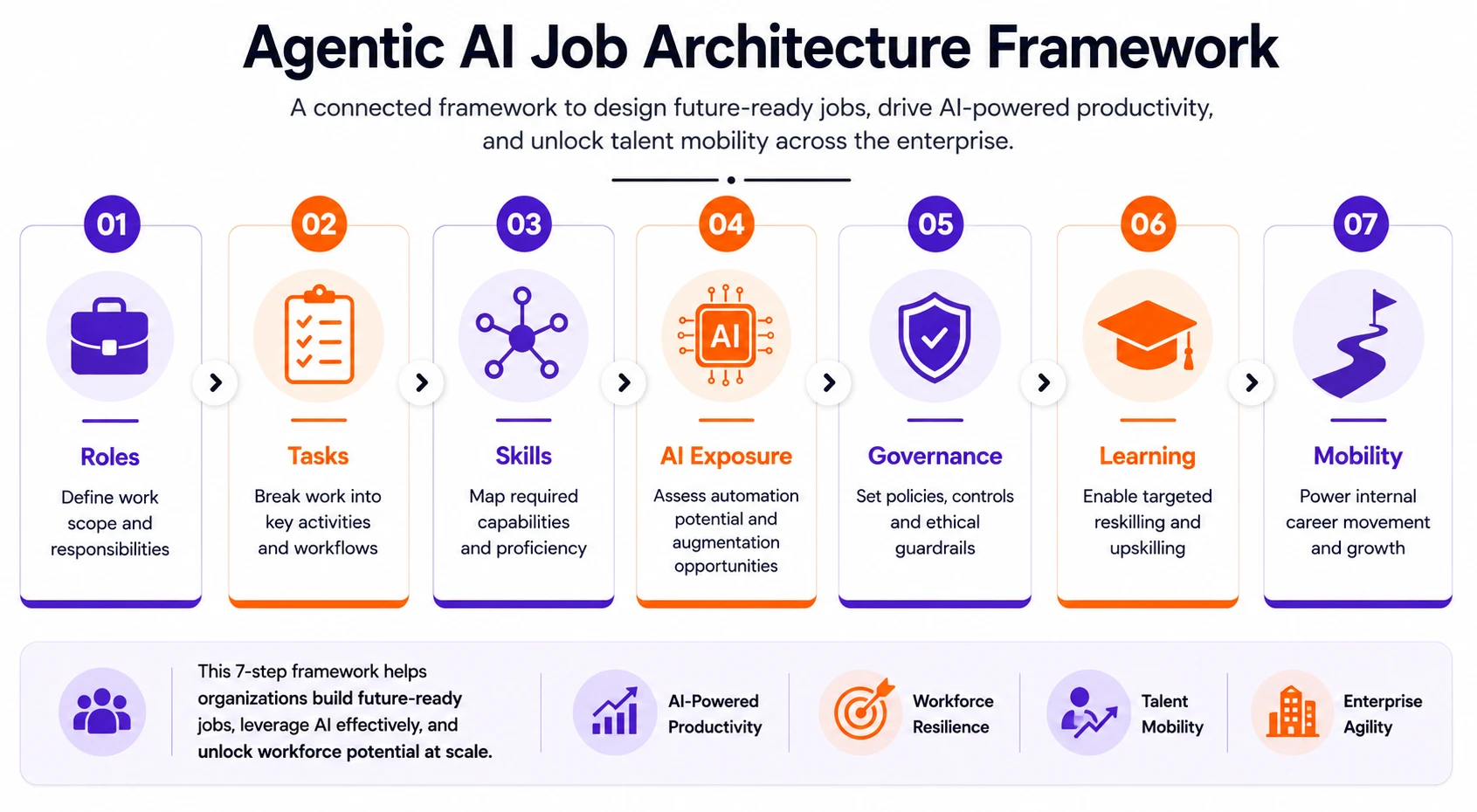
How Does Skills Intelligence Support Agentic AI Job Architecture?
Skills intelligence supports Agentic AI job architecture by giving CHROs a dynamic view of employee capabilities, skill gaps, role requirements, task-level skills, and workforce readiness.
Let us understand in depth how skills intelligence (SI) helps with the efficient creation of Agentic AI job architecture.
- Unified skills visibility: It provides a skills inventory that helps show current, real-time skills data from across roles, teams, and business units, empowering strategic decision-making.
- Task-to-skill mapping: Skill mapping translates to connecting redesigned work or roles to the emerging skills employees need, helping them work efficiently with AI.
- Skill gap analysis: Analysis of skill gaps becomes easier, as it helps identify which AI-era capabilities are missing or underdeveloped, enabling targeted development.
- Proficiency validation: With skills assessment and evidence gained through skills analytics, organizations can confirm if employees can perform new or redesigned work, allowing segregation of employees requiring upskilling and reskilling.
- Internal mobility: SI assists in matching employees to AI-era roles based on current skills and adjacent capabilities, facilitating cross-functional skill implementation and internal mobility.
- Learning alignment: Organizations can build a skills framework that helps them connect skill gaps to targeted upskilling, reskilling, and career pathways, creating customized trajectories for employees to scale operations.
- Workforce planning: SI also significantly supports workforce planning and helps leaders to make recruitment or talent mobility decisions, clarifying where to reskill, redeploy, hire, or redesign work for the best ROI.
What role does iMocha play?
Platforms like iMocha provide Skills Intelligence and Skills Assessment platforms, helping enterprises assess workforce skills, identify capability gaps, and align skill development with evolving role requirements. This helps CHROs move from static job descriptions to task-based workforce planning valid for the Agentic AI era.
Common Mistakes CHROs Should Avoid
CHROs often struggle with Agentic AI job architecture when they treat AI as a technology rollout instead of a work redesign, skills, governance, and workforce planning challenge. As Gartner’s survey earlier conveys, redesigning workflows with AI governance is more beneficial than simply deploying AI tools.
The mistakes that can be avoided:
1. Updating Job Titles Without Redesigning Tasks
Changed titles reflect no actual work changes. As a result, CHROs must focus on task-level redesign, enabling outcomes that evidently showcase results.
2. Treating AI Skills as One Generic Skill
AI is bifurcated into Generative AI and Agentic AI, each requiring different skills to operate them. AI skills are not one generic skill but are divided into the given capabilities: AI literacy, prompt design, agent orchestration, data judgment, and AI governance.
3. Ignoring Human Accountability
Agentic AI can augment tasks and execute workflows, but decision rights, reviewing of responsibilities, and understanding escalation paths need human judgment, emphasizing human oversight and accountability.
4. Relying Only on Self-Reported Skills
Self-reported skills can be incomplete or inflated, and must vary with actual, relevant employee capabilities. AI-era job architecture needs validated proficiency data. Self-reported validation might be unreliable sometimes, impacting authenticity.
5. Leaving L&D Out of Job Redesign
L&D must be involved in the initial stages; this helps learning pathways align with new tasks, proficiency expectations, and career transitions. Leaving L&D out of redesigning might provide inaccurate learning recommendations as skills are not mapped, delaying development.
How Can CHROs Start Building Agentic AI Job Architecture?
CHROs can start building Agentic AI job architecture by piloting task-level role redesign in high-impact functions, mapping skills and AI exposure, and connecting the results to learning, governance, and mobility.
The steps to build the Agentic AI job architecture:
Step 1: Select Priority Roles
Initiate through the roles that are affected by AI adoption, high-volume workflows, critical capability gaps, or transformation goals.
Step 2: Decompose Roles into Tasks
Bifurcate these roles in workflows, decisions, handoffs, tools, and outputs.
Step 3: Map AI Impact
Post the second step, classify tasks as human-led, AI-assisted, AI-augmented, AI-executed, or human-reviewed. This helps map AI impact on tasks, helping understand the requirement of human judgment.
Step 4: Define Required Skills
Moving ahead, identify the skills and proficiency levels needed for the redesigned work. These levels can be considered to assess employees, helping with workforce planning.
Step 5: Build Learning and Assessment Paths
Create targeted upskilling and validation pathways for employees moving into AI-era roles. Building customized journeys allows employees to develop and upskill willingly.
Step 6: Update Career and Mobility Pathways
Connect redesigned roles to internal mobility, succession planning, project staffing, and workforce planning. This updates career journeys based on evolving skills requirements and industrial requirements.
Conclusion
Agentic AI is changing the way work gets done, making it essential for organizations to move beyond static job descriptions and rethink how roles are designed. Building job architecture around tasks, skills, Human-AI collaboration, and governance creates a stronger foundation for the future of work.
CHROs that embrace a skills-based, task-aware approach will be better equipped to close capability gaps, support workforce mobility, and unlock the full value of AI. With the right Skills Intelligence in place, they can confidently guide their workforce through the Agentic AI era.
FAQs
What is job architecture in the agentic AI era?
Job architecture in the agentic AI era is a strategic workforce framework that aligns roles, tasks, skills, and AI collaboration models with business objectives. It enables organizations to redesign work around capabilities and outcomes rather than static job descriptions. This approach supports greater workforce agility, productivity, and talent mobility.
How does agentic AI change job architecture?
Agentic AI transforms job architecture by reshaping how work is assigned, executed, and governed across the enterprise. As AI agents take on increasingly complex tasks, organizations must redefine responsibilities, decision rights, and skill requirements. The focus shifts from managing roles to orchestrating work across humans and AI.
What should CHROs prioritize first when redesigning jobs for AI?
CHROs should begin by analyzing work at the task level to understand where AI can automate, augment, or support execution. This provides the visibility needed to redesign roles, establish governance, and identify future skill requirements. Effective transformation starts with work redesign, not technology deployment.
Why is skills intelligence important for AI-era job architecture?
Skills intelligence provides a reliable view of workforce capabilities, proficiency levels, and emerging skill gaps. It enables organizations to align talent with evolving role requirements, validate workforce readiness, and make informed decisions around workforce planning. This becomes critical as AI accelerates the pace of role transformation.
How can CHROs avoid workforce disruption from agentic AI?
CHROs can minimize disruption by combining job redesign with proactive workforce development. Clear governance, transparent communication, targeted upskilling, and internal mobility pathways help employees adapt to changing responsibilities. Organizations that prepare talent alongside AI adoption are better positioned for sustainable transformation.
What skills will employees need in agentic AI-enabled roles?
Success in AI-enabled roles will require a combination of AI literacy, critical thinking, decision-making, collaboration, and business judgment. As routine execution becomes increasingly automated, employees will be expected to focus on oversight, problem-solving, innovation, and human-centric responsibilities. These capabilities will define workforce effectiveness in the agentic AI era.

