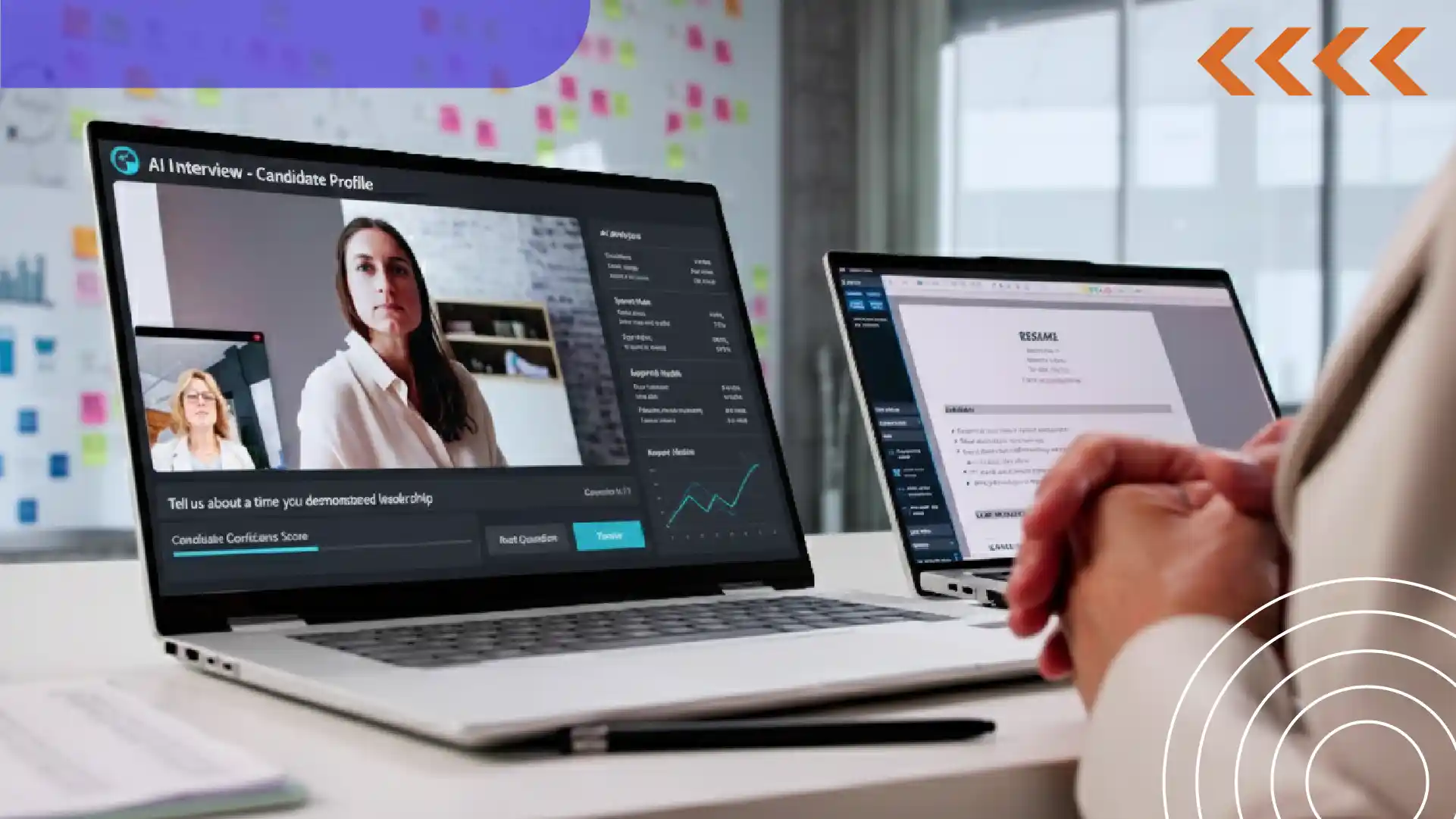
Recruiters today face an extremely competitive talent market. With tasks becoming increasingly complex, HR professionals are forced to hire faster while ensuring uncompromising fairness and quality.
With the talent demand still skyrocketing, the average time to hire across various sectors has increased to 43 days. To combat this issue, industries are rigorously incorporating AI-powered screening interviews. By eliminating the need for first-round evaluations through Natural Language Processing (NLP), Machine Learning (ML), and video/speech analysis, companies can now quickly and consistently identify the best candidates, even with a large number of applicants.
In this post, let’s examine the basics of AI-powered interviews and explore how they work.
What is an AI Screening Interview?
As the name suggests, this interview method facilitates a fully automated, initial evaluation with AI to assess a candidate’s suitability, behavioral patterns, communication skills, and abilities, all without the need for a human interviewer.
Rather than a recruiter asking questions manually, the AI interacts with the candidates through text, audio, or video, and subsequently measures their answers with scoring systems.
Ways of Differentiation from Other Early-Stage Screening Methods
1. Traditional Phone Screens
- Manual scheduling and recruiter time are needed.
- Evaluation rests predominantly on human judgment and subjective perceptions.
- It becomes hard to scale the process when handling high-volume positions.
- AI screening interviews automate the whole process, abolish scheduling, and apply objective, skills-based scoring.
2. One-Way Video Interviews
- The candidates record their replies, but humans still need to review them.
- Recruiter burnout and uneven scoring continue to be an issue.
- Conversely, AI-powered screening interviews automate the analysis of video/audio input, making the entire process faster and more standardized.
3. Chat-Based Assessments
- Typically consists of multiple-choice or chatbot-style question-and-answer formats.
- Limited assessment of behavioral traits, critical thinking, and communication.
- AI-driven interviews scrutinize nonverbal cues, reasoning, and speech and language patterns in depth.
How AI Screening Interviews Work: Technology Behind the Process
AI screening interviews depend on four basic technologies:
- Natural Language Processing: Comprehends what applicants verbally communicate or write, and evaluates factors such as domain knowledge, intent, vocabulary, relevance, and clarity.
- Speech Analysis: Uses voice analysis to measure tone, pace, sentiment, pronunciation, and confidence.
- Behavioral Analysis: Uses audio and video signals to identify patterns of engagement, reasoning style, and communication strength.
- Skill Inference Models: Correlates candidate responses with skill frameworks, such as role-specific competencies, problem-solving, and communication, to generate objective scores.
How AI Screening Interviews Work?
A simple breakdown of the entire process follows:
1. Job Requirement Mapping
The process begins with AI evaluating the job description, the required skills, and the specific competencies the role demands. The following are included in such an evaluation:
- Technical and functional skills
- Behavioral competencies
- Communication abilities
- Experience level
- Domain knowledge
Tools such as iMocha's AI Skills Match assist recruiters in automatically mapping the job description to a validated skills taxonomy, creating a skills blueprint for the role instantly.
2. Format of Candidate Interview
After the role blueprint is created, the system either selects or produces an interview format that is suitable for the job and the type of skill required. The most common formats include:
- Audio Q&A: Suitable for roles that require frequent communication, this method enables candidates to provide their responses via voice recording.
- Conversational AI Calls: Ideal for customer-facing roles, this telephone-based interview allows AI to converse with candidates just as a human interviewer would.
- Chat-Based Interviews: Ideal for roles requiring situational judgment, problem-solving, or writing abilities, where AI uses variable or structured questions through a chat interface.
- One-Way Video Responses: AI analysis of video and audio of candidates’ responses to set questions in real-time.
Every format is developed to create a balance between the candidates' flexibility and the recruiters' efficiency.
3. AI Evaluation
AI, after obtaining the responses, initiates an evaluation of several layers concerned with keywords or surface-level answers.
- Skill-Based Scoring Logic: The AI compares responses with the skills blueprint it created earlier. It seeks:
- Knowledge depth
- Concepts application
- Role preparedness
- Problem-solving method
- Communication & Behavioral Analysis: Through NLP and speech analysis, AI judges:
- Clarity and economy
- Manner, speed, and fluency
- Self-assurance and consistency
- Sensitivity (for customer-oriented jobs)
- Mental organization
- Domain-Specific Question Evaluation: AI verifies technical correctness for areas such as:
- IT and software
- Finance
- Sales
- Customer support
- Healthcare
- Automated Red Flags & Soft-Skill Cues: The system identifies:
- Unclear or off-topic responses
- Uninvolved participants
- Contradictions
- Bad communication cues
- Mismatch with role expectations
This way, recruiters can identify issues early on, without the need for manual screening.
4. Output & Reporting
Now, recruiters finally have a compiled, simplified, and candidate performance report in a snapshot. The report contains:
- Scorecards based on the roles
- Scoring detailed skill by skill
- Insights into the communication and behavior of the candidate
- Automatically performed ranking of candidates
- Recommended next steps for candidates
Since the output is universal, every candidate is assessed by the same standard, enhancing fairness, transparency, and hiring certainty.
Benefits of AI Screening Interviews
Here are the significant advantages of AI screening interviews:
- Efficiency and Speed: Handles the entire first-round screening process, evaluating a large number of applicants in a short time, allowing the company to hire even more quickly.
- Reduced Bias: Limits the influence of human subjectivity by concentrating on skills and responses only, enabling fairer and more equitable hiring decisions.
- Standardized Evaluation: Applies a uniform set of questions and scoring criteria to evaluate each candidate, resulting in a repeatable, objective, and consistent assessment.
- Skills-Based Insights: Links responses to competency frameworks, revealing more profound insights into communication, behavioral, and functional skills.
- Scalability: Capable of conducting thousands of interviews simultaneously in different languages and regions, allowing global hiring teams to cope with high-volume recruitment effortlessly.
- Stronger Compliance Documentation: Generates comprehensive scorecards and audit trails, providing transparent and justifiable hiring decisions.
Best Practices to Implement AI Screening Interviews
Here are the key best practices to follow:
- Start with Clearly Defined Competencies: Use pre-established job capability models and validated skills libraries to articulate precisely what the interview is intended to assess. iMocha’s Skills Taxonomy can help HR teams in mapping role requirements to functional, cognitive, and behavioral skills.
- Choose the Right Interview Format: The interview format should be tailored to the skills and role being evaluated. It could be:
- Video for customer-facing and managerial roles
- Chat for writing or analytical roles
- Audio for communication-heavy positions
- Hybrid formats for multi-skill or leadership evaluations
- Provide Candidates With Clear Guidelines: To create a good candidate experience, be clear. Help candidates by providing:
- Thorough directions
- Model questions
- Tech setup help
- Time to finish the estimation
- Use AI as a Decision Support Tool: Consider recruiters’ input alongside AI score to identify context, fit, and cultural alignment. Use this hybrid technique to ensure fairness and maintain a balanced technology use.
- Monitor Performance Continuously: Regularly review AI models to ensure accuracy and fairness.
How iMocha Supports AI-Driven Screening Interviews
With the help of a skills intelligence platform that pairs automated interviewing with an extensive repository of validated assessments, iMocha has made significant advances in AI-led hiring.
- AI-Powered Evaluation of Technical, Functional & Soft Skills: Uses NLP, skill inference models, and speech analytics to classify participant replies. It evaluates job-specific functional skills, technical problem-solving skills, communication skills, and personality traits, giving a comprehensive, skills-first perspective of each candidate.
- Automated Interview Scoring and Skill Assessments: The Automated Video Interview platform takes AI analysis of video, audio, or text responses a step further, assigning each candidate a score based on the standard criteria used for the interview.
- Seamless ATS Integrations: Seamlessly integrates with all major ATS platforms, enhancing the entire hiring process with a smooth, end-to-end workflow.
- A Library of 10,000+ Validated Skills Assessments: The iMocha library of skills assessments encompasses areas such as technical, functional, cognitive, and soft skills, spanning over 10,000 skills.
- AI Interviewer – Tara: iMocha’s AI interviewer Tara, conducts structured screening interviews, evaluates candidate responses, and helps ensure a consistent and unbiased initial assessment experience.
Conclusion
By automating the first round of evaluations, organizations can reduce time-to-hire, improve decision quality, and ensure fair and objective candidate assessment. As talent needs increase, large companies require scalable solutions that preserve quality without placing a burden on HR teams.
As talent needs increase, organizations are adopting AI hiring trends such as automated screening and skills-based evaluation to scale recruitment without overburdening HR teams.
FAQs
1. What data does the AI analyze?
AI examines candidates’ reactions in various forms, such as video, audio, and text. It uses skill inference models and NLP to evaluate candidates based on the skills, behavior, technical expertise, and language required for the position.
2. How do companies integrate AI screening into their hiring process?
Companies connect AI screening with their ATS, specify competencies, choose the interview format, and automatically evaluate first-round candidates. They also combine AI-generated scorecards with recruiters' judgment in making the final decision.
3. Does AI judge facial expressions or body language?
The latest AI applications may still focus on employees' voices, the way they speak, and their content, rather than on showing people's faces and movements, to prevent bias and ensure that the evaluation is ethical and fair.
4. Are AI screening interviews suitable for senior roles?
Yes, AI screening is beneficial for senior roles, as it evaluates candidates through communication, strategic thinking, and domain-specific knowledge.