Meet iMocha at SAP Connect, Workday Rising, & UNLEASH.
View Events


The Spark Streaming test evaluates candidates' ability to process real-time data streams using Apache Spark's streaming capabilities. It identifies skilled professionals who can handle continuous data ingestion, transformation, and analysis at scale. For hiring managers, this assessment streamlines recruitment by pinpointing expertise in building fault-tolerant streaming applications, ensuring teams deploy efficient, low-latency solutions for big data environments.
Spark Streaming, DStream transformations, checkpointing configurations, real-time data processing, Kafka integration, window operations, stateful stream processing
Spark Developer, Data Engineer, Streaming Architect, Big Data Developer, Analytics Specialist
Proficiency in designing scalable streaming pipelines
Knowledge of micro-batch processing and state management
Experience with fault tolerance and checkpointing mechanisms
Ability to integrate Spark Streaming with external data sources
Understanding of performance tuning for real-time applications
iMocha's Spark Streaming test provides deep insights into candidates' handling of DStreams, window operations, and fault-tolerant processing through scenario-based MCQs and code analysis tasks. It benchmarks against industry standards, helping identify top performers efficiently. With AI-proctored exams, secure browser lockdowns, and anti-cheating measures, it ensures reliable, high-integrity evaluations for streaming expertise.

Choose easy, medium, or tricky questions from our skill libraries to assess candidates of different experience levels.

Choose easy, medium, or tricky questions from our skill libraries to assess candidates of different experience levels.

Choose easy, medium, or tricky questions from our skill libraries to assess candidates of different experience levels.

Choose easy, medium, or tricky questions from our skill libraries to assess candidates of different experience levels.
This comprehensive assessment delves into Spark Streaming fundamentals, evaluating candidates through multiple-choice questions, code snippets, and scenario-based problems. It covers key areas such as creating and manipulating DStreams for data ingestion, applying transformations like map, filter, and join for stream processing, and implementing stateful operations for maintaining context across batches.
Candidates are tested on windowed computations for aggregating data over time intervals, integration with storage systems like HDFS or databases, and handling of exactly-once semantics via checkpointing and write-ahead logs. The test also explores advanced topics like combining streaming with batch data via Spark SQL and optimizing for low-latency with dynamic allocation. By simulating real-world challenges, such as processing high-velocity logs or sensor data, it reveals practical problem-solving abilities.
For organizations, this ensures hires can build robust, scalable streaming architectures that support continuous data flows, reducing latency and enhancing operational efficiency in big data ecosystems.

Wondering what other skills we have?
Checkout world’s largest Skills Assessment Library.

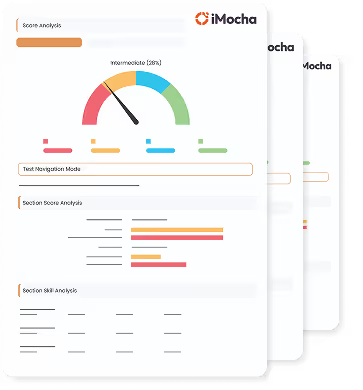
This a comprehensive PDF report, which you can instantly download and share with your hiring team or candidates for seamless collaboration.
Download Sample Report