

When used intellectually, skills data can be helpful in personalizing employee development and growth journeys; it smartly replaces generic, one-size-fits-all training with targeted learning paths built from each employee's validated skills, proficiency levels, and career goals.
With accurate skills data, organizations can close the specific capability gaps that block people from progressing, make internal growth visible, and reduce attrition, ensuring potential talents get a concrete reason to stay and grow.
Skills data connects to the wider disciplines of skills intelligence, workforce planning, internal mobility, and skills gap analysis. Personalization delivers what exactly is required, turning the training budget into a retention lever, thus increasing business efficiency.
Key Takeaways
- Generic training fails to increase retention because it is not tied to any individual's real gaps or ambitions.
- Validated skills data, not self-reported skill lists, is the input that makes personalization accurate.
- Understanding and implementing the six-step loop is vital: baseline, benchmark, gap analysis, learning paths, mobility, and measurement.
- The retention payoffs come through visible internal growth, addressing one of the top reasons high performers leave.
Why L&D spend rarely shows up in retention
For a VP of L&D at a 5,000-person financial services firm, the core problem is that training spend and attrition are being managed as unrelated. The learning catalog is broad, completion rates look healthy, and yet regretted attrition among high-potential employees keeps increasing. Most often this happens because those employees can't see a path forward, finding it easier to grow by leaving.
This problem often begins when skills and learning data remain disconnected across HR, LMS, and talent systems, preventing organizations from connecting training activity with capability growth.
The numbers behind this are consistent across the industry. Gartner has reported that internal hiring is a top priority for most HR leaders, while only a small fraction is effective at it. The gap between intent and execution is almost always a data problem, as leaders still refer to job titles and tenure, not the real view of what people are capable of.
The operational metrics that expose this are: regretted attrition rate, internal fill rate, learning-to-role alignment, and time-to-proficiency. When development is generic, none of the metrics change because the training was never mapped to the gap that mattered.
What does it mean to personalize employee development with skills data?
Personalizing development with skills data means building each employee's learning plan from evidence, their target role's requirements, and where the two diverge. Instead of assigning the same courses to everyone in a job family, fulfill the specific capabilities required to reach a role they want or the business needs.
Organizations can use employee career development tools to turn these skills insights into personalized learning plans, mentoring opportunities, and role-specific development journeys.
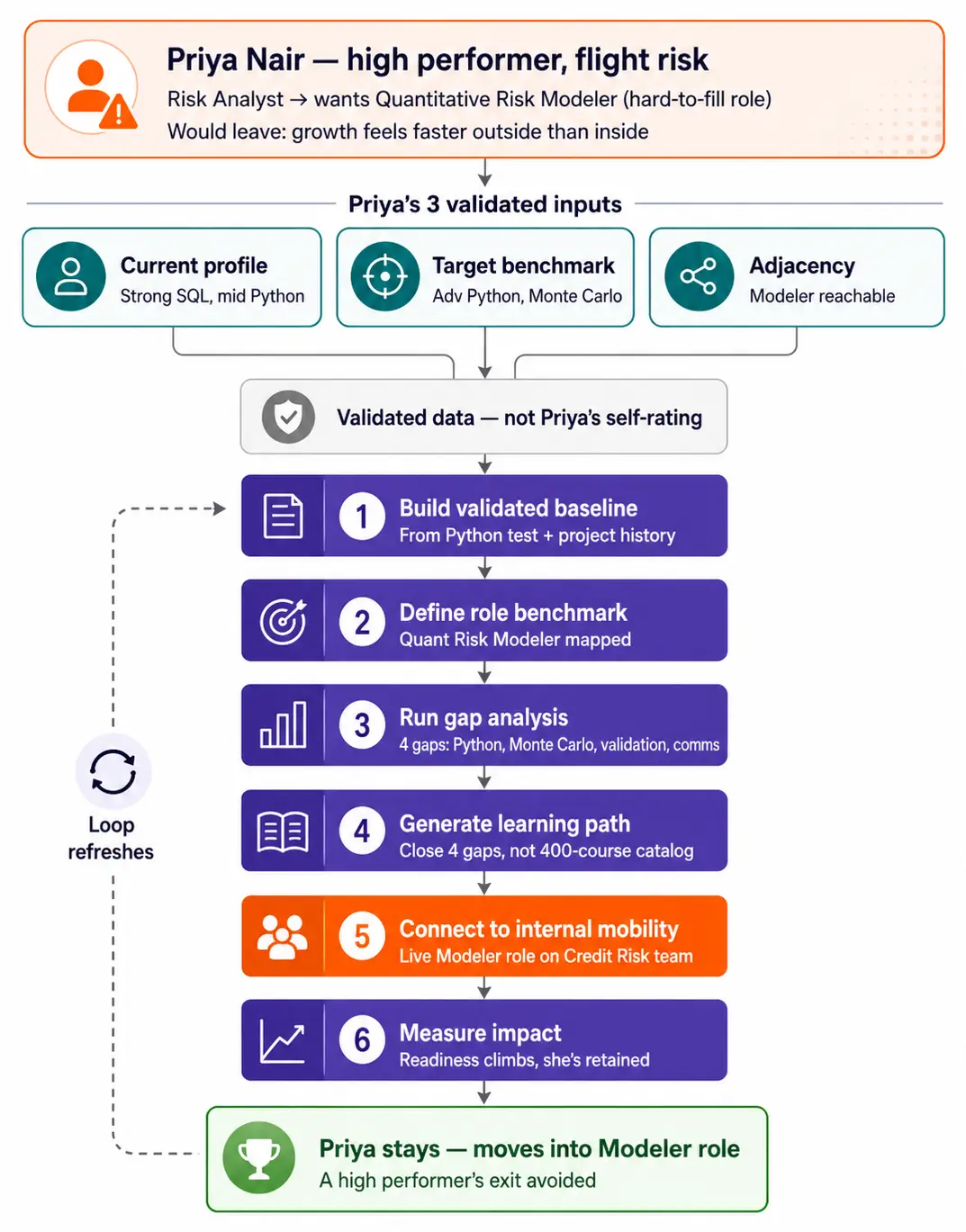
Three inputs make this work:
- A validated profile of the employee's current skills and proficiency
- A clear benchmark of the target role's required skills
- A skill adjacency map that shows nearby roles are within reach
Skills data replaces the static job title with a living picture of capability, enabling development to become genuinely individual rather than generic.
Why does generic L&D fail to reduce attrition?
Generic L&D fails to reduce attrition because it treats development as content consumption rather than career progression. A broad course catalog gives employees something to do, but it does not answer the question that drives retention: "What will be my next role, and how can I reach it?"
High performers leave when growth feels faster outside the organization than inside it. Broad training does nothing to change that calculation; however, targeted, skills-based development does. It ties learning to a visible destination, a promotion, a lateral move, a stretch project, providing the employee with the exact steps to reach it.
How do you use skills data to personalize employee development?
Personalizing development journeys requires running a repeatable six-step loop, where each step turns raw skills data into an individual decision.
Let us know the steps in depth:
1. Building a validated skills baseline
Build each employee’s capability baseline through enterprise skill validation, using evidence such as structured assessments, project history, certifications, and learning outcomes instead of relying solely on self-reported skills. Here's when iMocha's AI skills inference helps validate skill proficiency, assemble, and continuously refresh this baseline, reducing manual work for HR or employees.
2. Defining role and futures skill benchmarks
For each target role, map the required skills and proficiency levels through capability mapping. This provides a skills supply and demand picture: what the workforce has versus what current and future roles require. Also, where targeted development is defined and agile, generic training feels like a race, leading many to find their liking outside the organizations.
3. Running an individual skills gap analysis
Compare each person against the industrial skills requirement benchmark for the role they're growing toward. The output provides a short, specific list of gaps, not a generic development theme. This conveys the precise capabilities standing between the employee and their next opportunity.
4. Generating a personalized learning path
Translate those gaps into a focused sequence of learning tied to the employee's role, proficiency, and stated career goals. The point is precision: bridge the small number of high-impact gaps quickly, rather than spreading effort across a broad catalog.
5. Connecting development to internal mobility
Use skill adjacency to show employees the roles, projects, and career paths that their growing skills make reachable. This step converts development into retention; people stay when the next move is visible and attainable inside the organization. Here's when iMocha's AI internal mobility feature can link skills growth with role opportunities.
6. Measuring impact on engagement and attrition
Track readiness scores, internal fill rate, mobility rate, and regretted attrition over time using skills analytics. This closes the loop and lets you tie L&D investment directly to retention outcomes: the development that leadership wants to see.
Which skills data actually reduces attrition?
Skills data validated through multiple sources reduces attrition, which self-reported skills do not. Employees routinely overstate confidence or underreport capability, so a personalization engine built on self-assessment produces plausible-looking but unreliable learning paths that erode trust rather than building it.
The data that moves retention shares three traits:
- It is validated (drawn from assessments, project work, certifications, and learning history, not survey responses)
- It is proficiency-aware (it distinguishes “aware of Python” from “ships production Python”)
- It is adjacency-rich (it surfaces the related capabilities that make a lateral or upward move realistic)
Together, these turn a skills intelligence platform from a static inventory into a decision system that employees can trust with their careers.
How do you measure whether personalized development is reducing attrition?
Whether or not personalizing development reduces attrition can be measured by tracking regretted attrition against internal mobility and readiness metrics over a rolling period, segmented by the highest-value talent. A single attrition number won't inform whether personalization is working; however, the relationship between metrics will.
Organizations need to look out for these four signals together:
- Regretted attrition among high performers (should fall)
- Internal fill rate (should rise as more roles are filled from within)
- Skill readiness scores (should climb for employees on active learning paths)
- Time-to-proficiency (should shorten as learning gets more targeted)
When development is genuinely personalized, these should move in opposite ways; mobility should increase, and attrition must decrease. If they don't, the likely issue is either data quality (self-reported inputs) or a retention driver that development can't fulfill.
When this approach doesn't apply
Skills data personalizes development and strengthens the growth driver of retention, but it is not a complete retention strategy. If people are leaving primarily over the compensation, management's quality, or burnout, enhanced learning paths will not fix that, and no skills intelligence platform should claim otherwise.
This approach also depends on validated skill signals. If the underlying data is self-reported and unverified, personalization will be inaccurate and can do more harm than good. Here's when iMocha's Skills Intelligence works best as the capability layer on top of the organization's existing HRIS and LMS and does not replace them.
Conclusion
Personalization builds trust and provides motivation to understand employee potential, making it a leading retention lever. So, when skills data is used to personalize employee development, it turns generic training into a retention strategy.
Organizations personalizing career trajectories for their employees will be able to build validated skill baselines, benchmark target roles, close individual gaps with focused learning paths, and make internal growth visible through skill-based mobility.
However, those still following traditional practices might need to build strong strategies to benefit monetarily and enhance overall productivity. Hence, to gain specific capabilities that keep potential talent within the organization, personalization is essential.
FAQs
1. Can skills data really reduce employee attrition?
Yes, indirectly but measurably. Skills data reduces attrition by enabling visible internal growth and mobility, which addresses one of the leading reasons high performers leave. It works when development and internal opportunities are genuine retention drivers in your organization.
2. What kind of skills data do you need to personalize development?
Multi-source validated skills data: structured assessments, project history, certifications, and learning completions combined with proficiency levels and skill adjacency. Self-reported skill lists alone are not reliable enough to build personalized paths on.
3. Is self-reported skills data good enough?
No, it is not. Employees tend to overstate or understate their capabilities, so self-reported data produces inaccurate learning paths. A validated, inferred baseline is what makes personalization trustworthy.
4. How is a personalized learning path different from a generic training plan?
A generic plan assigns the same content to everyone in a role; a personalized path targets the specific gaps between one employee and a defined destination role, sequenced to their proficiency and career goals.
5. How long does it take to see attrition improve?
Readiness and mobility metrics typically move first, within a few quarters of launching targeted paths; regretted attrition is a lagging indicator and is best evaluated over a rolling 12-month window against a clear baseline.
6. Does this replace our LMS?
No, it does not. A skills intelligence layer identifies the gaps and triggers the right learning inside your existing LMS or LXP; it directs the training rather than delivering it. The difference is having the records in systems and actually utilizing them to create an impact.

