Upskilling ROI measures the business value created by learning and development investments compared with the cost of delivering them. It helps organizations understand whether training programs are beneficial in accomplishing their goals or not.
Organizations are investing heavily in upskilling because skills are changing faster than traditional hiring models can support. AI adoption, automation, digital transformation, market shifts, and talent shortages are forcing companies to build more skills internally.
The World Economic Forum’s Future of Jobs Report 2025 states that employers expect 39% of workers’ core skills to change by 2030. The report is based on input from more than 1,000 employers representing over 14 million workers across 22 industry clusters and 55 economies.
And this level of change asks one important question to L&D leaders:
What impact did this training actually create?
Many organizations still track enrollment, completion, attendance, and satisfaction scores. These numbers signal that learning has been completed, but don’t prove whether employees have become more capable yet.
Upskilling ROI does not refer to training completion; rather, it focuses on proving how it has helped improve capability.
Key takeaways
- Upskilling ROI connects learning investments to measurable business outcomes.
- Course completion and attendance do not prove ROI by themselves.
- Strong L&D ROI measurement combines skill improvement, application, business impact, and cost efficiency.
- ROI measurement should begin before training starts, with baseline skills and performance data.
- Skills intelligence helps validate whether employees gained the capabilities needed for current and future roles.
What is upskilling ROI in L&D?
Upskilling ROI is the measurable return an organization gets from investing in employee skill development. It compares the value created by improved workforce capability with the total cost of training, tools, time, and program delivery.
A strong upskilling ROI model looks beyond the training budget. It includes employee learning time, manager coaching time, assessment costs, technology costs, and the effort needed to measure results.
The business value can be financial or non-financial:
- Financial outcomes: They may include reduced external hiring costs, lower turnover costs, improved productivity, faster project delivery, increased revenue contribution, reduced contractor dependency, and lower role-transition costs.
- Non-financial outcomes: These include stronger employee engagement, higher workforce readiness, better succession coverage, faster skill gap closure, improved internal mobility, and greater adaptability during change.
Upskilling ROI is strongest when learning outcomes are tied to business outcomes, not just training activity. For example, a cloud upskilling program should not only report that 500 employees completed training, but also reflect whether they improved cloud proficiency, applied those skills on projects, reduced reliance on external vendors, or filled internal cloud roles faster.
Why are traditional L&D metrics not enough?
Traditional L&D metrics such as enrollment, attendance, completion, learning hours, and satisfaction scores help L&D teams understand program reach and learner participation, but whether employees gained skills, applied them at work, or created business value remains unanswered.
Hence, L&D ROI measurements must go beyond activity metrics. To prove upskilling ROI, it’s vital to connect learning data with skill improvement, on-the-job application, productivity, internal mobility, retention, and workforce readiness.
LinkedIn’s 2025 Workplace Learning Report found that 49% of L&D professionals agree that executives are concerned about employees not having the right skills to execute business strategies. Here’s when L&D ROI measurement helps bridge this gap by connecting learning activity to skill growth, work application, and business impact.
What is the 5-layer L&D ROI measurement framework?
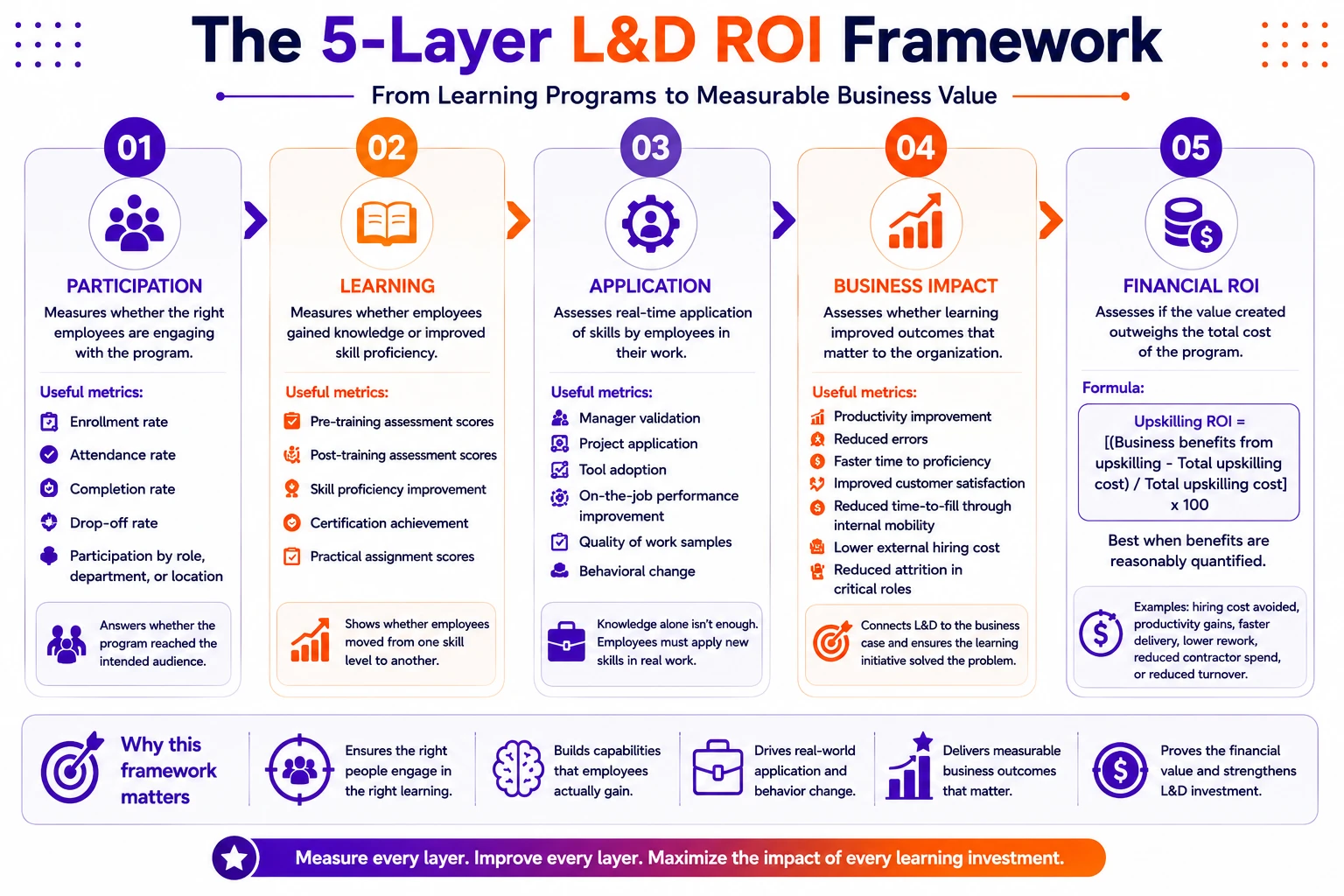
A strong L&D ROI measurement model should track five layers of impact: participation, learning, application, business impact, and financial ROI.
This framework helps L&D leaders move from “people attended training” to “the business gained measurable capability.”
The 5-layer framework:
1. Participation
Participation measures whether the right employees are engaging with the program.
Useful metrics: Enrollment rate, attendance rate, completion rate, drop-off rate, and participation by role, department, or location.
This layer answers whether the program reached the intended audience. Low participation may show that the program is poorly timed, poorly positioned, or not relevant to the target group.
2. Learning
Learning measures whether employees gained knowledge or improved skill proficiency.
Useful metrics: Pre-training assessment scores, post-training assessment scores, skill proficiency improvement, certification achievement, and practical assignment scores.
This is where upskilling ROI starts to become more meaningful. It shows whether employees moved from one skill level to another.
3. Application
Application is the layer where organizations can comprehend the real-time application of skills by employees in real work.
Useful metrics: Manager validation, project application, tool adoption, on-the-job performance improvement, quality of work samples, and behavioral change.
This layer is important because knowledge gained alone does not guarantee performance improvement. Employees need opportunities to apply new skills in their roles, projects, or internal mobility pathways.
4. Business impact
Business impact assesses whether learning improved the outcomes that matter to the organization.
Useful metrics: Productivity improvement, reduced errors, faster time to proficiency, improved customer satisfaction, reduced time-to-fill through internal mobility, lower external hiring cost, and reduced attrition in critical roles.
This helps connect L&D to the business case, ensuring whether the learning initiative has solved the original problem.
5. Financial ROI
Financial ROI assesses if the value created outweighs the total cost of the program.
Use this formula:
Upskilling ROI = [(Business benefits from upskilling - Total upskilling cost) / Total upskilling cost] x 100
This formula works best when benefits can be reasonably quantified.
Examples include hiring cost avoided, productivity gains, faster project delivery, lower rework, reduced contractor spend, or reduced turnover.
What costs should be included in upskilling ROI?
A realistic upskilling ROI model should include the full cost of designing, delivering, measuring, and supporting the program, along with the business benefits the program is expected to create. A complete cost model gives L&D leaders a more honest view of ROI. It also makes the final business case more credible during budget reviews.
Costs to include:
What benefits should be measured in upskilling ROI?
Upskilling ROI should measure benefits that connect directly to the business goal of the program. LinkedIn’s Workplace Learning Report 2025 reports that 88% of organizations are concerned about employee retention and want to prioritize providing learning opportunities as the top retention strategy among organizations having strong learning cultures.
Benefits to measure:
The strongest ROI stories connect learning to both capability and business value. For example, an analytics program may improve employee proficiency, reduce reporting delays, and lower dependence on external analysts.
How do you measure upskilling ROI step by step?
Organizations can measure upskilling ROI by starting with a business problem, defining target skills, establishing a baseline, measuring skill improvement, tracking application, and converting outcomes into business value.
The process should start before training begins. Without baseline data, L&D teams cannot show what changed.
Step 1: Start with the business problem
Defining the business issue helps to understand what the upskilling initiative is meant to solve.
The following questions must be answered:
- What business outcome are we trying to improve?
- Which roles or teams are affected?
- Which skills are missing?
- What will happen if we do not close this gap?
- How will we measure success?
For example, “improve digital skills” is a broad claim while “reducing reporting delays by improving data visualization and analytics skills in the operations team” is easier to measure.
Step 2: Define target skills and baseline
Defining the specific skills that employees must develop and measuring the current state before training begins is crucial.
Baseline data to be measured:
- Current skill proficiency
- Current performance level
- Current productivity
- Current error rate
- Current internal mobility rate
- Current hiring cost
- Current attrition rate
This step creates a comparison point that helps L&D teams prove whether the program changed capability, performance, or business outcomes.
Step 3: Run targeted learning interventions
Running learning interventions that are directly connected to the skill gaps and business outcomes is a vital step.
Examples include:
- Role-based learning paths
- Skills academies
- Simulations
- Project-based learning
- Mentoring
- Coaching
- Certifications
- Internal gigs
- Stretch assignments
Targeted interventions usually produce clearer ROI than generic programs because the learning is tied to a defined capability need.
Step 4: Measure skill improvement and application
This step critically assesses whether employees improved and applied the skill in their real work after training.
The metrics that help measure it:
- Pre- and post-assessment
- Practical assignment
- Role simulation
- Manager validation
- Peer review
- Work sample evaluation
- Tool adoption
- Project application
This step helps L&D teams avoid a common measurement mistake: assuming that learning equals application.
Step 5: Convert outcomes into business value and report ROI
Converting performance improvements into business value wherever possible showcases results being delivered through real-time application of skills.
The final report should include both the ROI percentage and the capability story behind it. Business leaders need the numbers, but they also need to understand what has changed in the workforce.
What is an example of an upskilling ROI measurement?
A practical upskilling ROI example can show how learning costs, business benefits, and financial return connect. For example, a company launches a data analytics upskilling program for 200 operations employees to reduce dependency on external analysts and improve reporting speed and faces the following program costs and benefits.
Program costs:
Business benefits:
ROI calculation:
Upskilling ROI = [($320,000 - $155,000) / $155,000] x 100
Upskilling ROI = 106%
Though the number is useful, the deeper insight is that the organization also increased internal capability, reduced external dependency, improved reporting speed, and strengthened workforce readiness. That’s the difference between a training report and an L&D ROI measurement story.
How does skills intelligence improve L&D ROI measurement?
Skills intelligence improves L&D ROI measurement by helping organizations validate employee skills before and after training, track proficiency improvement, and connect learning outcomes to workforce planning decisions.
Let us understand the ways skills intelligence is beneficial for organizations.
- It helps L&D teams have an accurate baseline. Instead of estimating skill levels through job titles or self-reported data, teams can use skills assessments and validated skill profiles.
- Skills intelligence also helps perform skills gap analysis, which helps identify skill gaps that need to be closed, allowing L&D leaders to prioritize investments based on workforce planning, business risk, and future capability needs.
- Pre- and post-assessments show measurable capability improvement by providing skills analytics that give authentic data.
- Skill adjacency data helps identify employees who may be ready for internal mobility after training by implementing cross-functional skill implementation.
- Workforce readiness dashboards can show whether L&D is reducing business risk by improving critical skill coverage or increasing the number of employees ready for priority roles.
- Connected skills data also helps report impact beyond completion rates. It links learning to skill gap analysis, internal mobility, workforce planning, and succession coverage.
Where do platforms like iMocha fit?
A skills intelligence platform like iMocha can help organizations validate employee skills, identify skill gaps, measure proficiency improvement, and connect upskilling programs to workforce planning outcomes.
For L&D leaders, this helps answer the business question more clearly: Did this program build the capabilities the organization needs?
For HR and workforce planning teams, it helps assess employees through its Skills Assessment platform to show which employees are ready for future roles, which gaps remain, and which investments are creating measurable workforce value.
What are the common mistakes in measuring upskilling ROI?
Upskilling ROI measurement often fails when organizations track learning activity without baseline data, business alignment, skill validation, or evidence of on-the-job application.
The mistakes that can be avoided:
1. Measuring completion instead of capability
Course completion shows that employees finished training, but it does not prove that they gained or applied the required skills. Strong L&D ROI measurement tracks proficiency improvement, applied skill use, and business impact.
2. Starting measurement after training ends
ROI measurement must begin before the program starts. Without baseline data in the initial stage, L&D teams might be unable to show how much skill proficiency, productivity, or performance improved.
3. Choosing generic training goals
Broad goals like enhancing digital skills are hard to measure. Hence, strong ROI measurement needs specific target skills, affected roles, baseline data, and business outcomes.
4. Ignoring skill application at work
Assessment scores are useful, but ROI depends on whether employees apply new skills in real work. Manager validation, project outcomes, tool adoption, and performance data help prove application.
5. Leaving out hidden costs
Program costs include more than content and technology. Employee learning time, manager coaching time, assessments, administration, and reporting should be included for a realistic ROI view.
6. Overclaiming attribution
Business outcomes are influenced by many factors. As a result, L&D teams should be honest about attribution and show reasonable links between the program, skill improvement, and business results.
What upskilling ROI does not measure perfectly?
Upskilling ROI does not always capture every long-term benefit of learning. Some outcomes, such as employee confidence, adaptability, leadership readiness, and a stronger learning culture, may take more time to appear in financial results.
ROI also does not prove causation by itself. Productivity, retention, and performance can be influenced by market conditions, manager quality, workload, compensation, and business strategy. This does not make ROI measurements less useful. It means L&D teams should combine financial ROI with skills data, business metrics, and a clear explanation of assumptions.
A transparent ROI model is more useful than an inflated one. It helps business leaders understand where learning created value, where assumptions were used, and where more data is needed.
Conclusion
Upskilling ROI helps HR and L&D leaders prove that learning investments are building real workforce capability. Organizations must move beyond completion rates and satisfaction scores; they must define business outcomes, establish skill baselines, measure improvement, validate application, and connect learning results to productivity, mobility, retention, and workforce readiness.
The strongest L&D ROI measurement approach combines skills data with business data, providing leaders with a clearer view of which programs are working and how learning investments are preparing the organization for future skill needs.
FAQs
How long does it take to see ROI from upskilling programs?
Some ROI signals, such as assessment gains and skill gap closure, can appear within weeks. However, business outcomes like productivity improvement, internal mobility, and retention usually take several months to measure.
What role do managers play in measuring upskilling ROI?
Managers help validate whether employees are applying new skills at work. Their feedback adds context to assessment scores, project outcomes, behavior change, and readiness for new responsibilities.
Why is L&D ROI hard to measure?
L&D ROI is hard to measure because learning outcomes, business performance, and employee behavior are influenced by many factors. It becomes easier when teams define baseline data, target skills, success metrics, and business outcomes before training starts.
What is the difference between learning metrics and ROI metrics?
Learning metrics track activity and progress, such as completion, attendance, assessment scores, and learning hours. ROI metrics connect learning to business value, such as productivity gains, reduced hiring costs, skill gap closure, internal mobility, and retention.
How does technology support measuring L&D ROI?
Technology supports L&D ROI measurement by connecting skills assessments, learning records, proficiency data, performance signals, and workforce planning insights. This helps teams track development from baseline to business impact.
How often should organizations measure L&D ROI?
Organizations should measure L&D ROI at key stages: before training, immediately after training, after on-the-job application, and after business outcomes have had time to appear. Quarterly reviews work well for most strategic upskilling programs.