

Workforce segmentation is the process of grouping employees based on shared attributes such as skills, roles, business impact, performance, or geography to improve workforce planning and talent decisions.
As organizations adopt skills-based workforce strategies, workforce segmentation has become essential for identifying skill gaps, improving internal mobility, optimizing talent allocation, and preparing for future workforce demands. Instead of managing employees as a single workforce group, businesses can use segmentation to create targeted hiring, learning, engagement, and retention strategies for different talent segments.
In this guide, we’ll explore the key types of workforce segmentation, implementation strategies, real-world examples, and how organizations can use skills intelligence to build a more agile and future-ready workforce.
Key Takeaways
- Workforce segmentation categorizes employees into groups based on shared characteristics, improving communication, engagement, and productivity.
- Implementing effective segmentation aligns employee efforts with organizational goals, optimizing resource usage and enhancing retention.
- Adopting best practices, like ensuring actionable differences and continuously adapting strategies, is vital for successful segmentation.
Why Workforce segmentation is Important?
Workforce segmentation is crucial for aligning employee contributions with organizational goals, ensuring efforts are directed toward shared targets. By organizing employees into specific segments, companies can tailor workforce planning to meet business needs, enhancing effectiveness.
Segmenting employees provides insights into trends that boost satisfaction and loyalty. Understanding the distinct needs of different segments allows for efficient resource allocation, maximizing time and financial investments.
This targeted approach ensures strategies significantly impact specific workforce groups, increasing productivity and retaining high-potential employees, which is vital for long-term success.
Key Methods of Workforce Segmentation
Workforce segmentation helps organizations group employees based on shared characteristics, skills, or business needs to improve workforce planning and talent management.
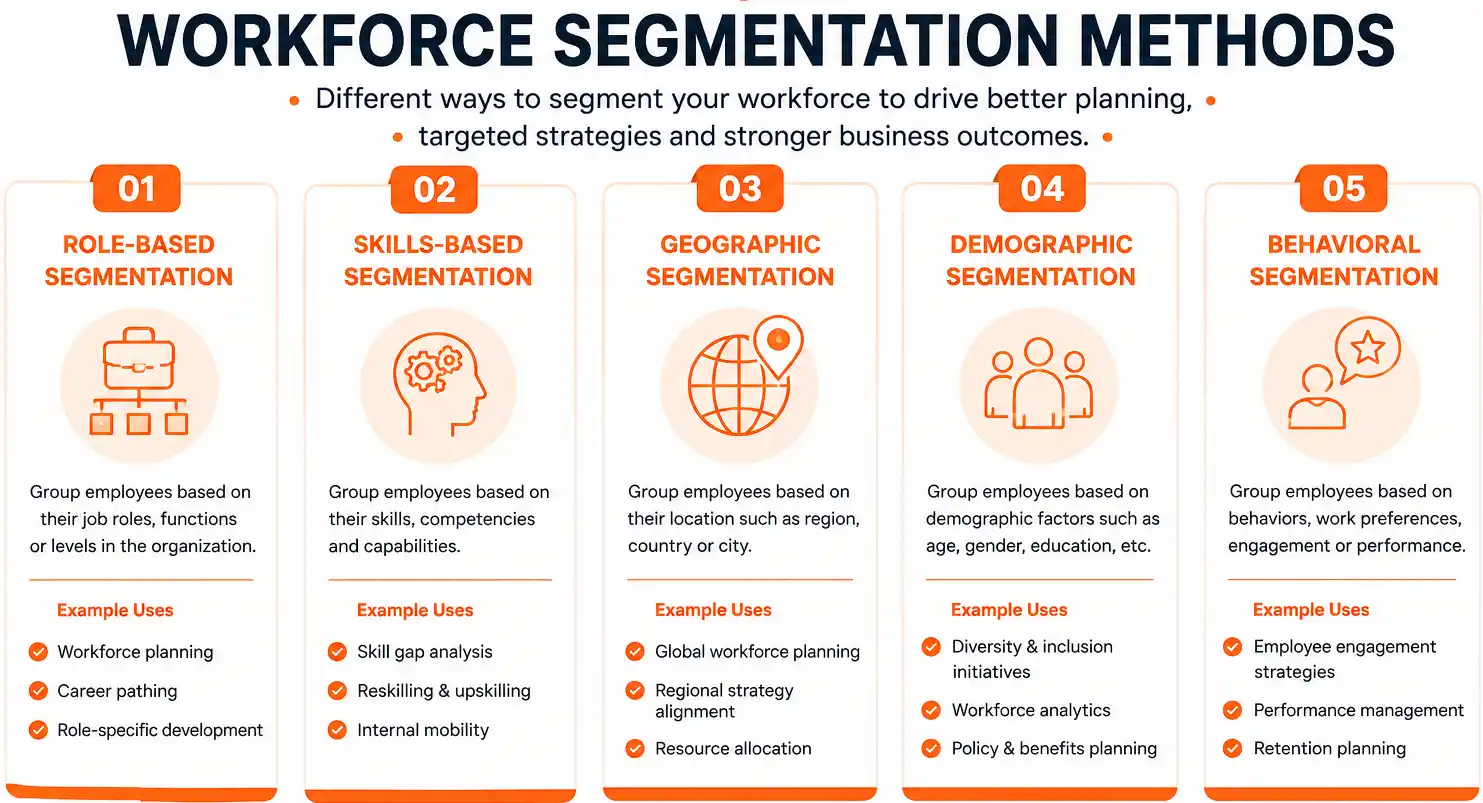
1. Role-Based Segmentation
Groups employees by job functions or departments such as engineering, sales, or leadership to align workforce capabilities with business goals.
2. Skills-Based Segmentation
Categorizes employees based on skills, certifications, or expertise to identify skill gaps, support reskilling, and improve internal mobility.
3. Geographic Segmentation
Organizes employees by region, office location, or remote work structure to address local workforce requirements and operational differences.
4. Demographic Segmentation
Segments employees by factors such as age, tenure, or career stage to personalize engagement and workforce development strategies.
5. Behavioral Segmentation
Groups employees based on work styles, engagement patterns, or collaboration preferences to improve employee experience and workforce communication.
Strategic Workforce Segmentation Frameworks for Enterprises
Modern enterprises use advanced workforce segmentation frameworks to improve workforce planning, talent mobility, and long-term business agility. These frameworks help organizations combine workforce analytics, skills intelligence, and business priorities to make more strategic talent decisions.
1. Critical Workforce Segmentation
Critical workforce segmentation identifies employees in roles that have a direct impact on business continuity, operational stability, innovation, or revenue generation.
Organizations use this framework to:
- reduce succession risk
- protect institutional knowledge
- identify workforce vulnerabilities
- prioritize critical talent investments
- strengthen business continuity planning
For example, organizations may classify cybersecurity specialists, senior engineers, or leadership roles as critical workforce segments due to their strategic business impact.
2. Skills-Based Workforce Segmentation
Skills-based workforce segmentation groups employees according to verified skills, proficiency levels, certifications, and future-ready capabilities.
Organizations use this framework to:
- identify current and future skill gaps
- prioritize upskilling and reskilling initiatives
- improve internal mobility
- support workforce transformation
- align workforce capabilities with business demands
For example, organizations undergoing digital transformation may segment employees based on AI, cloud, or data analytics skills to identify future talent pipelines and reskilling opportunities.
3. Business Impact Segmentation
Business impact segmentation categorizes employees based on their contribution to strategic business goals, operational performance, and organizational growth.
Organizations use this framework to:
- identify high-impact workforce segments
- prioritize strategic talent investments
- align workforce capabilities with business priorities
- improve workforce allocation
- support long-term workforce planning
For example, organizations may prioritize workforce segments involved in digital transformation, product innovation, or revenue-generating functions due to their direct influence on business performance.
4. Performance and Potential Segmentation
Performance and potential segmentation groups employees according to performance outcomes, leadership readiness, growth trajectory, and future business impact.
Organizations use this framework to:
- identify high-potential employees
- strengthen leadership pipelines
- personalize employee development
- improve succession planning
- optimize leadership investments
For example, organizations may identify employees with strong performance and adjacent leadership capabilities for accelerated career development or strategic internal mobility programs.
5. Workforce Mobility Segmentation
Workforce mobility segmentation identifies employees based on adaptability, redeployment readiness, and internal mobility potential across roles, projects, or business functions.
Organizations use this framework to:
- improve workforce agility
- optimize talent deployment
- accelerate internal mobility
- reduce external hiring dependency
- support dynamic workforce planning
For example, organizations may identify employees with transferable digital or cross-functional skills who can transition into emerging business-critical roles through targeted reskilling initiatives.
Benefits of Workforce Segmentation
- Improved Workforce Planning: Workforce segmentation helps organizations identify capability gaps, forecast future talent needs, and align workforce strategies with business objectives.
- Better Internal Mobility: Organizations can match employees to new roles, projects, and career opportunities based on skills, performance, and mobility readiness.
- Optimized Resource Allocation: Segmentation enables organizations to allocate talent, budgets, and workforce resources more effectively across business functions and strategic priorities.
- Stronger Employee Engagement: Organizations can create more personalized communication, rewards, and career development strategies for different workforce groups, improving employee experience and retention.
- Smarter Workplace Management: Organizations can develop more effective workplace policies, collaboration models, and employee support strategies across remote, hybrid, and in-office teams.
Steps to Implement Workforce Segmentation
The implementation involves identifying key factors, gathering data, analyzing employees, developing strategies, and monitoring segmentation.
1. Identify Key Factors
Pinpoint critical elements for categorizing employees through an employee attribute analysis. Focus on job roles, skill sets, experience levels, and locations to align with objectives.
Ensure segments are substantial and reachable through existing communication channels. Classifying employees by location can optimize outcomes for varied work arrangements.
2. Gather Workforce Data
Collect workforce data from employee surveys, performance evaluations, and HR systems. Accurate data is essential to avoid complex analysis due to inaccuracies.
Utilize diverse sources for insights. Correctly gathering data sets a strong foundation for effective segmentation.
3. Analyze and Categorize Employees
Organize employees into clusters by identifying patterns and influential variables. Assign individuals to segments based on attributes, sorting by expertise and proficiency.
Insight into employee dynamics and data interpretation is crucial for devising specialized strategies tailored to each group’s needs.
4. Develop Targeted Strategies
Formulate strategies for distinct segments to boost engagement and performance. Segmenting by skill sets identifies training needs and development plans.
Align approaches with company objectives. Implement targeted interventions for high-potential employees to aid retention and foster loyalty.
5. Monitor and Adjust Segmentation
Review and adjust segmentation strategies to remain relevant. Assess performance and modify to align with organizational objectives and employee needs.
Overcoming Workforce Segmentation Challenges
Implementing workforce segmentation can be complex, especially in large or rapidly evolving organizations. Below are some common challenges organizations face and how they can address them effectively.
- Inaccurate Workforce Data: Incomplete or outdated workforce data can reduce segmentation accuracy and impact workforce planning decisions.
- Limited Skills Visibility: Many organizations lack clear visibility into employee skills, making it difficult to identify capability gaps and future workforce needs.
- Resistance to Change: Employees may perceive workforce segmentation as restrictive or biased if communication and implementation are not handled transparently.
- Over-Segmentation: Creating too many workforce categories can complicate talent management and reduce the effectiveness of workforce strategies.
- Rapidly Changing Workforce Needs: Evolving technologies and business priorities can quickly make workforce segments outdated, requiring continuous workforce analysis and updates
Real-world Examples
Life Stages
Categorizing employees by generations, such as Millennials, Gen X, and Baby Boomers, helps tailor approaches to their unique demands. Baby Boomers value job security, Gen X seeks work-life balance, and Millennials prioritize meaningful tasks and collaboration. Despite differences, overlapping interests allow for universal development opportunities.
Work Styles
Segmenting employees by preferred work environments—team-based or independent—enables customized workspaces and policies. Some thrive in dynamic settings, others in consistent roles. Recognizing these preferences enhances productivity and satisfaction.
Engagement Levels
Dividing employees by engagement levels identifies those highly engaged, moderately engaged, or disengaged. Using engagement metrics helps detect burnout early and tailor support. Regular surveys assess commitment and well-being, guiding strategy adjustments
Summary
Workforce segmentation is a strategic tool that boosts employee engagement and productivity by categorizing employees into distinct segments based on shared traits. This enables tailored strategies that meet each group's unique needs.
Tools like iMocha's skills intelligence platform provide insights into employee skill sets, helping identify gaps and enhance workforce planning. By leveraging such data, businesses can align development opportunities with their objectives.
In summary, effective workforce segmentation involves identifying key factors, analyzing workforce data, and developing targeted interventions. Regularly monitoring and adjusting these strategies ensures an inclusive and high-performing work environment.
Frequently Asked Questions
What is a workforce segmentation model?
The segmentation models categorize employees into distinct groups based on shared characteristics, such as job roles or skills, to tailor strategies that boost engagement, productivity, and alignment with organizational goals.
What is the most popular method for workforce segmentation?
Role-based segmentation is the most popular method, as it aligns employees with specific job functions, enhancing efficiency and productivity by ensuring the right skills match the right roles.
What role does technology play in workforce segmentation?
Technology facilitates workforce segmentation by providing tools for data collection, analysis, and communication, enabling organizations to efficiently categorize employees and tailor strategies to meet their unique needs.

