
In the past 12 months, the share of employees with access to sanctioned AI tools has jumped by 50%(1). AI investment is increasing across every sector, and 78% of leaders report greater confidence in the technology(1). By every visible measure, enterprise AI has arrived.
Yet, according to Deloitte's State of AI in the Enterprise 2026-a survey of 3,235 business and IT leaders across 24 countries-only one in three companies agree that AI is genuinely transforming their business(1). Most are using AI only to accelerate existing work, rather than driving fundamental change.
That gap between AI access and AI activation - is the defining enterprise challenge of the next two years. The tools are deployed. The licenses are purchased. The training is scheduled. However, the work itself appears remarkably similar to its previous state, with the same job descriptions, roles, and organization charts remaining.
The core issue isn't technology itself. It’s that organizations have yet to redesign work around it.
The real bottleneck isn't technology; it's the work/job designed around it.
Here's the most uncomfortable number in the Deloitte report:
82% of leaders expect AI to automate at least 10% of jobs within three years. However, 84% of companies have not redesigned a single role to leverage AI capabilities(1).
That's not a small disconnect. It's an entire strategy hiding in plain sight.
When organizations layer AI on top of legacy job structures, they get incremental productivity, which is real but limited. The reason is structural: AI is being asked to optimize jobs that were never designed for a human-plus-AI workforce.
Even when leaders see the need, the pace of change is slow. While 53% of organizations have considered moving toward pod-based, non-hierarchical models better suited to AI-augmented work; only 16% have actually made the shift(1).
The first wave of AI adoption is rewarded with access. The next wave will reward redesign. And redesign starts not with technology decisions, but with workforce decisions.
Skills: the lowest-scoring pillar of AI readiness
When Deloitte asked leaders how prepared their organizations were across five capability areas, the results revealed a sharp asymmetry:
- AI strategy: 42% feel highly prepared
- Technical infrastructure: 43%
- Data management: 40%
- Risk and governance: 30%
- Talent and Skills: 20%
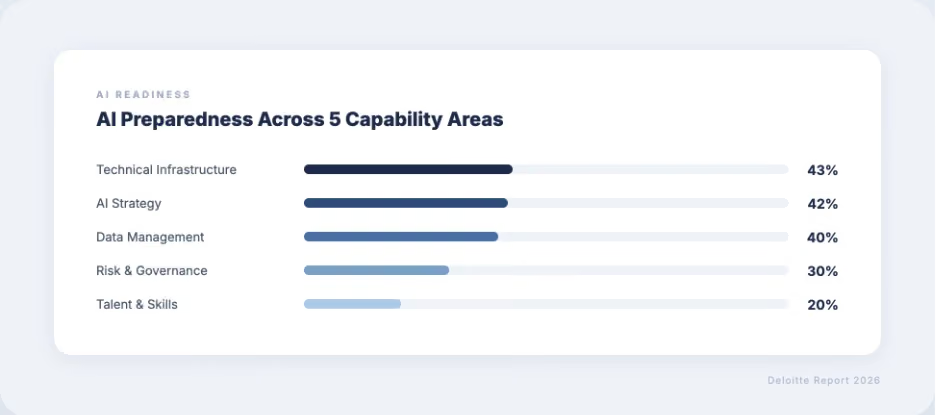
Talent isn't just the lowest-scoring area; it's the area leaders themselves cite as the single biggest barrier to integrating AI into how work actually gets done.
Most organizations are spending their efforts on:
- 53% are educating their broader workforce to raise AI fluency
- 48% are running upskilling and reskilling initiatives.
- Only 33% are redesigning career paths.
- Only 30% are forecasting future skill supply and demand. Only 30% are reshaping the organization itself(1).
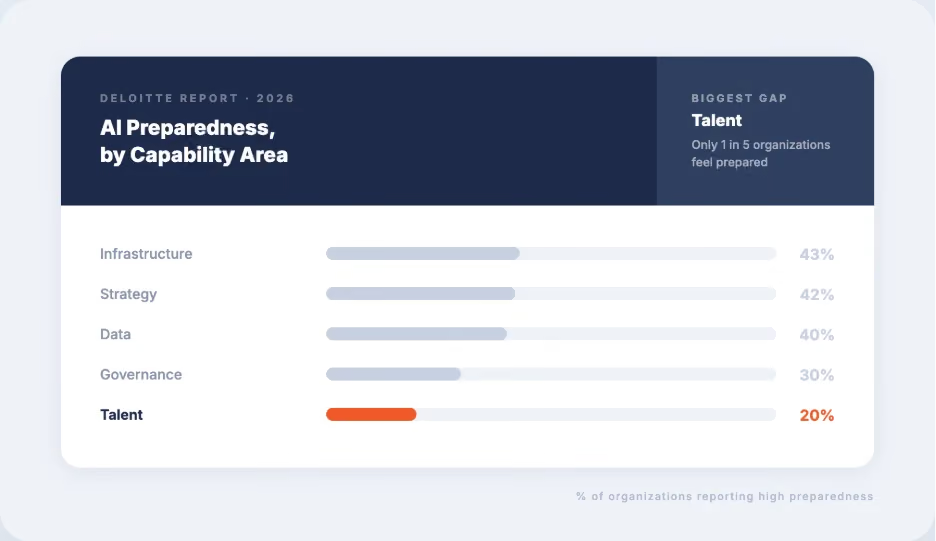
In other words, most companies are treating an AI workforce problem as a training problem. Training matters - but it can't tell you which roles are most exposed to AI, which tasks should be automated versus augmented, or which employees are ready to supervise autonomous agents. Those are work intelligence questions, and they need work intelligence answers.
Before redesigning roles and tasks, organizations can use the AI Readiness Index to benchmark demonstrated AI capabilities across the workforce and identify role-specific readiness gaps.
The missing layer: Work Intelligence
If access is the first wave of enterprise AI and activation is the second, work intelligence is the layer that connects them.
Most organizations today still ask the wrong question: Which jobs will AI replace? That framing is too coarse. Jobs are bundles of tasks - some routine, some creative,
some interpersonal, some heavy judgments. A useful workforce strategy doesn't operate at the job level. It operates at the task level.
That's the shift workforce intelligence enables. Instead of asking which jobs are at risk, organizations can ask:
But not all tasks are equal. Before deciding what to automate or augment, organizations need to understand which tasks are most critical to business outcomes. A work intelligence approach maps the full task landscape of every role - identifying high-volume, high-stakes, and high-exposure tasks - so leaders can prioritize where automation delivers the most value and where human judgment must be preserved.
Task intelligence provides this task-level visibility by helping organizations evaluate work based on effort, frequency, complexity, required skills, business value, and AI exposure. Without this clarity, AI adoption remains reactive rather than strategic.
Which tasks in this role can be AI-led - executed end-to-end by agents?
Which tasks should be AI-assisted - augmenting human judgment?
Which tasks must remain human-led - protecting decision quality, trust, or oversight?
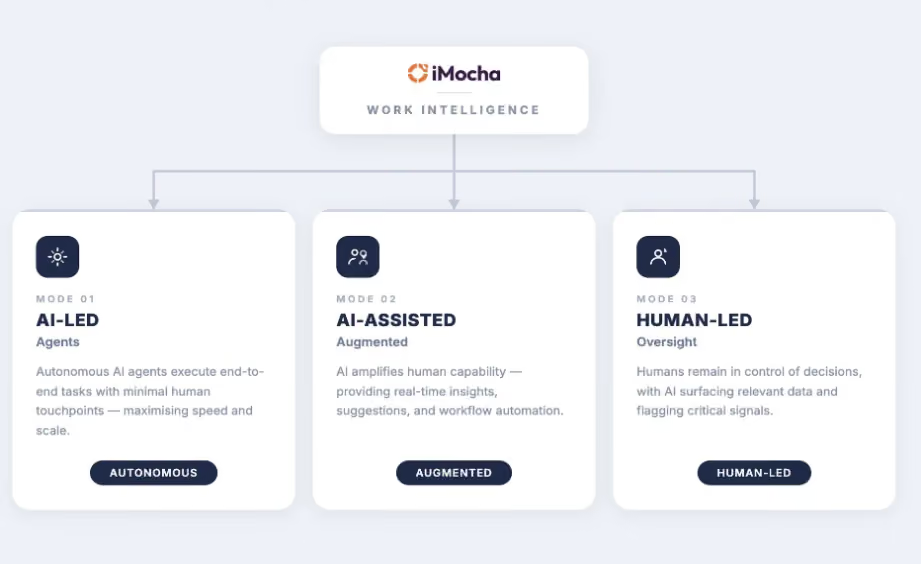
That single shift reframes every downstream decision. Instead of asking which roles to backfill, organizations can ask which tasks are being done today, which of those should be automated, which should be augmented, and which require human judgment to remain human-led. Work becomes the unit of analysis - not the job title, not the org chart. Reskilling becomes targeted, not generic. Career paths become navigable, not theoretical. Governance becomes designed in, not bolted on - which matters increasingly as agentic AI scales.
This is what iMocha's Work Intelligence is built to deliver: a structured, evidence-based
view of how every role in the organization is changing, what skills the workforce has today, how tasks are currently distributed across AI-led, AI-assisted, and human-led work, and where each task should sit as AI capabilities evolve - task by task, role by role.
What forward-looking enterprises are doing differently
The enterprises closing the access-to-activation gap aren't necessarily the ones with the biggest AI budgets. They're the ones treating AI transformation as an organizational problem, not a technology one.
In practice, that means three things:
- Mapping work at the task level - making the invisible structure of every task visible, so the AI conversation can be specific instead of speculative.
- Validating skills, not assuming them - replacing self-declared skill data and outdated job descriptions with assessed, evidence-based proficiency data.
- Designing governance into the workforce - defining now, while agentic AI is still nascent, which tasks require human approval, which can be AI-supervised, and which employees are equipped to do the supervising.
Together, the above capabilities are the difference between organizations that buy AI and organizations that transform with it. Real competitive strength lies in anticipating the evolution of work and preparing for those shifts ahead of the curve.
Source: (1) Deloitte State of AI in the Enterprise 2026

