Building workforce resilience across a large organization requires more than responding to disruption or launching isolated training programs. HR and L&D leaders need reliable skills data, clear capability priorities, scalable reskilling pathways, and processes that connect employees with emerging roles and business needs.
Workforce resilience, also referred to as workforce resiliency, is an organization’s ability to adapt its people, skills, roles, and workforce plans while maintaining performance during disruption.
This guide focuses on how organizations can operationalize workforce resilience at scale using the 5C framework: Clarify, Capture, Compare, Create, and Connect.
Key Takeaways
- Building workforce resilience at scale requires connected skills data, workforce planning, reskilling, and internal mobility, not isolated HR initiatives.
- The 5C framework, Clarify, Capture, Compare, Create, and Connect, turns workforce resilience into a repeatable implementation process.
- A shared skills taxonomy and validated workforce data help organizations identify capability gaps and make more reliable talent decisions.
- Reskilling creates new capabilities, while internal mobility helps deploy those capabilities into priority roles and projects.
- Workforce resilience should be measured through readiness outcomes such as critical-skill coverage, redeployment speed, and reskilling-to-role conversion.
- Shared ownership across business leaders, HR, L&D, workforce planning, and managers is essential for scaling workforce resilience.
What Does Workforce Resilience at Scale Require?
Workforce resilience is an organization’s ability to maintain performance and adapt its people, skills, roles, and workforce plans as business conditions change.
At scale, this requires more than individual adaptability. Organizations need systems that help leaders answer practical questions such as:
- Which capabilities will the business need over the next 12 to 36 months?
- Which skills already exist across the workforce?
- Where are the most critical capability gaps?
- Which employees can move into adjacent roles?
- Which teams are most exposed to disruption?
- How quickly can the organization reskill or redeploy talent?
Enterprise workforce resilience depends on consistent skills data, cross-functional ownership, targeted reskilling, internal mobility, and continuous workforce planning. Without these elements, organizations may understand the need for resilience but struggle to turn it into repeatable action.
Why Scaling Workforce Resilience Is Difficult
Large organizations often struggle to build workforce resilience because the information and processes needed to support it are fragmented.
Skills data may be spread across HR systems, learning platforms, employee profiles, assessments, certifications, project records, and manager feedback. Different teams may also use inconsistent definitions for the same skill, making it difficult to compare capability across business units.
Common barriers include:
- Limited visibility into current workforce capabilities
- Disconnected workforce planning and learning processes
- Inconsistent skill definitions across functions
- Learning programs that are not linked to real roles
- Limited support for internal mobility
- Outdated or self-reported skills data
- Unclear ownership across HR, L&D, finance, and business teams
- Difficulty measuring workforce readiness
Addressing these challenges requires a shared skills language, validated workforce data, and an operating model that connects business priorities with talent decisions.
Infrastructure Needed to Scale Workforce Resilience
Organizations need a connected workforce infrastructure to build resilience across teams, functions, and locations. The following elements provide the foundation for enterprise-wide implementation.
1. Common Skills Taxonomy
A shared skills taxonomy creates a consistent language for defining capabilities across roles, departments, and systems.
Without a common taxonomy, the same skill may be described differently across business units, making workforce analysis unreliable. A standardized structure improves skill mapping, gap analysis, learning alignment, and internal talent matching.
2. Validated Workforce Skills Data
Organizations need an accurate view of what employees can do, not just their job titles or self-reported profiles.
Skills data can be collected from assessments, certifications, project history, work outputs, learning records, manager validation, HR systems, and employee profiles. Combining multiple data sources helps improve confidence in workforce decisions.
3. Future Capability Mapping
Workforce resilience depends on understanding which capabilities the business will need in the future.
Organizations should translate strategic priorities, technology changes, growth plans, and operating-model shifts into clear workforce requirements. This creates a future capability map that guides hiring, reskilling, redeployment, and workforce planning.
4. Skills Supply-and-Demand Analysis
Leaders need to compare current workforce capability with future business demand.
This analysis should identify:
- Critical skill gaps
- Oversupplied capabilities
- At-risk roles
- Emerging skill requirements
- Hard-to-hire skills
- Role adjacencies
- Business-critical talent pools
This helps organizations prioritize action based on business impact rather than treating every skill gap as equally urgent.
5. Scalable Reskilling Pathways
Reskilling programs should be tied to specific workforce gaps, target roles, and proficiency requirements.
Effective pathways may include assessments, structured learning, applied projects, coaching, simulations, certifications, mentoring, and manager validation. Employees should understand which skills they need to build and how those skills connect to future opportunities.
6. Internal Mobility Infrastructure
Learning creates capability, but internal mobility turns that capability into business value.
Organizations need processes that connect employees with open roles, projects, career paths, succession opportunities, and redeployment programs. This may require skills-based job matching, internal talent marketplaces, manager-release policies, and clear mobility criteria.
7. Governance and Shared Ownership
Workforce resilience cannot be owned by HR or L&D alone.
Business leaders must define future capability needs. HR and workforce planning teams must coordinate workforce data and talent priorities. L&D must develop targeted pathways, while managers support learning and internal movement.
Clear ownership, decision rights, and review processes help ensure that workforce resilience becomes an ongoing business capability rather than a one-time initiative.
Workforce resilience requires shared ownership across business leaders, HR, L&D, workforce planning, finance, and managers to align capability needs, development priorities, and talent decisions.
How to Build Workforce Resilience at Scale
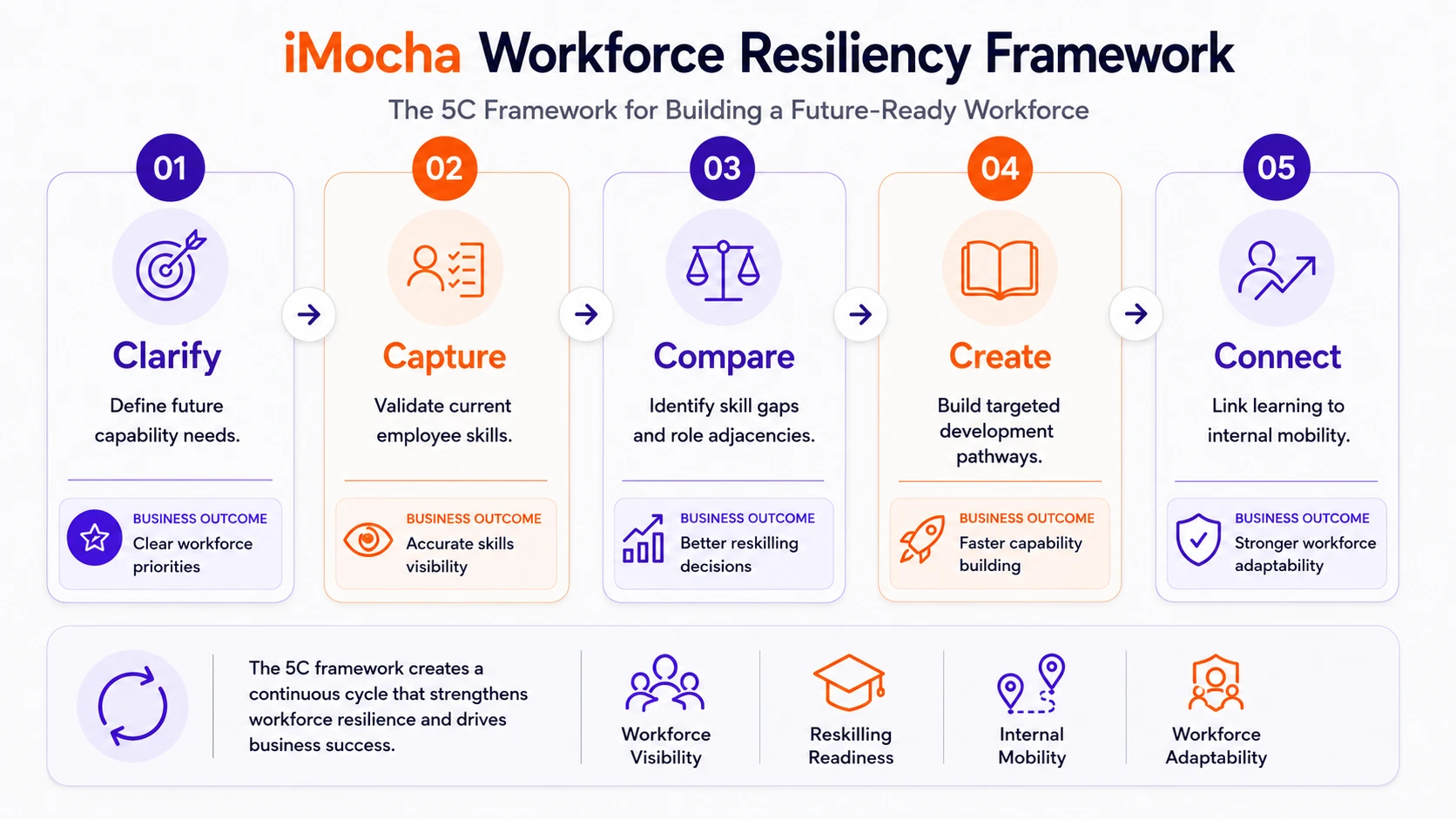
Organizations can build workforce resilience at scale by clarifying future capability needs, capturing current skills, comparing supply with demand, creating scalable reskilling pathways, and connecting learning to mobility.
The following is the 5C Workforce Resilience Framework:
Clarify → Capture → Compare → Create → Connect
1. Clarify Future Capability Needs
Clarify future capability needs by identifying which skills and capabilities the business will need over the next 12 to 36 months. It is required to initiate with business priorities, and then translate them into workforce questions such as:
- Which roles are changing because of AI or automation?
- Which capabilities are becoming more strategic?
- Which skills are declining in relevance?
- Which teams are most exposed to disruption?
The output should be a future capability map that connects business strategy to workforce skills. This step matters because workforce resilience cannot be built from generic training plans, needing a clear view of where the business is navigating.
2. Capture Current Workforce Skills
Capture current workforce skills by building a reliable, validated view of employee capability.
The data sources that can be used to capture skills:
- Skills assessments
- Employee profiles
- Manager validation
- Project history
- Learning records
- Certifications
- Performance data
- HRIS data
- HCM data
- Work outputs
- Role history
Self-reported skills are helpful, but they are not enough. Employees may understate, overstate, or forget to update their skills, while validated skills data gives HR and L&D teams the confidence to make better workforce planning, reskilling, and internal mobility decisions.
3. Compare Skills Supply and Demand
Compare skills supply and demand by identifying where current workforce capability does not match future business needs.
This includes identifying the following:
- Critical skill gaps
- Oversupplied skills
- Emerging skill demand
- At-risk roles
- Hard-to-hire capabilities
- Business-critical talent pools
- Role adjacencies
This is where skill gap analysis becomes strategic. It helps HR and L&D leaders prioritize development investments based on business risk and workforce readiness.
For example, if AI is changing a customer operations function, the organization may need more employees with data literacy, workflow automation, prompt writing, customer analytics, and change management skills. Comparing supply and demand shows whether those skills already exist inside the workforce, need to be built, or must be hired.
4. Create Scalable Reskilling Pathways
Create scalable reskilling pathways by translating skill gaps into targeted development programs.
These programs may include:
- Role-based learning paths
- Skill-based academies
- AI-readiness programs
- Leadership development
- Project-based learning
- Mentoring
- Coaching
- Certifications
- Internal gigs
- Stretch assignments
Reskilling works best when it is tied to real business needs. A generic course library may increase learning activity, but it may not build the capabilities the business needs next.
Scalable reskilling should also recognize different proficiency levels, for example:
- Beginners may need foundational learning.
- Experienced employees may need applied projects, simulations, or advanced coaching.
5. Connect Learning to Internal Mobility
Connect learning to internal mobility by helping employees move into roles, projects, or career pathways where their new skills are needed. Learning builds capability, but mobility turns that capability into business resilience.
Organizations must connect the following to enhance retention:
- Skills assessments
- Career pathing
- Internal job marketplaces
- Talent reviews
- Succession planning
- Redeployment programs
- Workforce planning
When employees see how new skills connect to real opportunities, they are more likely to engage in development. When organizations can redeploy talent faster, they are less dependent on external hiring during disruption.
How Can HR and L&D Measure Workforce Resilience?
HR and L&D teams can measure workforce resiliency by tracking how quickly the organization identifies skill gaps, builds needed capabilities, redeploys talent, and maintains readiness for future business priorities.
The goal is to measure readiness, not just activity.
These metrics help HR and L&D teams show whether workforce resiliency is improving over time. They also help business leaders understand whether the organization can respond to change without constant restructuring or high-cost external hiring.
How Does Skills Intelligence Support Workforce Resilience?
Skills intelligence gives HR and L&D teams a validated view of employee capabilities, proficiency gaps, role adjacencies, and future workforce readiness.
It creates the data foundation needed to build resilience at scale.
With skills intelligence, organizations can understand:
- Which skills employees have
- Where priority gaps exist
- Which employees may qualify for adjacent roles
- How capabilities are changing over time
- Which development investments are producing outcomes
- Where internal talent can reduce external hiring dependency
Instead of relying primarily on job titles or manager recommendations, HR teams can make workforce decisions using more reliable capability data.
iMocha can support workforce resilience by helping organizations assess skills, map capability gaps, identify role adjacencies, and find employees who can be reskilled or redeployed into priority roles.
Common Mistakes That Weaken Workforce Resilience
Workforce resiliency often fails when organizations treat it as crisis response instead of building the skills visibility, internal mobility, reskilling, and workforce planning systems needed before disruption happens.
Mistakes that can be avoided:
1. Treating Resilience as Crisis Response
Workforce resiliency should be built before disruption affects productivity. When HR teams act only after skill gaps, talent shortages, or when business shifts create pressure, reskilling becomes rushed and redeployment becomes harder.
2. Planning Around Roles Instead of Capabilities
Roles change quickly, but skills give organizations a more flexible way to plan. A skills-based workforce planning approach helps leaders see who can move, grow, or be redeployed into emerging work.
3. Measuring Learning Activity Instead of Capability
Course completion does not prove that employees are ready for future work. HR and L&D teams need to measure skill growth, proficiency improvement, applied capability, and readiness for priority roles.
4. Ignoring Internal Mobility
Reskilling has a limited impact if employees cannot move into roles or projects where their new skills are needed. Internal mobility turns learning into business value and gives employees clearer growth paths.
5. Relying Only on External Hiring
External hiring is useful, but relying on it for every new skill requirement can slow transformation and increase costs. A resilient workforce balances hiring with upskilling, reskilling, and redeployment from within.
6. Using Outdated Skills Data
Workforce resilience depends on current and validated skills data. Old spreadsheets or static employee profiles can lead to inaccurate skill gap analysis, weak workforce planning, and poor talent decisions.
7. Failing to Communicate with Employees
Employees are more likely to support change when they understand what is changing, why it matters, and how it connects to their growth. Clear communication builds trust, and trust supports adaptability.
A 90-Day Workforce Resilience Pilot
Organizations can start building workforce resilience in 90 days by diagnosing disruption risks, mapping priority skills, and launching targeted reskilling and mobility actions in critical workforce areas. The first 90 days should pay heed to a focused pilot, not to company-wide transformation.
Let us understand and take a glance at how this plan works.
First 30 days: Diagnose
Initially, in the first 30 days, organizations must identify priority business disruptions and select the critical roles or functions most exposed to change.
They must then gather available skills and workforce data, review current L&D programs, and identify known capability gaps. The motive is to create a clear starting point where HR, L&D, and business leaders should agree on which workforce risks matter most.
Days 31 to 60: Map
Validating skills in priority talent groups and mapping skill gaps against future business needs must be done in the second half (31 – 60 days).
Here’s when identifying adjacent roles, redeployment pathways, and segmenting roles by risk, criticality, and skill readiness is necessary. This helps leaders understand where talent can be developed, moved, or supported before disruption becomes a performance issue.
Days 61 to 90: Act
In the concluding (61 – 90 days) period, the ultimate focus must be on launching targeted reskilling pathways and creating internal mobility opportunities.
Redesigning roles where work is changing, tracking skill progress and movement, and building a repeatable review cadence are essentially required. By the end of 90 days, the organization should have a working model for skills visibility, targeted reskilling, and mobility that can be scaled to other functions.
Conclusion
Workforce resilience at scale depends on connected skills data, future capability planning, targeted development, and internal mobility. These elements help organizations understand current capabilities, prepare for changing business demands, and make better workforce decisions.
The 5C framework (Clarify, Capture, Compare, Create, Connect) turns business priorities into action by helping organizations identify skill gaps, develop internal talent, and build the adaptability required for future change.
FAQs
1. How Can Organizations Scale Workforce Resilience Across Business Units?
Organizations should begin with a shared skills taxonomy, consistent capability data, and common measurement standards. Each business unit can then adapt reskilling, mobility, and workforce-planning initiatives to its own priorities while following the same enterprise-wide framework.
2. Who Should Own a Workforce Resilience Program?
Workforce resilience should be jointly owned by business leaders, HR, L&D, workforce planning, talent management, finance, and people managers. Business leaders define future capability needs, while HR and L&D coordinate the data, development, and mobility systems required to address them.
3. What Data is Needed to Assess Workforce Readiness?
Organizations typically need employee skills, proficiency levels, role requirements, future capability demand, assessment results, learning records, mobility history, succession coverage, and workforce-planning data. Combining these sources provides a more reliable view of current capability and future readiness.
4. How Long Does it Take to Build Workforce Resilience?
Organizations can launch a focused workforce resilience pilot within 90 days. Scaling the approach across multiple functions usually takes longer because it requires reliable skills data, leadership alignment, connected systems, and repeatable governance.
5. What is a Workforce Readiness Score?
A workforce readiness score measures how prepared an organization is to meet future capability needs. It may combine factors such as critical-skill coverage, gap severity, proficiency levels, role adjacency, succession coverage, and redeployment readiness.