
Organizations are under pressure to fill roles faster, retain skilled employees, and redeploy talent as work changes. Yet many HR teams still rely on job titles, manager nominations, outdated job descriptions, and disconnected systems to make talent decisions.
Skills intelligence and work intelligence help solve this by connecting three important views: what employees can do, what work needs to be done, and which roles, tasks, and capabilities are becoming more important.
The impact is not only better data. The real impact is better decisions across internal mobility, retention, workforce planning, and hiring.
Skills intelligence shows workforce capability. Work intelligence shows how work is changing. Together, they help organizations move talent where it creates the most value.
This matters because skills are changing quickly. The World Economic Forum’s Future of Jobs Report 2025 says technological change, economic uncertainty, geoeconomic fragmentation, demographic shifts, and the green transition are expected to reshape jobs and skills by 2030. The report is based on input from more than 1,000 employers representing over 14 million workers.
Key takeaways
- Skills intelligence shows what employees can do, where capability gaps exist, and which skills are validated.
- Work intelligence shows how roles, tasks, workflows, and business demand are changing.
- Together, skills and work intelligence improve internal mobility by matching employees to roles, projects, and adjacent opportunities.
- They support retention by giving employees clearer career pathways and targeted development.
- They reduce time-to-fill by helping teams identify internal talent before relying on external hiring.
What are skills intelligence and work intelligence?
Skills intelligence is the structured, validated understanding of employee capabilities, proficiency levels, skill gaps, and adjacent skills. Work intelligence is the structured understanding of roles, tasks, workflows, work demand, and how work is changing.
Skills intelligence answers a critical talent question: what can employees do?
It includes employee skill profiles, proficiency levels, skill gap analysis, skills taxonomy, skill adjacency, skills validation, learning data, assessment data, and workforce capability visibility.
Work intelligence answers a different question: what work needs to be done?
It includes role requirements, task-level work data, job architecture, workflows, tools used, business processes, work demand changes, role exposure to AI or automation, and business-critical work.
Within this broader model, task intelligence provides detailed insight into individual tasks, including their skill requirements, complexity, frequency, workload, automation potential, and business impact.
When these two views are connected, HR teams can make better talent decisions. They can see whether the organization already has the skills needed for a role, whether employees can move into adjacent opportunities, and where targeted reskilling is needed.
This connection is becoming more important as work changes. The World Economic Forum reports that employers expect skill disruption to continue through 2030, with workers’ core skills changing as business and technology shifts accelerate.
Why does traditional talent data fall short?
Traditional talent data falls short because it often shows who employees are on paper, but not what they can do, what work they are ready for, or how roles are changing.
Job titles are useful for structure, but they do not reveal real capabilities. Two employees with the same title may have different skills, proficiency levels, project experience, and career goals.
Resumes and self-reported profiles may also be incomplete or outdated. Employees may forget to update skills, describe capabilities differently, or understate experience gained through projects.
Job descriptions create another problem. Many job descriptions are static, while the work itself changes through automation, AI adoption, customer demand, new tools, and shifting business priorities.
Performance data helps managers understand how someone performed in a current role. But it does not always show whether that person is ready for a future role, a project opportunity, or an adjacent career path.
Learning completion data has similar limits. A completed course does not prove that an employee has gained proficiency or can apply the skill at work.
Manager nominations can also miss hidden talent. Employees outside visible networks may have transferable skills but never appear in mobility discussions.
This is why skills and work intelligence matter. They give HR leaders a more current and evidence-based view of capability, demand, and movement.
How do skills and work intelligence improve internal mobility?
Skills and work intelligence improve internal mobility by matching employees to open roles, projects, gigs, and career paths based on validated skills, adjacent capabilities, and changing work requirements.
Internal mobility often fails because organizations cannot see their own talent clearly. Employees may have transferable skills, but those skills are hidden inside disconnected systems, manager knowledge, or outdated profiles.
Skills intelligence helps by showing employee capabilities, validated proficiency, and skill gaps. Work intelligence adds the other side of the equation by showing what each role, task, or project actually requires.
Together, they help HR teams move from “who has done this job before?” to “who has the skills or adjacent skills to succeed with targeted support?”
1. Better role matching
Skills and work intelligence help match employees to opportunities based on skills, proficiency, role requirements, and readiness.
This creates a more accurate view of who can move into an open role now, who may be ready soon, and who needs a specific development path.
It also helps internal mobility teams reduce reliance on job titles. An employee may not have held the exact role before, but their skills may show strong fit.
2. Adjacent skill discovery
Adjacent skills help HR teams identify employees who are close to future-fit roles, even if they do not have the expected career background.
For example, an employee in IT operations may have skills in networking, cloud infrastructure, risk monitoring, and incident response. With targeted upskilling, they may be a strong candidate for a cybersecurity role.
This helps organizations expand internal talent pools instead of assuming that every capability must be hired externally.
3. Project and gig mobility
Work intelligence helps organizations understand task-level needs. This supports mobility into short-term projects, internal gigs, stretch assignments, and cross-functional work.
This is useful when the business needs skills quickly but does not always need a full role change.
Employees also benefit because they can build experience and visibility without waiting for a formal promotion.
4. Fairer access to opportunities
Internal mobility often depends on manager nominations, informal networks, or employee self-advocacy.
Skills and work intelligence can make more employees visible based on verified capability, not only who is already known to leaders.
This supports fairer access to roles, projects, and development opportunities. It can also uncover high-potential employees who may otherwise be missed.
5. Stronger career pathing
Employees are more likely to explore internal opportunities when they can see how their current skills connect to future roles.
Skills intelligence shows what they already have. Work intelligence shows what the target role requires.
Together, they create a clearer path: current skills, missing skills, learning actions, and possible next roles.
6. Lower external hiring dependency
When internal talent is easier to identify, organizations can fill more roles from within before launching external searches.
This does not remove the need for hiring. It helps talent teams make better build, move, or buy decisions.
Internal mobility becomes a practical workforce strategy, not just an employee experience initiative.
How do skills and work intelligence improve retention?
Skills and work intelligence improve retention by helping employees see relevant growth paths, receive personalized development, and move into internal opportunities before they look outside the organization.
Retention is closely tied to growth. Employees are more likely to stay when they can see a future inside the company.
LinkedIn’s 2025 Workplace Learning Report says nearly half of learning and talent development professionals see a skills crisis, with 49% agreeing that executives are concerned employees do not have the right skills to execute business strategy. The same report emphasizes that learning and career development are closely connected in a changing skills environment.
Skills and work intelligence help HR teams turn that connection into action.
1. Career visibility
Employees often leave when they cannot see where they can grow.
Skills intelligence helps show employees what skills they have and what skills they need for future opportunities. Work intelligence helps show which roles, projects, and tasks are becoming more important.
This creates clearer career pathways. Employees can understand how to move laterally, move upward, or shift into emerging work.
2. Personalized development
Generic learning plans are less effective because employees do not all have the same skill level, career goal, or role readiness.
Skills intelligence helps L&D teams recommend learning based on verified skill gaps and proficiency. Work intelligence helps connect that learning to real business needs and role requirements.
This makes development more relevant. Employees can see why the learning matters and where it may take them next.
3. Reduced career stagnation
Career growth does not always mean a promotion. Employees may want to move into a new function, join a project, build technical depth, or gain leadership exposure.
Skills and work intelligence make more growth paths visible. This reduces the feeling of being stuck in one role or one career track.
When employees can move into meaningful work internally, they may be less likely to search outside.
4. Stronger manager conversations
Managers often want to support employee growth, but they may not have enough data to guide the conversation.
Skills intelligence gives managers a clearer view of current capability, skill gaps, and proficiency. Work intelligence helps connect the conversation to future work and role changes.
Instead of saying “keep developing your leadership skills,” a manager can discuss specific skills, target opportunities, and next steps.
5. Better retention signals
Skills and work intelligence can also reveal early warning signs.
Stagnant skill growth, repeated lack of mobility, mismatched work, limited development activity, or employees whose skills are in declining demand can all signal retention risk.
These signals do not replace employee listening or manager judgment. But they help HR teams act before disengagement becomes resignation.
How do skills and work intelligence reduce time-to-fill?
Skills and work intelligence reduce time-to-fill by helping talent teams identify internal candidates, adjacent talent, and role-ready employees before relying on external hiring.
Time-to-fill often increases when recruiters start every search from the external market. This can happen even when internal employees have relevant skills, because those skills are hard to find.
Skills intelligence allows recruiters and talent teams to search internal skill profiles before launching an external search. Work intelligence clarifies which skills are truly required for the role based on tasks and business demand.
This creates faster and more accurate shortlists.
1. Internal-first sourcing
Recruiters can search validated internal skill profiles to find employees who already meet role requirements or are close to meeting them.
This can reduce sourcing time and improve workforce agility.
It also helps employees see that internal opportunities are real, not only published as a formality.
2. Better role requirements
Many job descriptions include long lists of requirements that do not reflect the work.
Work intelligence helps clarify which skills are required, which are preferred, and which can be developed after the move.
This improves hiring accuracy and reduces unnecessary screening.
3. Adjacent candidate discovery
Some roles are difficult to fill because the exact skill combination is scarce.
Skills intelligence can identify employees with transferable skills who may become role-ready through targeted upskilling.
For example, a cybersecurity analyst role may take months to fill externally. Skills intelligence may reveal internal IT employees with adjacent skills in networking, risk, compliance, cloud security, or incident response who can move faster with a focused learning path.
4. Reduced screening time
Validated skills data helps talent teams shortlist candidates faster.
Instead of relying only on resumes, job titles, or keywords, recruiters can use assessed skills, proficiency data, and role match signals.
This supports both internal mobility and external hiring quality.
5. Faster redeployment
Work demand can shift quickly. Some roles may decline while others become more urgent.
Skills and work intelligence help identify employees who can move from lower-priority work into critical roles, projects, or transformation programs.
This supports faster redeployment and reduces the cost of waiting for external hires.
What is the skills and work intelligence impact framework?
Organizations can measure the impact of skills and work intelligence by connecting workforce capability data, work demand data, and talent movement data to internal mobility, retention, and time-to-fill outcomes.
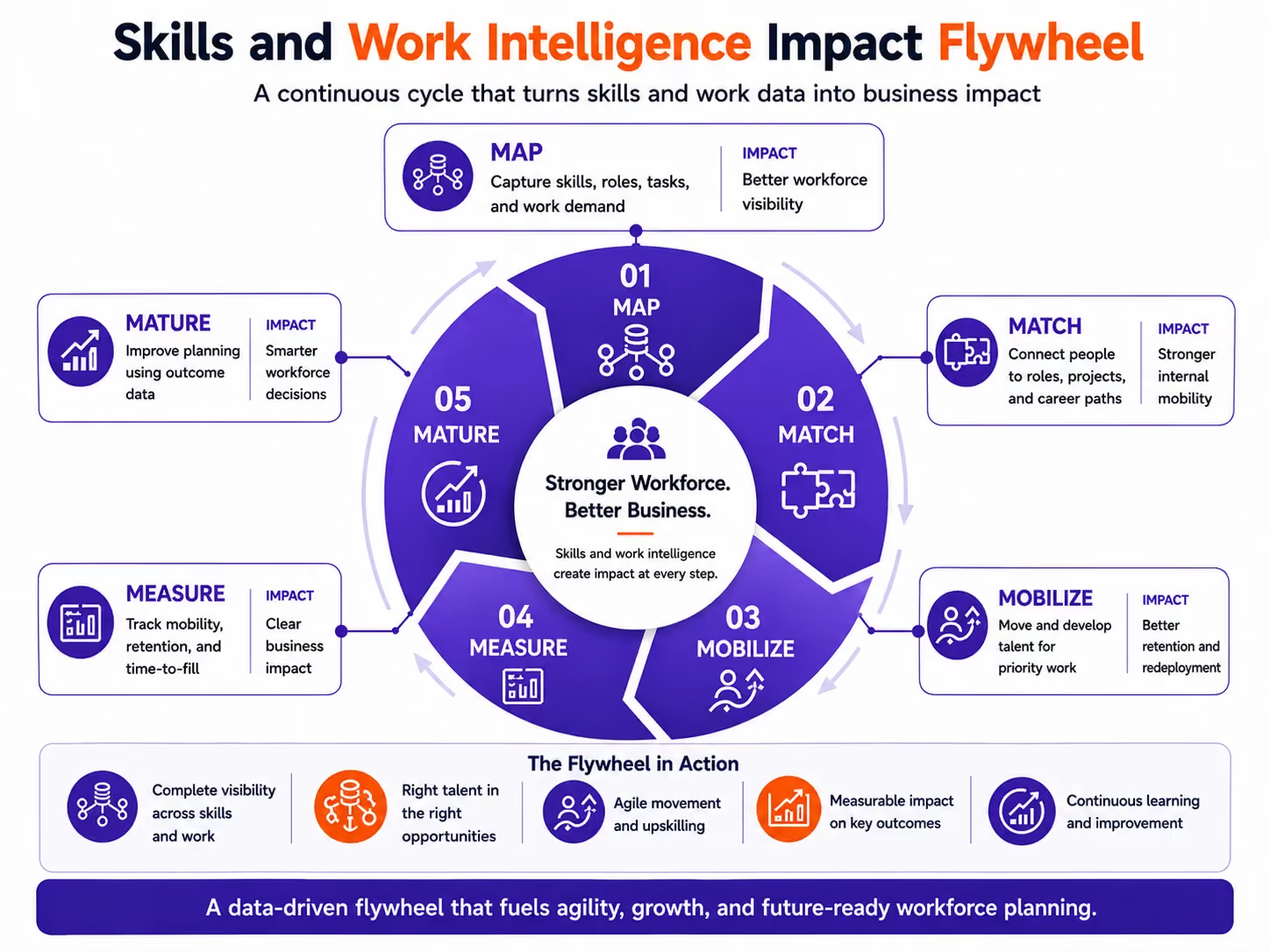
A practical way to do this is the 5M Skills and Work Intelligence Impact Framework.
1. Map
Map employee skills, proficiency levels, role requirements, tasks, and work demand.
This creates the foundation for better workforce visibility. It helps HR teams understand both talent supply and work demand.
The goal is to move beyond static job titles and build a living view of workforce capability.
2. Match
Match employees to roles, projects, gigs, and career paths based on skills, adjacencies, and business needs.
This is where skills and work intelligence become actionable.
Matching helps internal mobility teams identify role-ready employees, near-ready employees, and employees who need targeted development.
3. Mobilize
Mobilize talent into priority opportunities through internal mobility, redeployment, upskilling, and role transitions.
This step turns insight into movement.
It helps organizations respond faster when priorities shift and gives employees clearer growth opportunities inside the company.
4. Measure
Measure internal mobility rates, retention improvement, time-to-fill reduction, skill gap closure, and hiring cost avoided.
This helps HR teams prove the impact of skills and work intelligence on business outcomes.
Measurement also helps leaders see whether talent decisions are improving over time.
5. Mature
Mature the system by using outcome data to improve workforce planning, learning strategy, role design, and talent acquisition.
This is how organizations build a repeatable talent engine.
Over time, the organization becomes better at forecasting capability needs, identifying talent earlier, and moving people into priority work.
What metrics should HR track?
HR teams should track metrics that show whether skills and work intelligence are improving talent movement, retention, hiring speed, and workforce readiness.
For internal mobility, track internal fill rate, lateral moves, promotions, project participation, gig participation, and redeployment rate.
For retention, track voluntary attrition, retention in critical roles, employee engagement, career growth participation, and retention among employees who received mobility or development opportunities.
For time-to-fill, track average time-to-fill, internal candidate shortlist time, time-to-match, and time-to-productivity after placement.
For skill gaps, track skill gap closure rate, proficiency gains, critical skill coverage, and the number of employees ready or near-ready for priority roles.
For workforce planning, track build versus buy decisions, workforce readiness score, role adjacency strength, and capability supply versus future demand.
For hiring efficiency, track hiring cost avoided, reduced agency spend, offer acceptance rate, and the share of roles filled through internal talent.
These metrics help HR teams move from anecdotal success stories to evidence-based impact.
They also help leaders see whether internal mobility, retention, and hiring speed are improving because of better workforce intelligence.
How do skills intelligence platforms support talent decisions?
Skills intelligence platforms help organizations turn employee skills, assessments, role requirements, and workforce demand into actionable insights for mobility, retention, and hiring decisions.
They support validated employee skill profiles, skill gap analysis, skills taxonomy, role mapping, skill adjacency identification, internal mobility recommendations, workforce readiness insights, talent planning dashboards, and reskilling prioritization.
A strong platform helps HR teams answer questions that are hard to answer with disconnected systems.
Who has the skills we need? Which employees are ready for priority roles? Which skills are missing? Which employees can move with targeted upskilling? Which teams are most exposed to capability gaps?
This improves workforce planning because leaders can compare talent supply with work demand.
It also improves L&D investment decisions because learning can be tied to verified gaps, future role needs, and internal mobility pathways.
Where platforms like iMocha fit
Platforms like iMocha help enterprises assess workforce skills, identify skill gaps, and create validated skill profiles that support internal mobility, retention, and faster talent decisions.
This helps HR teams move from static talent data to skills-based workforce intelligence.
With iMocha, organizations can validate skills, map role requirements, identify adjacent talent, and support targeted upskilling for priority roles.
For talent leaders, this means better visibility. For employees, it means clearer growth pathways. For recruiters, it means faster access to internal talent before starting external searches.
What skills and work intelligence cannot solve on their own
Skills and work intelligence can improve talent decisions, but they cannot replace leadership alignment, manager accountability, or employee trust.
A platform can show who may be a strong match for a role. Leaders still need to create mobility policies, encourage managers to release talent, and make internal opportunities visible.
Skills data can show development needs. L&D teams still need to design relevant learning and employees still need time, support, and opportunities to apply new skills.
Work intelligence can show how roles and tasks are changing. Business leaders still need to decide which work matters most and how teams should be designed.
This transparency matters. Skills and work intelligence are powerful decision systems, but they work best when paired with clear governance, strong communication, and a culture that supports internal movement.
Conclusion
Skills and work intelligence help organizations connect what people can do with what the business needs.
That connection creates a stronger foundation for internal mobility, retention, time-to-fill, workforce planning, and hiring decisions.
The value is not only better data. It is better talent movement, more visible career paths, faster access to internal capability, and reduced dependency on external hiring.
Organizations that combine skills intelligence with work intelligence can move beyond static job titles and build a more agile, mobile, and future-ready workforce.
FAQs
How can organizations get started with skills and work intelligence?
Organizations can start by mapping critical roles, validating employee skills, and identifying the work areas most affected by business change. A focused pilot in one function or talent segment is often easier than starting enterprise-wide.
What data is needed for skills and work intelligence?
Organizations need employee skill profiles, proficiency data, assessment results, learning data, role requirements, job architecture, task data, workflow data, and workforce planning inputs. The goal is to connect what people can do with what the business needs.
How can organizations ensure skills data remains accurate?
Skills data should be updated through assessments, manager validation, employee updates, learning records, project history, and system integrations. Regular refresh cycles help prevent skills data from becoming static or outdated.
Why are job titles not enough for internal mobility and hiring?
Job titles do not show actual skills, proficiency, adjacent capabilities, or readiness for future work. Skills and work intelligence give HR teams a more accurate view of who can move, grow, or fill priority roles.
How often should organizations update skills and work intelligence data?
Organizations should update skills and work intelligence data regularly, especially when roles change, employees complete learning, new tools are adopted, or business priorities shift. High-change functions may need more frequent updates than stable roles.