Organizations possess a vast amount of essential workforce information, yet the skills data and learning data often remain disconnected. The primary reason for this disconnect is that organizations manage HR, L&D, LMS, LXP, talent, and workforce planning systems separately, resulting in fragmented taxonomies and inconsistent data structures and metrics, and thus measure their outcomes differently.
This fragmentation impacts decision-making owing to incomplete and unstructured data. Without the unification of skills and learning data under one system, it becomes challenging for organizations to understand evolving skills as per market trends, industrial requirements, and learning initiatives to be deployed, thus delaying strategic decisions.
According to the World Economic Forum's Future of Jobs Report 2025, 39% of workers’ core skills are expected to change by 2030, underscoring why static skills profiles and outdated learning catalogs quickly become unreliable. The need for skills intelligence platforms, enabling organizations to gain real-time skills visibility, perform skills gap analysis, facilitate capability mapping, and internal mobility, has now become business-critical.
Key Takeaways
- Skills and learning data live in silos, and that disconnect is quietly stalling your workforce strategy.
- Course completion is not proof of capability. Proficiency needs to be validated, not assumed.
- Disconnected data means L&D can't prove ROI; talent can't move people internally, and leaders can't plan with confidence.
- 39% of workers' core skills will change by 2030; static profiles and outdated learning catalogs won't keep up.
- The fix isn't another system; it's a connected intelligence layer that turns fragmented data into intellectual and feasible workforce decisions.
- Organizations that unify skills and learning data hire less externally, move talent faster, and build a true skills-based organization.
What Is the Difference Between Skills Data and Learning Data?
Skills data describes what employees can do, while learning data describes what employees have learned, completed, or consumed through training platforms.
Skills data describes relationships between employee capabilities, roles, skills gaps, and business objectives, providing organizations with real-time data concerning current and emerging skills. While learning data describes what employees have learned, capturing content engagement, development progress, evaluation results, and learning paths and helping develop better learning initiatives.
Though course completion logs training data, showing learners’ curiosity, it cannot precisely prove skill proficiency. Proficiency validation can be assessed only through skill assessments, applications, projects, or manager feedback. This conveys how both datasets can be useful but provide different results, signifying the importance of skills intelligence more.
Skills Data vs. Learning Data
Why Do Skills Data and Learning Data Become Disconnected?
Skills data and learning data become disconnected because enterprises capture them in separate systems, define them with different taxonomies, and measure them against different outcomes, providing non-unified data. This impacts decision-making and affects operations’ scalability since data has to be manually stitched for evaluation, delaying timelines.
Sometimes, the systems lack frameworks that adjust according to the evolving requirements of the market. Traditional practices delay operations owing to the following hindrances:
1. HR and L&D Systems Were Built for Different Jobs
HR systems were designed to manage employees, jobs, roles, and workforce records, and learning & development systems to deliver content and track completion. But neither system was originally built to operate as a unified, real-time skills intelligence engine, thus fragmenting data. This causes firms to manually restructure data and stitch it together, delaying initiatives concerning workforce planning.
2. Learning Completion Does Not Equal Skill Proficiency
Completing a course does not always prove job-ready capabilities because employee proficiency cannot be assessed by just completing a certain training, as they may conclude the training without practically applying the skill. Skills require validation through assessments, work outputs, projects, or manager feedback. Without feedback, there’s no reliable metric of learning completion.
3. Skills Taxonomies Are Often Missing or Inconsistent
Since the data stored is not always consistent, it becomes difficult to determine the correct data to make industry-relevant decisions.
LMS course tags might not match HR skill frameworks, and job architecture may use broad role labels, preventing data specificity. Certain differences, such as learning content using vendor-specific labels and business units defining the same skill differently, amplify inconsistency.
4. Data Ownership Is Split Across Teams
Skills and learning data, often managed by different teams, further provide decentralized data.
The data ownership is bifurcated across teams as follows:
- L&D department - Learning Data
- HR department - Employee Records
- Talent teams - Career and Mobility Data
- Business leaders - Role Demand
- IT - Integrations
This leads to no single team owning an end-to-end connection between skills and learning.
5. Systems Do Not Update at the Same Speed
Learning systems update whenever employees complete courses. Skills data, however, may update when assessments and reviews are completed; this data is reflected annually.
As job requirements evolve faster than HR systems can capture because of which emerging skills within the systems create stale learning recommendations. This disconnect between systems might create irrelevant skill profiles and increase skill gaps.
Why This Disconnect Hurts Workforce Planning and Upskilling
The disconnect between skills data and learning data hurts enterprises because it prevents leaders from proving whether learning investments are improving workforce capability.
Because if organizations gain real-time insights concerning skills and ongoing learning initiatives taken alongside under one system, most manual efforts will be reduced, leading to accelerated decision-making.
1. Poor skill gap visibility
Dispersed data limits skill gap visibility, preventing leaders from identifying critical and missing skills and comprehending the roles at risk. With no system providing accurate skills and employee learning data together, the required upskilling gets delayed.
2. Rising executive concern
When skills and learning data are disconnected, it becomes difficult for executives to assess if the workforce possesses the skills required to execute the business strategy. This is also confirmed by LinkedIn’s Workplace Learning Report 2025, where 49% of learning and talent development professionals agree.
3. Generic learning recommendations
Employees receive generic courses based on broad role categories or content popularity instead of verified skill gaps. These courses, not being customized with skills as per employees’ career trajectories, lead to major skill gaps.
4. Weak internal mobility
When there’s an issue concerning misalignment of employee roles and required skills, talent teams face trouble matching employees to internal roles. This happens as learning records and skill profiles do not connect.
5. Limited L&D ROI measurement
L&D teams can report learning completions, hours engaged, and attendance, but measuring proficiency improvement or gap closure remains challenging as data specificity is limited to learning data. Whereas skills assessment provides deeper insights into proficiency data.
6. Higher dependency on external hiring
When data is fragmented, the disconnect prevails and hinders the mobilization of internal talent. As internal skills are invisible, organizations may hire externally instead of reskilling existing employees, leading to hiring costs and delayed operations.
7. Slower workforce transformation
Decentralized data and siloed teams slow down AI readiness causing AI skills gap; digital transformation and workforce planning become harder when capability data is fragmented. Unified systems connect learning activities with skills data and showcase gaps to take upskilling initiatives early.
Common Mistakes That Keep Skills and Learning Data Disconnected
1. Treating Course Completion as Proof of Skill
Though course completion signals that an employee has completed training related to a skill, it shouldn’t be mistaken for a verified capability. The only relevant metric for assessing capability is when proficiency is validated through skills assessments.
2. Building a Skills Taxonomy Without L&D Input
Organizations cannot align learning content with skills if they create taxonomies excluding L&D. This affects the mapping of skills data with learning data, further causing delays in training programs or upskilling initiatives.
3. Letting Every Business Unit Define Skills Differently
Siloed teams work independently, leading to differences in their data and making the data even more dispersed. Here’s when inconsistent naming causes duplicate skills, weak reporting, and poor recommendations, delaying learning and upskilling initiatives.
4. Connecting Systems Without Cleaning Data
The unification of data is necessary, but clean segregation and structuring are vital for clarity in decisions. Organizations must be aware that though integrations move data, they do not fix bad taxonomies or inconsistent proficiency models.
5. Measuring Learning Activity Instead of Skill Progress
Since organizations expect a system that connects skills data and learning data, L&D teams must also report on capability improvement, and not only enrollments and completions. Measuring skill progress alongside learning data helps measure and understand gap closures and analyze further skill gaps.
6. Ignoring Employee Experience
Many organizations refer to generic skills while forming training programs, neglecting employees' personal experience. They need clear career pathways, relevant learning, and transparent skill expectations customized specifically for them to effectively contribute.
The Connected Skills-Learning Intelligence Framework
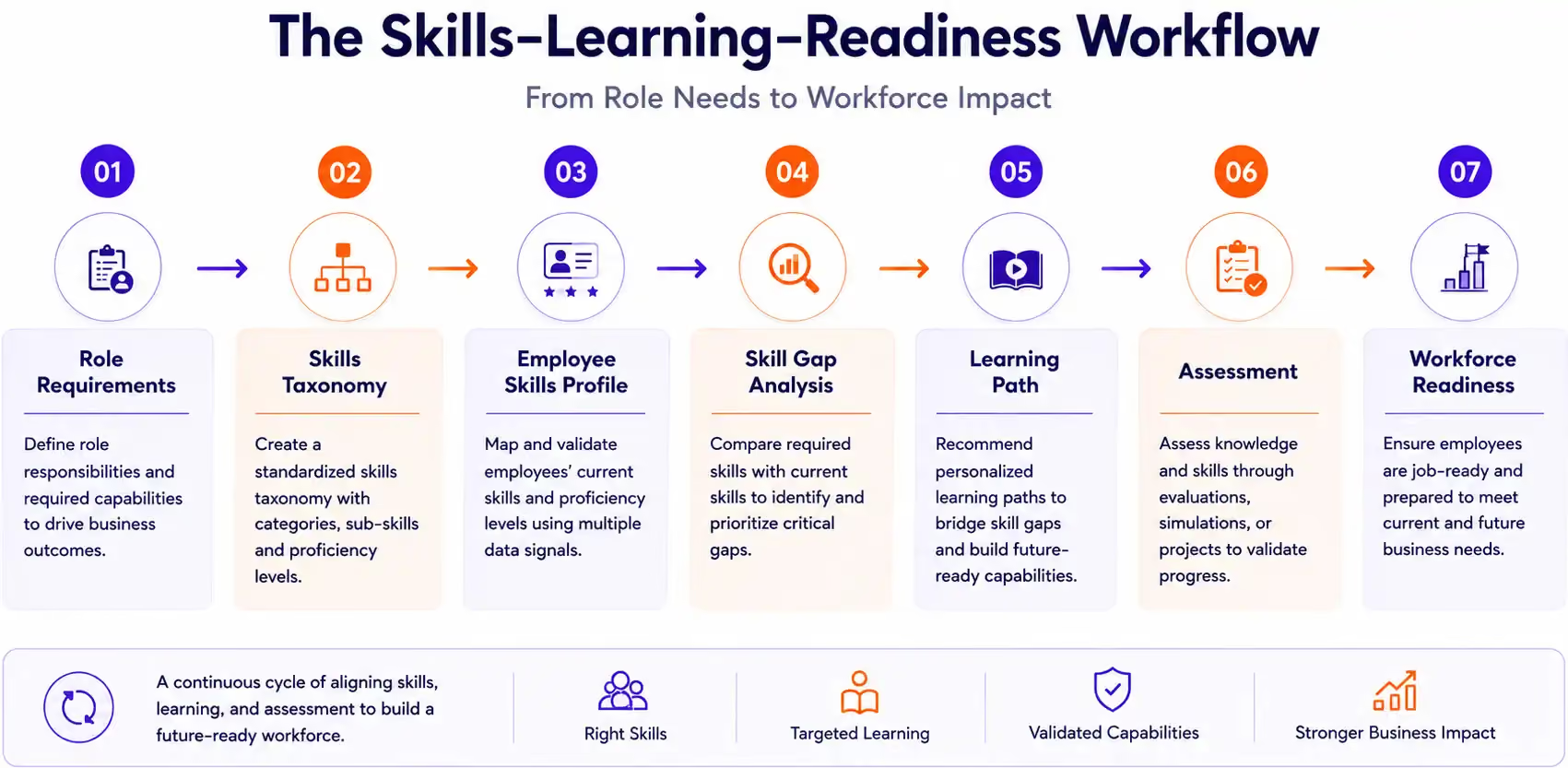
Enterprises can connect skills data and learning data by creating a shared skills language, capturing multiple skill signals, validating proficiency, and converting gaps into targeted learning actions. This initiative can be supported using the 5C Framework for reconnecting skills.
Let us understand how it can be performed.
1. Clarify the Skills Framework
The initial step involves defining the enterprise skills taxonomy and role-based capability requirements. Firstly, establishing a common language for workforce capabilities is essential. Without standardized skill definitions, organizations struggle to align learning investments with business needs.
There are multiple skills within an organization, which, without categorization, remain scattered and impact strategic decisions.
If categorized as follows, they provide greater clarity on future projects:
- Core and role-specific skills
- Emerging skills
- Leadership and behavioral skills
- Proficiency levels
- Role-based capability requirements
2. Capture Skills and Learning Signals
Post clarifying and categorizing, organizations must identify and consolidate skills and learning data from the systems where it currently resides. When data is centralized, unified, and transparent, business-critical decisions can be delivered with precision.
This can be accomplished using iMocha’s Skills Intelligence platform, which provides a unified view of workforce capabilities and development activities by extracting data from the following systems:
- HRIS
- LMS
- LXP
- Skills Assessment Platforms
- Talent Marketplace
- Performance Management System
- Applicant Tracking System (ATS)
- Workforce Planning Tools
- Project Management Tools
- Certification Platforms
3. Connect Learning to Skills
A critical step in the 5 C skills framework involves mapping the learning content, assessments, roles, and employee profiles to the same skills framework. Unless the mapping is done, the skill progress associated with the learning initiative/course cannot be evaluated.
Certain courses mapped with skills, roles, and proficiencies give a proper overview of assessment data. And using iMocha’s AI Skills Match, organizations can also perform role-to-skill mapping, fulfilling gaps with external talent as well.
4. Confirm and Measure Skills
Learning data provides employees’ engagement rate with training initiatives, but skills validation is assessed by evaluation of proficiency levels through evidence-based platforms. By using iMocha’s Skills Assessment platform, pre/post-learning assessments can be conducted smoothly.
While its AI Skills Inference extracts critical/required skills from simulations, projects, work samples, and certifications, reducing manual screening. Manager endorsement and proficiency improvement tracking should also be prioritized for authentic evaluation.
5. Convert Insights into Workforce Actions
And the concluding step involves turning the analysis of skill gaps into practical actions, such as performing skill gap analysis and filling the gaps. Using iMocha’s Skills Intelligence, organizations can gain deeper insights and take critical decisions that improve workforce readiness and business performance. As a result, only verified skills data helps enable development efforts and make informed talent decisions.
How AI Helps Reconnect Skills and Learning Data
AI helps reconnect skills and learning data by mapping skills automatically, identifying adjacent capabilities, recommending personalized learning, and updating skill profiles as roles evolve.
As per SHRM’s 2025 Talent Trends research, 4 in 5 organizations report difficulty finding qualified candidates with new skills and capabilities like data analysis, AI, and cybersecurity among the top new technology-related skills required.
Let us understand how AI helps reconnect skills and learning data:
1. AI-based skills inference
AI helps infer and extract skills from assessments, resumes, job history, project work, learning activities, and employee profiles. This helps organizations perform skills-based hiring rather than relying on degree evaluations.
2. Skill adjacency mapping
It helps identify related skills employees may already be close to developing, helping L&D create faster reskilling paths. This enables organizations to develop upskilling and reskilling initiatives, facilitating talent mobility.
3. Personalized learning recommendations
AI suggests customized learning based on current skills that helps target roles and verified gaps, instead of recommending generic courses. This facilitates and accelerates internal mobility.
4. Dynamic taxonomy updates
AI helps update skills frameworks and taxonomies in real time as new technologies, tools, and business priorities emerge. Here’s when iMocha’s Skills Intelligence provides structured skills taxonomies and ontologies, enabling executives to perform skills gap analysis with ease.
5. Workforce planning intelligence
AI assists leaders in understanding the current capability supply, forecasting future skill demand, and deciding whether to build, buy, borrow, or automate talent. iMocha eases strategic workforce planning and helps make better workforce decisions.
6. Disconnected vs. Connected Skills and Learning Data
Broadly speaking, a disconnected model tracks the learning activity separately from workforce capability, while a connected model links learning, skills, roles, assessments, and workforce planning in one intelligence layer.
Conclusion
Skills are continuously evolving globally; 65% of workers agree that the skills required to perform their jobs have changed, emphasizing how adaptation to emerging skills has become the new norm. Learning and skills data serve differently, and combining them works wonders for organizations.
Siloed systems majorly increase disconnect; independent operations and decentralized data create inconsistent taxonomies. This limits skills visibility and impacts workforce decisions. Deploying a shared skills framework and utilizing validated skills data is vital, as unification helps perform evaluation, keep vigilance, identify critical gaps, and take preventive measures.
iMocha's Skills Intelligence offers that intelligence to organizations, increases operational efficiency, and enhances workforce planning. Overall, the path towards becoming a skill-based organization is simply connecting the data that already exists.
FAQs
Why is course completion not enough to prove skill proficiency?
Course completion indicates learning participation, not workforce capability. Business leaders need evidence that employees can apply skills in real-world scenarios, which requires proficiency validation through assessments, projects, work outcomes, or manager verification.
How can enterprises connect LMS data with skills data?
Enterprises can connect LMS data with skills data by establishing a shared skills framework that links learning activities to verified capabilities. This enables leaders to understand whether learning investments are translating into measurable workforce readiness.
What systems should be integrated to connect skills and learning data?
A connected skills ecosystem requires integration across HRIS, LMS, LXP, skills assessment platforms, talent marketplaces, performance management systems, workforce planning tools, and ATS platforms. Together, these systems provide a unified view of workforce capability and development.
How does this disconnect impact L&D ROI?
When learning data is disconnected from skills data, organizations can measure training activity but not business impact. This makes it difficult to demonstrate proficiency gains, skill gap closure, workforce readiness, or the true return on learning investments.
How does disconnected skills data affect internal mobility?
Without visibility into verified skills, organizations struggle to identify internal talent for emerging opportunities. As a result, career mobility decisions rely heavily on job titles, manager recommendations, and historical experience rather than actual capability.
Why does disconnected data increase external hiring dependency?
When workforce capabilities are not visible, organizations often assume required skills do not exist internally. This drives unnecessary external hiring, increases talent acquisition costs, and overlooks opportunities to reskill or redeploy existing employees.