Most annual workforce plans rest on one revenue number, one hiring budget, and one set of assumptions about each country. By mid-year, at least one of those has usually moved: a large client delays a program, a visa rule changes, or a region grows faster than finance expected. In a global enterprise the response is harder, because the same decision moves at different speeds in different countries. This guide shows what workforce scenario planning looks like in practice across borders.
Workforce scenario planning is a planning method that models how workforce demand, supply, and cost would change under several plausible futures, so HR, finance, and business leaders can agree in advance which skills to build, buy, or move, and in which countries, once early signals show which future is arriving.
It sits inside strategic workforce planning as the part that deals with uncertainty, and it relies on the same foundation as a skills gap analysis: an accurate view of the skills you have today, by location, set against the skills each future would require.
Key takeaways
A scenario set replaces one forecast with three plausible futures, each translated into skills, locations, and cost, plus the signals that show which one is arriving.
In a global enterprise the scenarios are shared, but the responses differ by country, because legal processes, visa rules, and local hiring markets set different lead times.
Triggers work best when they're set per lever and per country, working backward from each lever's lead time, so slow levers start early enough to matter.
Scenarios built on headcount alone hide the skills you could redeploy, which is usually the fastest and cheapest response available.
In this article
What workforce scenario planning is
Why a single workforce plan breaks in a global enterprise
What changes when your workforce spans countries
How to run workforce scenario planning: six steps
Worked example: one uncertainty, three scenarios, four countries
Common mistakes in global workforce scenario planning
How to measure whether your scenarios are working
What scenario planning can't do
Frequently asked questions
What workforce scenario planning is
A workforce scenario describes one plausible future and translates it into the skills, headcount, locations, and cost the business would need if that future arrived. A scenario set usually contains three of these, built from the same two or three uncertainties, so leaders can compare them side by side. That makes scenario planning distinct from the two tools it's most often confused with.
| Approach | Question it answers | Typical output | Where it falls short |
|---|---|---|---|
| Workforce forecast | What is the most likely workforce need next year? | One headcount and cost figure per team | Assumes the future is known, so it breaks when a key assumption moves |
| Workforce scenario plan | What would we need under each plausible future, and how will we know which one is arriving? | Three skill-demand profiles, levers by country, and trigger points | Takes more upfront work, and loses value if nobody reviews the signals |
| Contingency plan | What do we do if one specific event happens? | A response playbook for that event | Handles single shocks well but doesn't reshape the overall plan |
Most enterprises already have the first and third. For example, a forecast might say the cloud data engineering practice needs 900 engineers next year, and a contingency plan might cover the loss of its largest client. A scenario set fills the space between them: roughly 920 engineers if two large programs land, 800 if demand stays flat, and 700 if the largest client segment pulls back, along with the signals that would show which path is unfolding.
Why a single workforce plan breaks in a global enterprise
A single-number plan works when its assumptions hold for 12 months, and fewer executives expect them to. Only 30% of CEOs are confident about revenue growth over the next 12 months, down from 56% in 2022, according to PwC's 2026 Global CEO Survey of 4,454 CEOs in 95 countries and territories. When revenue confidence is that low, a workforce plan tied to one revenue figure is likely to be wrong in at least one region before the year ends.
Most planning processes aren't designed to absorb that. Only 11% of organizations take a long-term perspective in workforce planning, with the rest focused mainly on short-term headcount, according to McKinsey's HR Monitor 2026. A 2026 PotomacHarbor study of 106 HR executives found that 28% say their organizations use workforce scenarios effectively, and 51% still treat headcount as their primary planning unit. The pattern will be familiar to anyone who has sat through a mid-year reforecast: the approved plan becomes the plan everyone defends, so when demand shifts, the response is a hiring freeze or emergency contractor spend that nobody modeled.
The payoff for planning well is measurable. Organizations with effective workforce planning are 1.4 times more likely to exceed their revenue goals and 1.5 times more likely to exceed their cost goals, according to Gartner (2026). That figure covers workforce planning broadly, but scenarios are the part of the process that keeps a plan useful after conditions change, which is exactly when most plans lose their value.
What changes when your workforce spans countries
In a global enterprise, the scenarios are usually the same everywhere, but the responses vary by country. Each country offers a different set of workforce levers, and each lever takes a different amount of time to pull. Four differences shape most global scenario plans.
Reductions follow country-specific legal timelines. In the US, the Worker Adjustment and Retraining Notification (WARN) Act generally requires covered employers to give 60 calendar days' written notice of a plant closing or mass layoff, and the Department of Labor advises that the decision itself needs to be made an estimated 65–70 days in advance. Some states have their own notice laws on top of the federal rule. In the EU, the Collective Redundancies Directive requires employers to begin consultation with workers' representatives in good time, and notified redundancies can take effect no earlier than 30 days after the public authority is notified. National laws, and works council rights in countries such as Germany, can add further steps. The practical consequence is that a contraction response at a European site has to start well before the equivalent response at a US site.
Immigration costs can change in the middle of a planning cycle. For US enterprises that sponsor H-1B workers, the cost of that lever has moved several times in a year. A September 2025 presidential proclamation added a $100,000 payment for certain new H-1B petitions, federal courts blocked its collection in 2026, and a September 2026 proclamation extended the requirement to September 2027, according to SHRM. A separate $103,265 fee for cap-subject petitions was proposed in August 2026 but isn't final. Cap-subject H-1B employment also can't start before October 1 each year, so sponsorship can't close a gap that opens in the spring. A scenario plan that treats sponsorship as a fixed-cost lever that's always available will be wrong in at least one scenario.
Skills data rarely lines up across countries. Global enterprises often run separate HR systems or job architectures by region, so the same title can describe different work. A "senior consultant" in one country might do what a "manager" does in another, and neither title says whether the person can lead a data migration. That's a problem for scenarios, which need skill-level demand and supply. In a 2026 SD Worx survey of 5,936 HR decision-makers in 16 European countries, 39% of employers said they don't have a clear picture of the skills they'll need in the next two to three years, even though 55% now look beyond job titles to skills when planning staffing.
Internal moves are slower across borders than within them. Redeployment is usually the fastest lever in any scenario, but it depends on people being able to see and move into open work. Two-thirds (66%) of employees in the same SD Worx survey said their organization doesn't make it easy to explore internal jobs, roles, or projects that match their skills. Cross-border moves add visas, pay differences, and relocation, so a realistic scenario counts redeployable supply by country or region and treats cross-border internal mobility as a slower, separate lever.
How to run workforce scenario planning: six steps
The steps below assume HR, finance, and business leaders build the scenarios together, with HR owning the skills and supply view and finance owning the demand and cost assumptions.
Choose the two or three uncertainties that move workforce demand
Build a skills baseline by country and site
Write three scenarios and translate each into skill demand
Map the levers in each country, with their lead times
Set signposts and trigger points
Rehearse the decisions and refresh on a fixed cadence
1. Choose the two or three uncertainties that move workforce demand
Start with the business drivers that would change how much work there is, and where. For an IT services firm, that might be bookings in its largest practice and the cost of US visa sponsorship; for a bank, it might be loan volumes in one region and the timing of a core system migration. Ask finance and business leaders which assumptions in the current plan they're least confident about, then keep only the ones that would change workforce needs by a meaningful amount. Teams usually go wrong by listing every risk on the enterprise risk register, which produces scenarios that are hard to tell apart and impossible to staff against.
2. Build a skills baseline by country and site
Each scenario is measured against what you have today, so the baseline has to show skills, proficiency, and location alongside headcount and job title. In practice, this means mapping employees in every HR system to one shared skills taxonomy and agreeing on how proficiency is validated, whether through assessments, manager input, project history, or a combination. The common stall point is inconsistency: one region rates proficiency on a five-point scale and another uses three, so the global totals don't add up. A skills intelligence platform such as iMocha can keep this baseline current as skills change, which matters because a baseline built from an annual survey is already months old by the time leaders review the scenarios.
3. Write three scenarios and translate each into skill demand
Three scenarios are usually enough: one where demand grows, one where it holds, and one where it falls, each built from the uncertainties you chose in step 1. Give each scenario a short, neutral name and a one-paragraph narrative, then translate the narrative into demand for specific skill clusters by country and quarter. For example, a growth scenario for a cloud practice becomes "about 120 more cloud data engineers by the third quarter, most of them in delivery centers." Avoid labels like "good," "base," and "bad," because leaders start treating the middle scenario as the forecast and the other two as unlikely.
4. Map the levers in each country, with their lead times
For each skill cluster and country, list the ways you could close a gap or absorb a surplus: redeploy, upskill, use contractors, hire locally, sponsor, relocate, slow hiring, or reduce. Then record how long each takes from decision to effect, including legal notice and consultation periods, the notice periods new hires must serve with their current employers, training time, and visa timelines. This step usually takes longer than expected because the lead times sit with different teams: employee relations knows the consultation rules, recruiting knows local time to hire, and L&D knows how long a reskilling cohort takes. The output is a lead-time ladder for each country, with levers ranked from fastest to slowest.
5. Set signposts and trigger points
A signpost is an early indicator that a scenario is arriving, such as signed statements of work, pipeline coverage for the next two quarters, attrition in a critical skill, or a change in visa policy. A trigger is the threshold on that signpost that starts a specific action. Set triggers per lever and per country by working backward from the date you'd need the capacity, minus the lever's lead time, minus a few weeks for approval. That's why one global trigger rarely works: if you'd need 50 more engineers in July, the trigger for a 12-week upskilling cohort has to fire in March, while the trigger for contractors can wait until May.
6. Rehearse the decisions and refresh on a fixed cadence
Before any scenario arrives, walk the leadership team through it: if this trigger fires next month, who approves the response, from which budget, and in which countries first? These rehearsals surface the decisions that would otherwise stall for weeks, such as who funds a reskilling cohort that serves two business units. After that, review the signposts on a set rhythm. The review cadence should be set by the lever with the tightest decision window, not by the fiscal calendar. If a reduction at a European site requires consultation followed by at least 30 days after notifying the authorities, a review held twice a year can spot the signal after the window to act has already closed.
Worked example: one uncertainty, three scenarios, four countries
The following is an illustration built for this guide, not data from a real company. The headcount, attrition rate, and most lead times are assumptions chosen to show the method; the legal notice periods come from the US and EU rules described earlier.
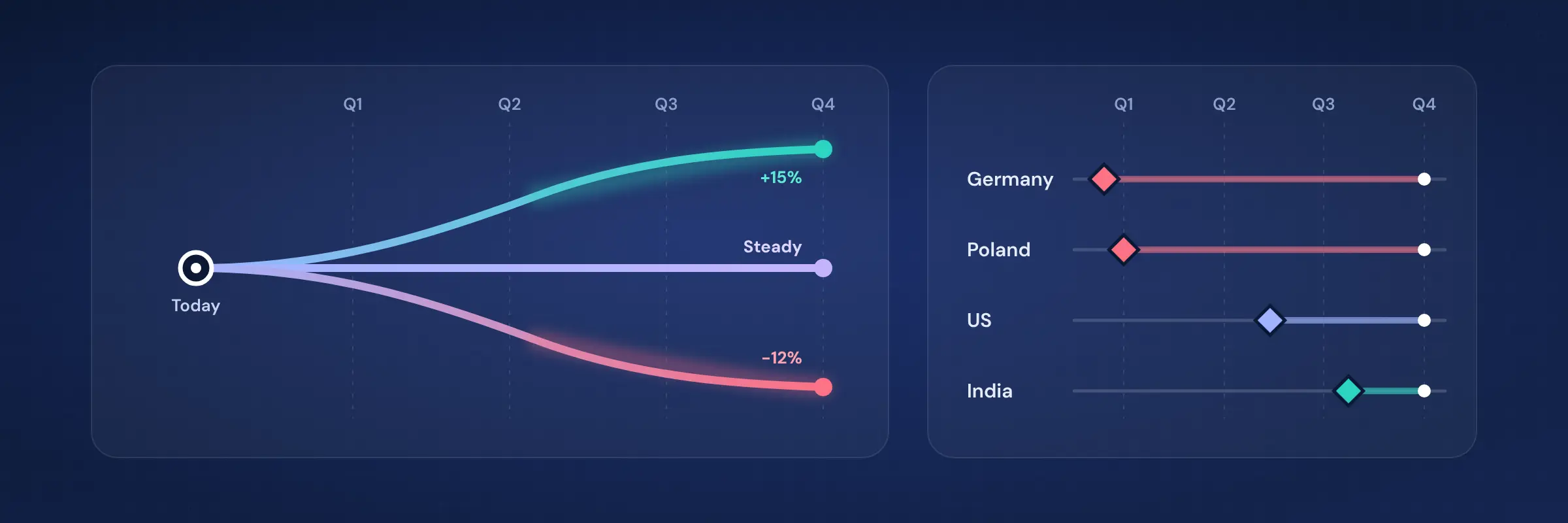
Picture a US-headquartered IT services firm with about 12,000 employees across the US, India, Poland, and Germany. Its cloud data engineering practice has 800 engineers today: 200 in the US, 400 in India, 120 in Poland, and 80 in Germany. The main uncertainty is demand from its financial services clients over the next four quarters, so the firm builds three scenarios around it.
| Scenario | Demand change | Engineers needed | Gap or surplus | First responses |
|---|---|---|---|---|
| Programs land | +15% | 920 | Gap of 120 | Redeploy 40 engineers with adjacent skills, start an upskilling cohort of 50, add 30 contractors |
| Steady demand | No change | 800 | None | Backfill attrition only in critical skills |
| Client pullback | −12% | 704 | Surplus of 96 | Pause backfills, redeploy 40 engineers to other practices, review remaining roles by country |
The pullback scenario shows why a skills-level baseline matters. Assuming 10% annual attrition, pausing backfills absorbs about 20 roles a quarter, and redeploying 40 engineers to other practices absorbs more. After two quarters, about 16 roles are left to review, against a headline surplus of 96. A headcount-only plan would have started with the larger number.
The firm then builds its lead-time ladder, ranking each lever by how long it takes from decision to effect.
| Lever | Assumed lead time | Where it applies | Note |
|---|---|---|---|
| Redeploy within a country | 2–4 weeks | All four countries | Depends on a current skills baseline |
| Contractors | 4–6 weeks | All four countries | Highest cost per hour; suits short gaps |
| Upskill adjacent employees | 10–12 weeks | All four countries | Needs engineers with adjacent skills, such as SQL and Python |
| Hire locally | 3–6 months | All four countries | Includes candidate notice periods, which vary by country |
| Sponsor H-1B workers for US roles | 6–18 months | US | Annual cap cycle; cost currently under legal challenge |
| Reduce roles in the US | Decision at least 65–70 days ahead | US | WARN Act, where it applies |
| Reduce roles in Germany or Poland | Consultation, then at least 30 days after notification | Germany, Poland | Collective Redundancies Directive plus national law |
Read against the scenarios, the ladder changes the plan in two ways. In the growth scenario, any US capacity needed before October has to come from redeployment, upskilling, contractors, or local hiring, because sponsorship can't deliver in time. In the pullback scenario, the decision point for Germany and Poland comes earlier than for the US, so the European review needs an earlier signpost, such as two consecutive months of declining pipeline coverage, instead of waiting for signed contract cancellations.
Common mistakes in global workforce scenario planning
Most scenario plans that stall do so for a handful of predictable reasons.
Building more scenarios than anyone can act on. Six or eight scenarios feel thorough, but leaders can't keep that many in mind, and the responses start to overlap. Three distinct scenarios with clear triggers usually lead to more decisions than a larger set that's discussed once and filed.
Planning in headcount only. A headcount scenario says the US needs 40 more people; it can't say whether 25 of them already work for you in a different practice. Building scenarios on skills, the idea behind skills-based workforce planning, surfaces redeployment options that headcount hides, and that's often where the cheapest response sits.
Using one global trigger. A single enterprise-wide trigger, such as "revenue 5% below plan," fires at the same moment for every country, which is too late for slow levers and too early for fast ones. Set triggers per lever and per country, as described in step 5.
Leaving the scenarios with finance alone. When scenarios live only in the financial model, they describe cost but not capability, so the plan can't say which skills to build or move. HR's job is to own the skills and supply side and to make sure each scenario ends in a people decision.
Letting scenarios go stale. Scenarios built for the budget cycle and never revisited stop matching the business within a few quarters. Retire a scenario once its signposts rule it out, and replace it with the next most relevant uncertainty.
How to measure whether your scenarios are working
The test of a scenario plan is whether it changes decisions and their timing, so measure those more than forecast accuracy.
| Metric | What it tells you |
|---|---|
| Decision lead time | Days between a trigger firing and an approved action, compared with the lever's lead time. If decisions take longer than the lever allows, the triggers are set too late. |
| Share of gaps filled internally | The proportion of scenario gaps closed through redeployment or upskilling. A rising share suggests the skills baseline is doing its job. |
| Unplanned contractor and overtime spend | Spend that no scenario anticipated. Large amounts point to a missing uncertainty or a trigger that didn't fire. |
| Scenario coverage | Whether actual demand fell within the range of your scenarios each quarter. Repeated misses mean the uncertainties need rethinking. |
Most teams start with decision lead time because it's the easiest to track, and it shows quickly whether triggers are turning into action.
What scenario planning can't do
Workforce scenario planning shortens the time between a signal and a decision, but it can't tell you which future will arrive. It also depends on data quality: if the skills baseline is out of date or inconsistent across countries, every scenario inherits the error. It isn't a substitute for employment or immigration counsel either, because notice periods, consultation duties, and visa rules change, and each country's specifics need legal review before a contraction or sponsorship decision. A skills intelligence platform such as iMocha can keep this baseline current and on one proficiency scale across regions, which matters because a baseline built from an annual survey is already months old by the time leaders review the scenarios.
Frequently asked questions
How many scenarios should a workforce plan include?
Three is usually enough: one where demand grows, one where it holds, and one where it falls. Beyond four, the differences between scenarios blur and decisions slow down.
How often should workforce scenarios be updated?
Review the signposts monthly or quarterly, and rebuild the scenarios at least once a year or whenever a major assumption changes. The review cadence should be short enough that your slowest important lever can still be pulled in time.
Who owns workforce scenario planning, HR or finance?
Both share it: finance usually owns the demand and cost assumptions, and HR owns the skills, supply, and people levers. A named HR leader, often in workforce planning or people analytics, should own turning each scenario into actions.
What data do you need for workforce scenario planning?
You need a skills baseline by location, attrition and hiring lead times by country, workforce cost data, and the business signals that indicate demand. The skills baseline is usually the hardest part to get consistent across countries.
How is workforce scenario planning different from strategic workforce planning?
Strategic workforce planning defines the long-term workforce needed to deliver the business strategy, and scenario planning tests that plan against several possible futures. In most enterprises, scenario planning is one component of strategic workforce planning.
How do you account for different labor laws in workforce scenarios?
Record each country's notice, consultation, and visa timelines as lead times on the relevant levers, and set triggers early enough to respect them. Have employment counsel confirm those timelines for each country before relying on them.
Where to start
Workforce scenario planning gives a global enterprise a short list of plausible futures, the skills each would require in each country, and the signals that say when to act. What makes it work across borders is respecting lead times: the levers available and how long they take differ by country, so the triggers have to differ too. Every scenario is measured against your current skills, so the practical first step is to run a skills gap analysis in your largest practice and country, then add scenarios once that baseline holds up.