When a plan doesn’t work, it becomes clear that it has a weak foundation. Similarly, when executive decisions are considered routine HR drills with no actual business execution model in place, it hinders prosperity in workforce planning.
This is a critical concern for CFOs and CEOs, as this might increase workforce constraints, which negatively impact revenue, margin, and productivity, while also affecting transformation timelines, understanding of risk exposure, and required capital allocation.
Most often, such issues occur when organizations adhere to their traditional practices, focusing on fulfilling the headcount, anticipating forecasts, and accomplishing hiring targets. This doesn’t benefit, as markets today demand a more effective workforce planning model that answers all the following questions:
- Do we have the skills to execute the strategy?
- Where will talent gaps slow growth?
- Which roles or skills are most business-critical?
- Should we build, buy, borrow, automate, or redeploy capabilities?
- What is the cost and risk of each option?
And this conveys that a workforce planning model can earn executive action when it turns talent data into business trade-offs.
Key Takeaways
- CFOs and CEOs believe that precise workforce planning purely connects talent decisions to business outcomes, cost, risk, and execution.
- Traditional headcount plans are too static and role-based and stay disconnected from real-time skills requirements and work demand, affecting productivity.
- Workforce planning models that forecast demand, skills supply, gap analysis, cost modeling, scenario planning, and execution tracking help gain immense profit.
- Only upgraded skills intelligence will help HR leaders provide proper data on ideal options (build, move, or hire the capabilities) needed for strategic priorities.
- Workforce planning models turning HR data into decision options and not just dashboards will prove valid in the future.
Why CFOs and CEOs Ignore Many Workforce Plans
CFOs and CEOs often divert their focus from workforce planning when it seems disconnected from business priorities, financial trade-offs, execution risks, and measurable outcomes. Traditional workforce plans lack skills intelligence and are subject to static and role-based developments owing to rigid and linear career plans.
Many organizations focus on managing headcounts instead of capabilities; this might accomplish hiring demand/targets, but critical capability gaps might remain unfulfilled. Weak workforce planning lacks in-depth details, delaying decisions concerning costs of building, buying, and borrowing capabilities, and does not define business scenarios clearly.
When the planning does not connect roles and skills to revenue, productivity, compliance, customer experience, or transformation timelines, the operations might get negatively impacted. The primary reason for the disconnect is stale job descriptions or manager estimates providing no real-time, objective skill insights, thus affecting strategic decision-making owing to assumptions.
What CFOs and CEOs Need from a Workforce Planning Model
When organizations have objective and in-depth skills data/insights, they can build workforce planning models that reveal loopholes and help resolve issues early. CFOs and CEOs need workforce planning models showing exact talent gaps affecting growth, cost, productivity, execution speed, and business risk. Hence, models linked to business priorities interest leadership and executives.
Proper workforce planning models enable an understanding of costs and budgets that impact the organization; it also gives clarity on capacity and productivity that can be delivered using precise analytics. Organizations can gain real-time insights into skills supply and demand, which helps with skill gap analysis. As a result, it helps to understand critical roles and cover critical skills either by building, buying, borrowing, automating, or redeploying capabilities.
A workforce planning model is designed to anticipate future workforce requirements, as it involves scenario planning, understanding risk exposure, measuring time-to-impact, recommending data-driven decisions, and providing measurable outcomes.
These expectations also reflect current talent management trends, particularly the shift toward skills-based decisions, workforce analytics, internal mobility, and human-AI workforce planning.
Practically, it answers the questions in the table below, helping executives build a future-ready workforce:
How to Build a Workforce Planning Model
Every plan works on a set framework with ideal expectations to provide measurable outcomes. A workforce planning model that executives can act on must include business demand, work demand, skills supply, gap analysis, financial scenarios, and execution tracking.
The 6S Executive Framework helps organizations scale their operations, helping to accomplish long-term goals with great efficiency. Let us understand how organizations can implement this.
Framework: The 6S Executive Workforce Planning Model
1. Strategy Demand
The first step involves initiating with business priorities, not HR assumptions. It is important to comprehend strategies demanding actual attention and acquire skills to fulfil them. To perform this, it is vital to map the following goals with the skills requirements:
- Revenue growth plans
- Digital transformation goals
- Productivity targets
- Market expansion
- Customer experience goals
- Risk and compliance priorities
- Cost optimization goals
2. Scope of Work
A workforce planning framework involves providing clarity on tasks, projects and goals. With the scope of work defined, enterprises can translate their strategy into work demand by asking the following questions:
- What work needs to be done?
- Which roles are changing?
- Which tasks are increasing or declining?
- Which work can be automated or augmented?
- Which capabilities are becoming business-critical?
3. Skills Supply
One major step includes assessing the current workforce capability. The following must be evaluated to reveal essential skills requirements as per the market trends and industrial needs:
To be evaluated:
- Current skills
- Skill proficiency
- Skill gaps
- Adjacent skills
- Critical skill concentration
- Internal mobility readiness
- Learning potential
- Succession coverage
4. Shortfall and Risk
As we proceed with each step, identifying where supply does not meet demand, finding shortfalls and risks also become critical. Analysis of the following issues and risks assists organizations in pre-planning and taking preventive measures.
To analyze:
- Critical skill gaps
- Role shortages
- Attrition risk
- Productivity constraints
- Talent concentration risk
- Time-to-proficiency risk
- Compliance or customer-impact risk
5. Scenario Options
Most often, getting stuck with one decision might result in unforeseen risks, which might become difficult to tackle. Building decision options/scenarios or keeping better alternatives enables better risk handling.
Things that must be compared:
- Building through reskilling
- Buying through hiring
- Borrowing through contractors or partners
- Redeploying internal talent
- Automating repetitive work
- Redesigning roles or workflows
6. Score and Track
When plans are designed, execution tracking and scoring must be properly done to ensure correct measures are taken to reduce bottlenecks and make the process flow smoothly.
Organizations can turn the plan into an executive operating model by tracking the following:
- Workforce readiness score
- Skill gap closure rate
- Internal mobility rate
- Time-to-fill
- Time-to-proficiency
- Productivity impact
- Cost variance
- Execution milestones
This 6S Executive Framework, when leveraged properly, makes workforce planning efficient and productive.

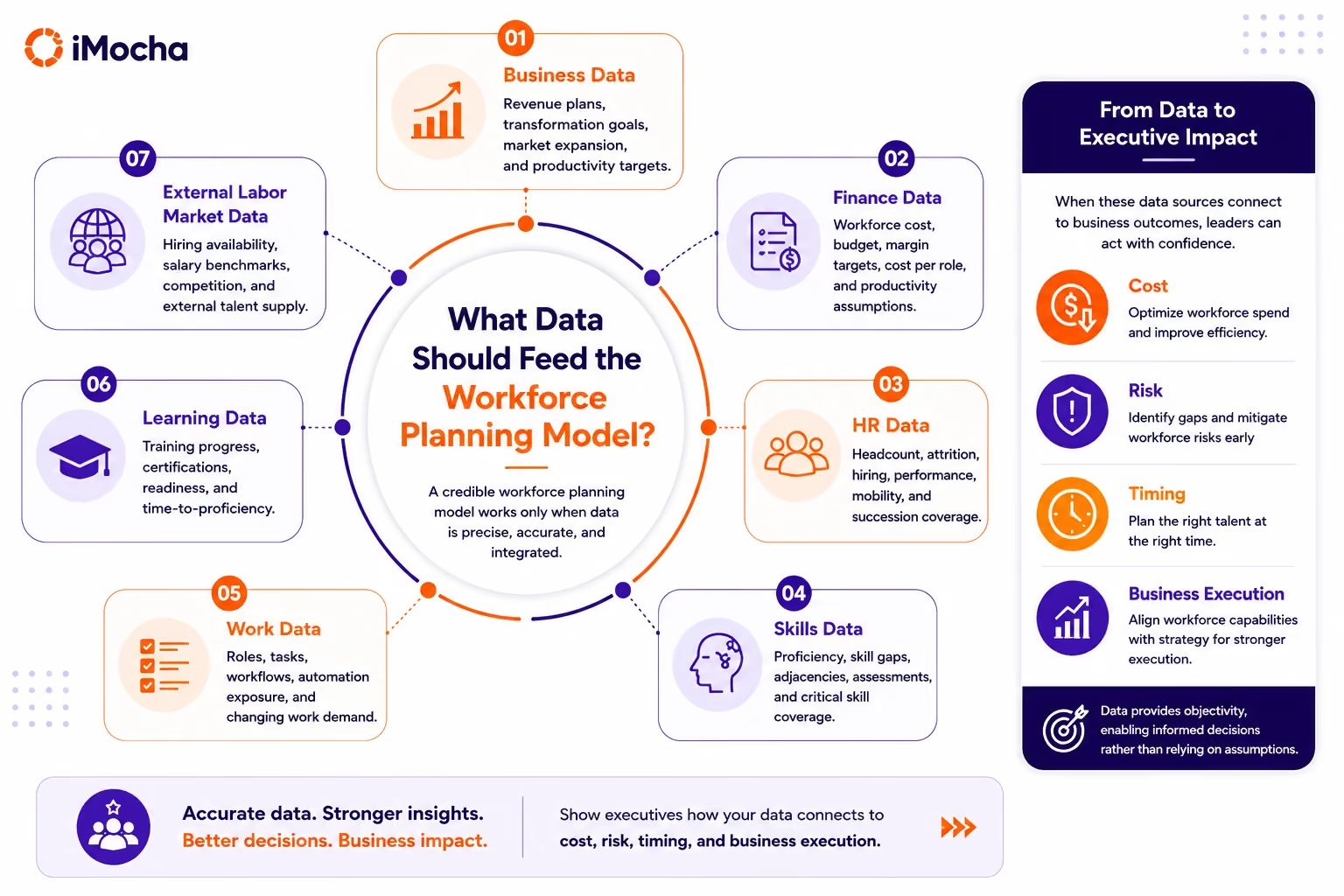
What Data Should Feed the Workforce Planning Model?
A credible workforce planning model facilitates and works only when data is precise and accurate. Data ensures decisions are backed up by valid insights.
As a result, it should combine the following data inputs:
- Business data: Revenue plans, transformation goals, market expansion, and productivity targets
- Finance data: Workforce cost, budget, margin targets, cost per role, and productivity assumptions
- HR data: Headcount, attrition, hiring, performance, mobility, and succession coverage
- Skills data: Proficiency, skill gaps, adjacencies, assessments, and critical skill coverage
- Work data: Roles, tasks, workflows, automation exposure, and changing work demand
- Learning data: Training progress, certifications, readiness, and time-to-proficiency
- External labor market data: Hiring availability, salary benchmarks, competition, and external talent supply
Executives are more likely to act when HR leaders can showcase how these data sources connect to cost, risk, timing, and business execution. Data provides objectivity, enabling informed decisions rather than relying on assumptions.
How to Turn Workforce Planning into CFO and CEO Decisions
Workforce planning becomes actionable when it gives executives clear choices, trade-offs, cost implications, timing, and ownership. A plan works out when it converts gaps into decision options and helps compare them (build, buy, borrow, automate, and redeploy). Instead of relying on single forecasts, if a niche role is slow to fill, organizations can compare contractors with redeploying adjacent internal talent.
Workforce plans make management’s tasks easier by assigning owners to each workforce action and attaching timelines and milestones, thus motivating the employees to take progressive action. For example, if there is an AI analytics skill gap, organizations can compare external hiring with reskilling current analysts.
Proper planning and its execution clarify the stage at which executive intervention will be required. In the case where attrition is high in a critical role, organizations can make strategic decisions by comparing retention investment with assembling a successor bench. Additionally, a workforce planning model’s efficiency becomes evident to CFOs and CEOs when outcomes get reported as business trade-offs.
How Skills Intelligence Strengthens Workforce Planning
Skills intelligence (SI) strengthens skills-based workforce planning by giving leaders a validated view of current capabilities, future skill gaps, adjacent talent, and workforce readiness. It provides validated and precise skills data that improves workforce planning accuracy. For e.g., if repetitive work is creating capacity pressure, it enables organizations to perform a data-driven comparison of adding headcount with automating selected tasks.
Organizations can use iMocha's Skills Intelligence platform to perform skill gap analysis and understand where exactly capability gaps affect the strategy, helping make resolutions early. It also facilitates internal mobility as a complementary benefit by identifying skill adjacency, which helps identify “build” and “redeploy” options.
After skill gap analysis, organizations can create customized assessments through skills data, improving confidence in internal employee readiness and reducing overreliance on external hiring. They can also create precise workforce readiness dashboards, which make talent risks easier to explain to executives, since SI helps connect L&D, internal mobility, workforce planning, and hiring decisions in one place.
This helps HR leaders present CFOs and CEOs with workforce plans grounded in capability data and not assumptions. IMocha not only replaces assumptions but also enables insight-driven decisions to sustain long-term risks and scale operations.
What Metrics Should the Executive Workforce Planning Dashboard Include?
An executive workforce planning dashboard has relevant metrics that show whether the organization has the required skills, capacity, cost control, and talent movement needed to execute business priorities.
The following table provides an overview of how a dashboard with appropriate workforce planning metrics helps make decisions for distinct significant operations:
Conclusion
Clarity brings precision, and insights drive decisions. As a result, CFOs and CEOs act with workforce planning models when they give them clear, business-linked decisions. A strong model built with skills intelligence helps connect strategy, work demand, skills supply, risk, cost, scenarios, and execution tracking in one place.
In today’s era, workforce planning cannot be limited to headcount requests or annual hiring forecasts, but it must widen its scope to helping executives decide the right places to invest, reskill, redeploy, and comprehend talent gaps slowing down business execution.
Practically, a workforce planning model that gets executive action is likely to turn workforce data into business trade-offs, decision options, and measurable execution outcomes. With iMocha’s Skills intelligence, organizations can not only empower employee growth but also increase business productivity.
FAQs
How is a workforce planning model different from a hiring plan?
A hiring plan focuses on filling out vacancies, managing headcounts, and meeting recruitment targets. A workforce planning model ensures that the business has the skills, capacity, roles, and cost structure needed to execute strategies. It helps leaders decide when to hire, reskill, redeploy, automate, borrow talent, or redesign work.
What makes CFOs more likely to trust a workforce planning model?
CFOs trust workforce planning when it is backed by evidence and has a financial impact. The model should show cost, productivity risk, time-to-proficiency, margin impact, and the cost of delay. It should help finance leaders compare workforce options with the same rigor used for other business investments.
How can HR show the cost of not acting on workforce gaps?
HR can show the cost of inaction by connecting skill or role gaps to business consequences. These may include delayed revenue, missed transformation milestones, higher contractor spends, lower productivity, compliance exposure, or customer delivery risk. This shifts the discussion from accomplishing hiring targets to understanding the skills gap delaying business productivity.
What is the role of scenario planning in workforce planning?
Scenario planning helps leaders compare different workforce decisions before committing budget and resources. Instead of relying on one forecast, HR leaders can use models that provide build, buy, borrow, automate, and redeploy options. Each scenario should show cost, speed, risk, and business impact, making workforce planning more useful for executive decisions.
How can workforce planning support build vs. buy decisions?
Workforce planning helps leaders compare whether it is better to develop internal talent or hire externally. If employees have adjacent skills and can reach proficiency quickly, building may reduce cost and protect institutional knowledge. If the skill is urgent, scarce, or highly specialized, buying may be faster. The right decision depends on cost, time, risk, and business priority.
How can HR make workforce planning more actionable?
HR can make workforce planning actionable by turning workforce gaps into clear decision options. Each gap should be linked to a business priority, expected impact, recommended action, owner, timeline, budget need, and success metric. This gives CFOs and CEOs choices they can approve, fund, and track.