

Globally, organizations face issues structuring their data precisely. As per Voxy, fewer than 20% of organizations have been able to scale their skills architecture successfully. Most are still working from skills data that is fragmented across HR systems, learning platforms, and job descriptions.
Most HR leaders deal with great confusion while building their skills architecture, as they consider "Skills taxonomy" and "skills ontology" to be the same thing; they are not. It is vital to understand how they function and differ, as enterprises building a scalable skills architecture need both, not one or the other.
Taxonomy answers where a skill belongs, while an ontology answers how that skill relates to work. Hence, the skills gap that usually organizations face is not usually due to the absence of any one of them; it could be both.
This article breaks down what each one does, how they differ, and why HR leaders need both to build a working skills architecture.
Key Takeaways
- Taxonomy gives skills structure; ontology gives them context.
- A scalable skills architecture needs both taxonomy and ontology, not one in isolation.
- Connected skills data supports smarter role matching, career pathing, and workforce planning.
- Upskilling and reskilling become more targeted when skill relationships are visible.
- Skills Intelligence platforms turn structured workforce data into actionable business decisions.
What is a Skills Taxonomy?
A skills taxonomy is a hierarchical framework that organizes skills into categories and subcategories. It groups skills into domains, narrowing them down into specific, named skills. Each skill sits in exactly one place in the hierarchy, similar to a folder structure.
A skills taxonomy typically standardizes and structures:
- Skill domains and groups (Domain)
- Parent-child relationships between skills (Sub-domain)
- Role and job family alignment (Skill Cluster)
- Standardized terminology across the business (Skill Name)
- Job and learning content classification (Skill Classification)
Example: Information Technology (Domain) → Data and Analytics (Sub-domain) → Data Analysis (Skill Cluster) → SQL (Skill Name) → Technical Skill (Skill Classification)
As a result, a skills taxonomy answers one core question: where does this skill belong?
This enables organizations to place the skills correctly, pacing up the decision-making and increasing productivity.
What is a Skills Ontology?
A skills ontology is a connected data model that maps relationships between skills, roles, tasks, and tools. Unlike a taxonomy, an ontology does not place a skill in a single branch. It links that skill outward to everything it connects/relates with, e.g., adjacent skills, transferable skills, required proficiency, certifications, and relevant job roles.
A skills ontology typically maps:
- Relationships between skills, roles, tasks, and tools
- Adjacent and transferable skills
- Proficiency and context
- Certifications and experience
- Semantic relationships between skills
Example: SQL connects to data analysis, reporting, Power BI, business intelligence, and data analyst roles.
A skills ontology answers a different question: how does this skill relate to work?
This enables organizations to understand the network/relationship amongst skills and tasks present within the organization to make better workforce decisions.
Skills Taxonomy vs. Skills Ontology: Key Differences
The core difference between a skills ontology and a skills taxonomy is the depth and variety of relationships each one represents.
A taxonomy is hierarchical and answers where a skill sits. An ontology is network-based and answers how a skill connects to work. Let us understand how they function and differ by referring to the table below:
Examples of a Skills Taxonomy and Skills Ontology
A single skill can illustrate both models side by side.
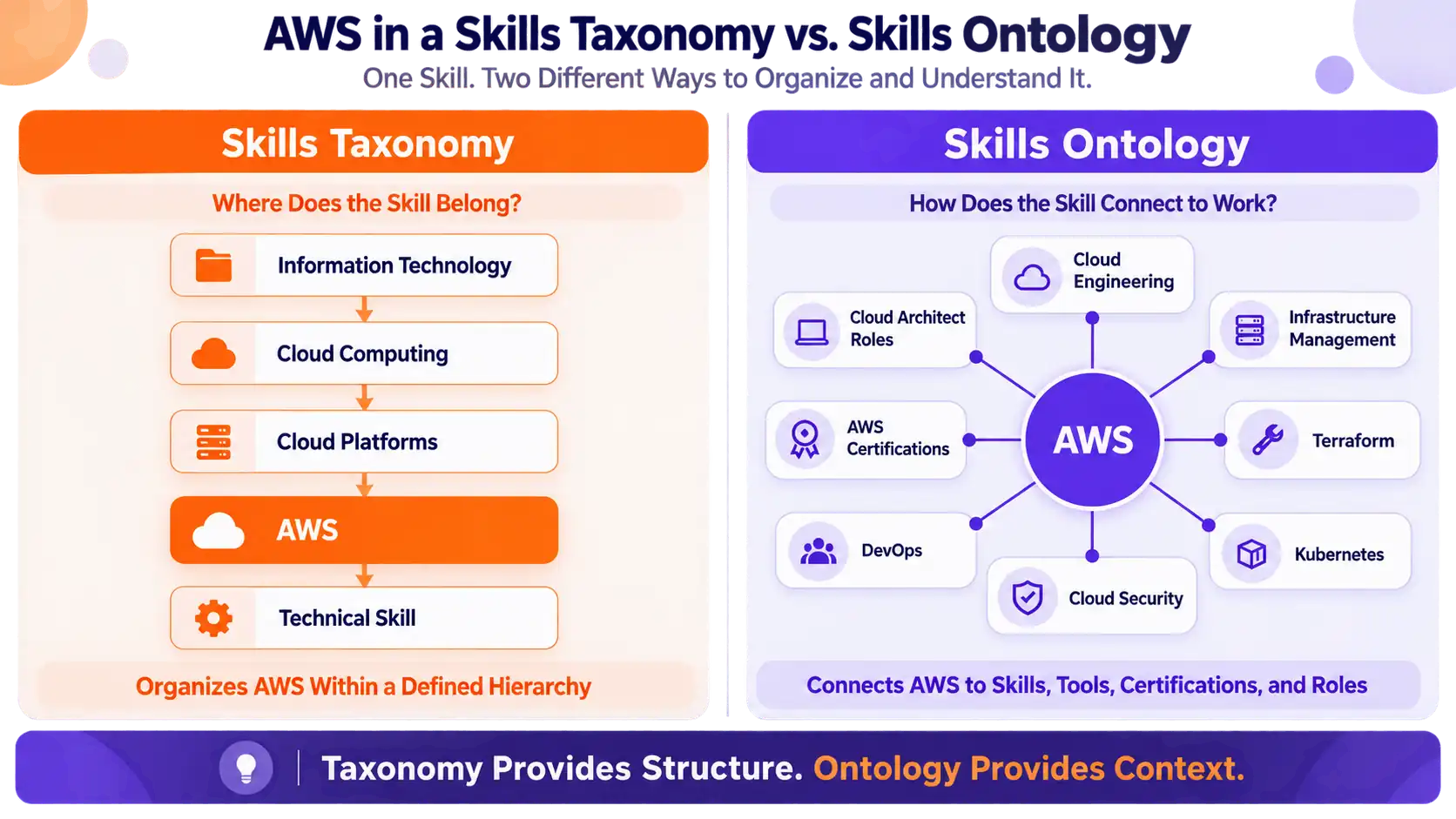
Let us understand it through precise examples for each:
Skills taxonomy example: Information Technology → Cloud Computing → Cloud Platforms → AWS → Technical Skill
This shows AWS filed under one hierarchical path, informing where exactly the skill sits in the skill library, and nothing more.
Skills ontology example: AWS connects to cloud engineering, infrastructure management, Terraform, Kubernetes, cloud security, DevOps, AWS certifications, and cloud architect roles.
This shows AWS in context. It links the skill to adjacent tools, related roles, and the certifications that validate it, so HR can act on the connection, not just the label.
Here's how the taxonomy shows where the skill "AWS" belongs, and the ontology explains how "AWS" connects to work, roles, technologies, and career paths.
Why HR Leaders Need Both for Skills Architecture
HR leaders need both a skills taxonomy and a skills ontology because each one solves a different part of the skills architecture problem.
A taxonomy creates a common skills language across the business. Without it, one team's "data analysis" is another team's "analytics," and reporting breaks down.
An ontology adds the context a taxonomy cannot provide on its own. It connects skills to roles and capabilities, which is what makes internal mobility, career pathing, and workforce planning possible.
Most organizations do not have a unified platform or a skills architecture that provides consolidated taxonomy or ontology functions in one place. Hence, many still stitch together partial views from disconnected systems.
This might lead to a lapse in decision-making or judgement since taxonomy provides the structure and ontology provides relationships, and the presence of both is mandatory to build a skills architecture.
Use Cases of Skills Taxonomy and Skills Ontology
A skills taxonomy is typically the starting or initial point, useful for creating a standardized skills structure with a precise hierarchy, while a skills ontology creates networks or relationships of those skills with tasks, supporting more advanced workforce use cases.
Skills Taxonomy Use Cases
- Standardizes skill terminology: Establishes a common language for skills across teams and systems, reducing duplicate entries and inconsistent naming.
- Organizes learning content: Maps courses and learning materials to relevant skills, connecting learning investments with the capabilities they develop.
- Structures job families: Groups related roles by their shared skill requirements, helping organizations maintain consistent and scalable job architecture.
- Builds role profiles: Defines the skills required for each role, creating a structured foundation for role-specific skill profiles and capability expectations.
- Improves workforce reporting: Categorizes skill data consistently, enabling organizations to compare capabilities across teams, roles, and business units.
Skills Ontology Use Cases
- Identifies adjacent and transferable skills: Surfaces related skills employees can develop or apply based on their existing capabilities.
- Matches employees to roles or projects: Connects employee skills with role or project requirements, beyond job titles alone.
- Supports internal mobility: Identifies employees whose skills align with other roles, highlighting potential internal transition opportunities.
- Builds personalized career paths: Maps realistic routes/connections between current employee skills and those required for a target role.
- Supports workforce planning: Reveals relationships between existing capabilities and emerging skill requirements to identify future skill gaps.
Although the use cases for both taxonomy and ontology differ significantly, both are vitally required to build a skills architecture. It cannot be built using either of the above, as both use cases are essential for making workforce decisions with clarity and precision.
Skills Taxonomy vs. Skills Ontology: Benefits and Limitations
We understood the use cases of skills taxonomy and skills ontology. Now we'll gain insights into how both models come with trade-offs and have an equal share of benefits and limitations worth understanding before committing any budget and governance time to either one.
Let us understand the benefits of both models first.
Skills Taxonomy Benefits
- Easier to build and manage: Provides a hierarchy that is simpler to design and maintain than a network of relationships.
- Improves consistency: Helps everyone work with a common skill language (names and categories), reducing duplication.
- Supports reporting and governance: Uses consistent categories that make skill data easier to audit and roll up.
- Organizes roles and learning content: Provides job profiles and courses with a shared structure to map against.
Skills Ontology Benefits
- Identifies skill relationships: Shows how a skill connects to adjacent skills, tools, and roles.
- Supports better role matching: Aligns employee capability to role requirements beyond job titles.
- Improves internal mobility: Surfaces employees who are close to ready for a different role.
- Surfaces adjacent and transferable skills: Reveals capability that a taxonomy alone would’ve otherwise missed.
- Enables dynamic workforce insights: Updates relationships as skill data changes, keeping insights current and relevant.
These were the benefits of skills taxonomy and skills ontology, and how they support building the skills architecture smoothly. Let us understand their limitations as well.
Skills Taxonomy Limitations
- Limited relationship mapping: A hierarchy does not show how skills connect across categories.
- Weak contextual understanding: It does not capture how a skill is applied for the task in the job description.
- Can become outdated: The categories might need manual review as roles and technologies evolve.
- Does not validate employee proficiency: It lists what a skill is, not whether an employee possesses it.
Skills Ontology Limitations
- More complex to build: Mapping relationships takes more effort than building a hierarchy.
- Requires reliable underlying data: Weak input data produces weak or misleading relationships.
- Needs strong governance: Ownership needs to be taken to govern and validate how relationships are defined and maintained.
- Requires regular updates: New tools, roles, and certifications change relationships continuously; hence, ontologies must be updated regularly.
- AI-generated relationships require validation: Inferred connections need human review before HR leaders act on them.
How Taxonomy and Ontology Work Together in Skills Architecture
Most enterprises need both models working together, not one instead of the other.
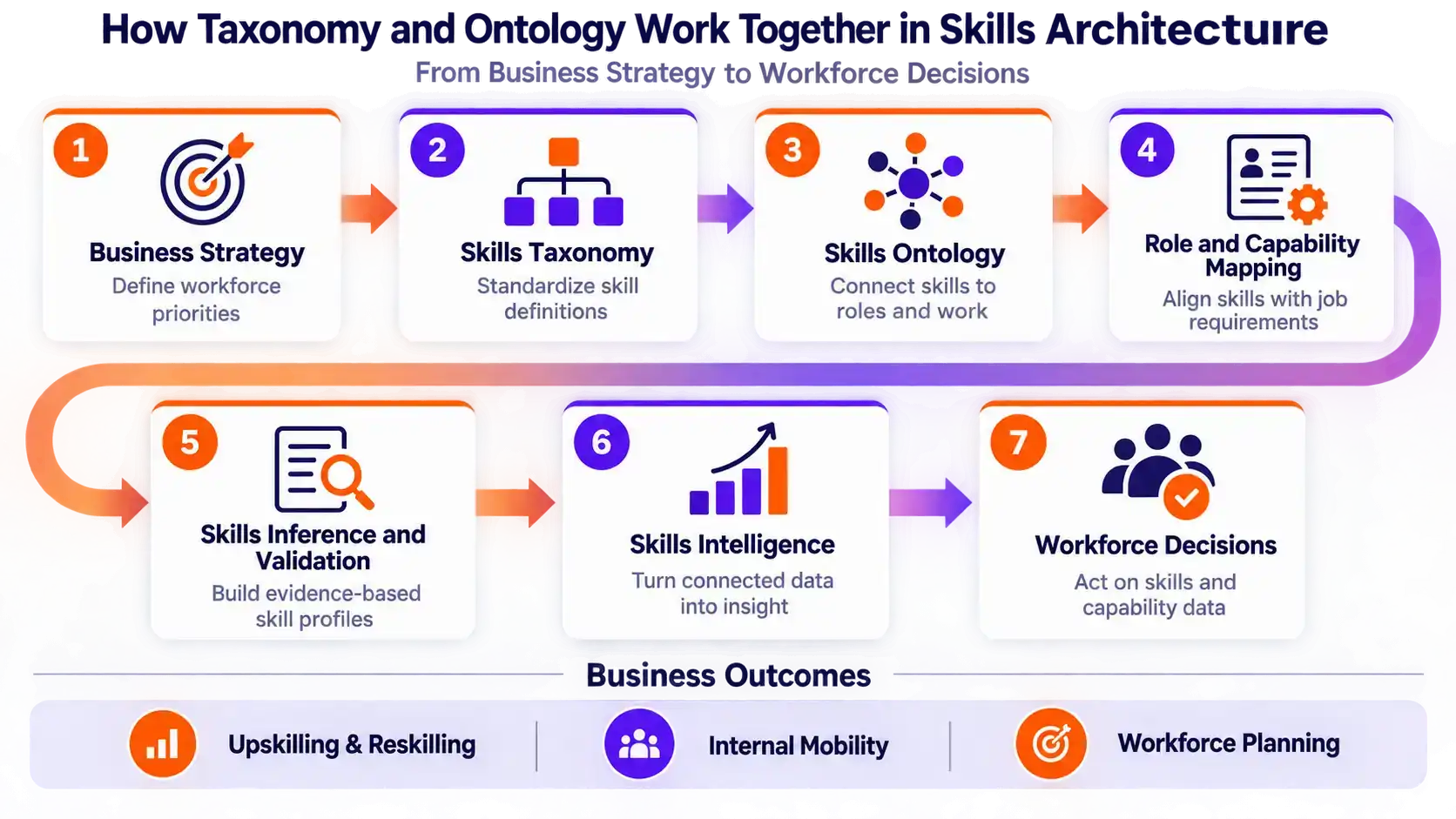
One practical way to sequence the work is by understanding how these components typically depend on each other. To understand the dependency, check whether:
- The business strategy sets the direction.
- The skills taxonomy provides standardized skill definitions.
- The skills ontology connects those skills to roles and work.
- Role and capability mapping align skills to job requirements.
- Skills inference and validation establish employee skill profiles.
- Skills intelligence turns that connected, validated data into workforce insight.
- Leaders use that insight to make workforce decisions.
The above sequence is an editorial framework for understanding how these components typically fit together. It is not an established industry standard, and the actual implementation may vary depending on an organization’s existing systems, data, and business priorities.
In simple terms, the taxonomy defines the business language through standardized skills data, and the ontology creates the relationship among those skills. Inference identifies potential skills, and validation establishes evidence. Finally, skills intelligence turns this connected data into actionable workforce insight.
How Skills Taxonomies and Ontologies Support Skills Intelligence
Skills taxonomies and ontologies support skills intelligence by providing a complete view to the organization that combines standardized skill definitions, skill-to-role relationships, skills inference, proficiency data, workforce demand data, and business capability mapping. A skills taxonomy and skills ontology are foundational to skills intelligence, but neither one can give HR leaders a complete view of workforce capability alone.
iMocha's Skills Architecture defines role-level skills profiles, maps skills to business strategy, and maintains a skills taxonomy that can evolve as industries and job roles change. Its Skills Intelligence platform provides data, unifying taxonomy and ontology data in one place; it gives enterprises a current, AI-powered view of workforce skills, including which skills exist, who holds them, at what proficiency, and which are missing.
This skills data helps leaders act on workforce planning, skill gap analysis, internal mobility, and capability-building decisions, thereby increasing business productivity.
Conclusion
Fragmented skills data can hold organizations back from making timely, informed workforce decisions. When information remains scattered across HR systems, learning platforms, and job descriptions, leaders spend valuable time reconciling data instead of focusing on strategic priorities.
A skills architecture built on taxonomy and ontology data brings the structure and context needed to turn disconnected information into a clearer view of workforce capabilities. This foundation helps HR leaders make better decisions about talent development through upskilling and reskilling, internal mobility, and workforce planning.
As business needs evolve, organizations must look beyond static skill lists and build an architecture that can support changing workforce requirements. The priority is to turn disconnected data into actionable workforce insight, helping organizations align talent with business needs and prepare for future growth.
FAQs
1. What Is the Difference Between a Skills Ontology and a Skills Graph?
A skills ontology defines the types of relationships between skills, roles, and other workforce entities. A skills graph is often the technical structure, typically a network of nodes and edges, used to store and query those relationships. In practice, many platforms use the terms loosely and interchangeably.
2. How Is a Skills Taxonomy Different From a Competency Framework?
A skills taxonomy classifies individual skills into categories and subcategories. A competency framework typically groups broader behaviors and capabilities, often tied to performance levels or job grades, rather than discrete skills. Taxonomies are usually a narrower, more skill-specific structure.
3. How Often Should a Skills Taxonomy and Skills Ontology Be Updated?
Update frequency depends on how fast your industry's skill requirements change, but reviewing core taxonomy structures at least annually is a reasonable baseline for most enterprises. Ontology relationships should be updated more continuously, since new tools, certifications, and adjacent skills emerge faster than formal taxonomy categories do.
4. Who Should Own Skills Taxonomy and Ontology Governance?
Ownership typically sits with HR or L&D leadership, often within a center of excellence, with input from business unit leaders who understand role requirements. Clear governance matters because inconsistent updates from multiple teams recreate the fragmentation both models are meant to solve.
5. Can AI Automatically Build a Skills Ontology?
AI can accelerate ontology building by inferring relationships between skills, roles, and tasks from sources like job data and learning content. Those AI-generated relationships still require human review before HR leaders rely on them for mobility or workforce planning decisions, since inferred connections are not automatically accurate.

