
Organizations with enduring leadership capability gaps are often more vulnerable to succession crises than they think about. As business priorities evolve, determining leadership readiness solely on tenure or titles will no longer benefit, since it’ll be vital to assess the current leaders against future role requirements to align leadership skills with business strategies. Significantly, validating readiness through evidence and continuously monitoring the leadership pipeline are also crucial.
Succession crises are a rare occurrence; however, overreliance on outdated role assumptions and annual talent reviews fails to fulfill the current requirements. Additionally, informal nominations and self-reported readiness, instead of validated leadership capability data, might gradually result in such crises.
Building a future-ready workforce needs continuous visibility into leadership bench strength. With leadership assessments and skills intelligence, organizations can fine-tune their succession planning. According to Gartner, succession planning facilitates internal mobility, filling critical positions early and maintaining business continuity, while reducing leadership risk.
Key Takeaways
- Leadership capability gaps create succession risks when readiness is unclear.
- Succession planning should rely on validated capability, not just performance or tenure.
- Delaying early planning might threaten business continuity, impacting its efficiency negatively.
- Skills intelligence helps identify future leaders early, while assessments guarantee assessing their readiness.
- Organizations smartly preparing early might fulfill critical positions within appropriate timelines, facilitating employee and business growth.
In this article, we’ll get an in-depth insight into ways that’ll help understand & identify leadership capability gaps before they gradually build up the succession crises.
What Are Leadership Capability Gaps?
The leadership capability gap is the difference between the leadership skills, behaviors, experiences, and decision-making abilities that an organization needs and the capabilities that its current or potential leaders can presently demonstrate. Practically defined as what an organization needs and what its leaders currently possess.
Leadership capability gaps are not necessarily skills gaps; they are disparities weakening the workforce, affecting business productivity. Gaps usually occur in strategic thinking, change leadership, communication, decision-making, teaching, business intelligence, AI/technical readiness, and resilience.
Although the performance might be strong for the current leaders, fulfilling complex future roles can become difficult, as future roles might require updated and validated skills. When leaders lack the skills required for critical roles, fulfilling essential business needs becomes tough and impacts succession pipelines. Hence, leadership readiness must be measured against current business needs and not previous leadership performances to build future-ready teams.
Why Leadership Capability Gaps Become Succession Crises
Succession crises occur when organizations discover capability gaps too late, making the internal pipeline fragile to absorb the pressure. Critical roles require expertise, and hence, their dependency relies on a small number of leaders. When leaders leave owing to retirement, turnover, restructuring, burnout, or business expansion, pipelines become weak with no internal talent being prepared or having definite skills to replace them.
At times, organizations often confuse high performance with leadership readiness. Performance data reflects current expertise and not readiness to equip complex roles. As succession reviews are provided annually, and not quarterly, real-time, evolving changes in the business strategy, leadership behavior, or role complexity remain uncaptured, delaying strategic workforce planning.
Most often, successor lists might include professionals without validated readiness, inducing leadership gaps that affect decision speed, business continuity, employee confidence, and transformation execution. There’s a mounting pressure to maintain leadership pipelines, with DDI’s Global Leadership Forecast 2025 highlighting how only 20% of HR leaders believe they have a strong bench of leaders ready to fill critical roles. This makes early identification and fulfilling of gaps a business norm rather than a trivial initiative.
Which Leadership Capabilities Should Organizations Assess?
Organizations should assess leadership capabilities that predict future-role readiness, including having strategic judgment and predictive analysis understanding, adaptation skills, and people leadership, business acumen, digital fluency to reduce the AI skills gap, and resilience.
Let us understand the core leadership capabilities to assess:
- Strategic thinking: The ability to connect business contexts, dynamic market trends, and long-term priorities is a vital skill. Strategically aligning things as per requirements showcases great leadership abilities.
- Decision-making: Abilities that help make timely, ethical, data-informed decisions under uncertainty provide critical thinking capabilities, which assist in making informed and insightful decisions.
- Change leadership: Leading teams through transformation, restructuring, or new operating models displays how leaders with amazing collaboration initiatives can bring impactful change.
- People leadership: The ways a professional can coach, develop, motivate, and retain talent highlights the patience level they possess to deliver training and knowledge to teams and subordinates with ease.
- Collaboration and influence: The ability to work across functions, align stakeholders with their intelligence, and influencing tactics help teams thrive on collaboration, thereby scaling operations.
- Business acumen: Leaders possessing an understanding of financial, operational, customer, and market realities help them deliver outstanding results.
- Digital and AI fluency: Knowledge of technology and AI-driven environments helps contribute widely to strategic operations and improve digital transformation, thereby accelerating them.
- Execution discipline: Strategizing operations and converting them into measurable results showcases the discipline necessary for leadership readiness.
- Learning agility: Adaptation, quick learning, and handling unfamiliar challenges displays situational alertness, highlighting the learning agility that a leader needs.
- Enterprise mindset: Having decision-making power to handle multiple teams, functions, or geographies reflects the leadership scope and enterprise mindset that critical roles demand.
How to Identify Leadership Capability Gaps Early
HR teams must prioritize identifying leadership capability gaps at their initial stages. Certain steps can be followed by HR teams to identify leadership capability gaps, act upon them, bridge them, and enact intellectually to refine processes dynamically.
The following steps can be implemented to identify gaps earlier:
Step 1: Define Critical Leadership Roles
The first step is identifying and defining roles that are essential for creating a strategy, maintaining continuity, increasing revenue, helping in transformation, customer success, operations, or culture.
Step 2: Map Future Leadership Requirements
The second step is to define the capabilities the future leaders will need based on business strategy, market change, digital transformation, AI adoption, and operating model shifts.
Step 3: Assess Current Leadership Capability
As we proceed, it is vital for organizations to use structured assessments, gain and provide 360-degree feedback, perform simulations and behavioral interviews, review performance data, and assess outcomes to evaluate readiness.
Step 4: Compare Current Capability Against Future Role Needs
The gap between current and future skill requirements must be assessed by using predictive analytics that help anticipate future requirements and provide proper analytics to make smarter decisions.
Step 5: Segment Leaders by Readiness
Moving forward, it is necessary that the organization bifurcate potential employees well amongst certain successor readiness categories: ready now, ready in 1 to 2 years, ready in 3 to 5 years, and not yet ready. This helps make appropriate decisions in a timely manner.
Step 6: Link Gaps to Development Actions
Reaching toward the end, it is crucial that each is connected to coaching, stretch assignments, mentoring, learning paths, assessment-based development, or internal mobility opportunities. Channeling gaps and mapping them to correct upskilling and reskilling initiatives helps bridge them faster.
Step 7: Monitor Succession Risk Continuously
The concluding step involves reviewing readiness data regularly, not only during annual talent reviews. This helps make real-time updates and provides solutions without any delay.
Leadership Capability Gap Analysis Framework
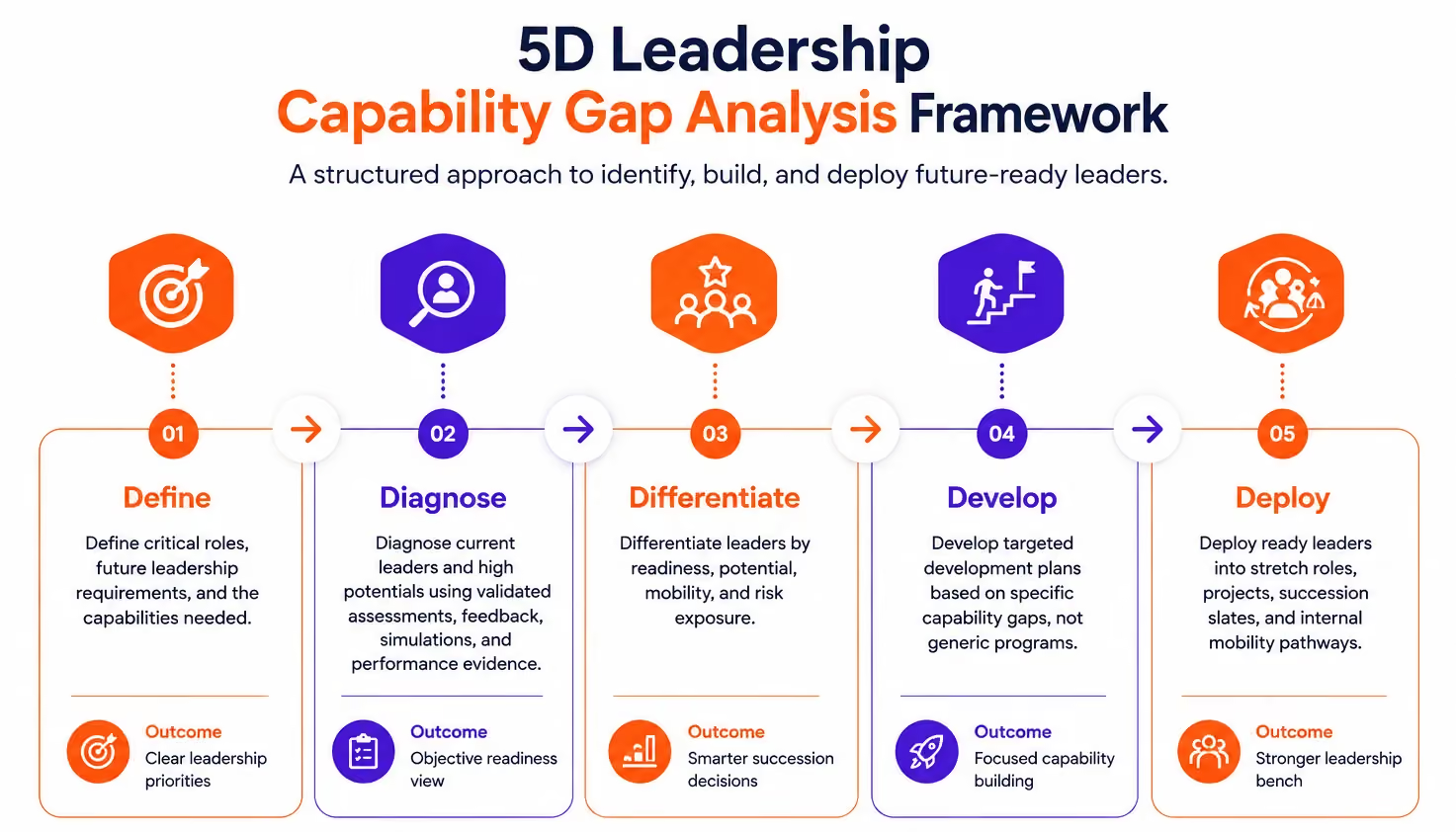
We’ve gone through the steps of identifying capability gaps, but without a strict framework, loopholes can impact the processes negatively. Here’s when a structured leadership gap analysis framework helps HR teams move from informal succession discussions to evidence-based leadership readiness planning.
The Ideal 5D Leadership Capability Gap Framework provides organizations the ability to:
1. Define critical roles, future leadership requirements, and the capabilities needed for business continuity.
2. Diagnose current leaders and high-potential employees using validated leadership assessments, 360-degree feedback, simulations, and performance evidence.
3. Differentiate leaders by readiness, potential, mobility, and risk exposure.
4. Develop targeted development plans based on specific capability gaps, not generic leadership programs.
5. Deploy ready leaders into stretch roles, projects, succession slates, and internal mobility pathways.
What Data Sources Help Identify Leadership Gaps?
When organizations connect assessment data, performance evidence, career aspirations, learning records, and succession planning data altogether, identifying leadership capability gaps is easier.
Data sources to connect:
- Leadership assessments
- 360-degree feedback
- Performance reviews
- Employee engagement data
- Manager feedback
- Business outcome data
- Learning and leadership program data
- Career aspirations
- Internal mobility history
- Succession slate
- Role requirements
- Skills taxonomy
- Workforce planning data
Common Mistakes That Hide Leadership Capability Gaps
Leadership capability gaps often stay hidden when organizations rely on informal judgment, outdated competency models, or generic development programs.
The following mistakes can be avoided by organizations:
1. Equating Performance with Readiness
Most organizations mistake high performers' expertise with their current role with leadership capabilities, while handling complex roles needs skills to be validated as per current standards.
2. Relying Only on Manager Nominations
Nominations can be useful, but they may reflect familiarity, bias, or current-role visibility. Reliance on decisions followed by such parameters might reduce credibility.
3. Reviewing Succession Only Once a Year
Leadership risk changes as people leave; roles evolve, and business priorities shift. All these shifts affect succession planning, and hence, need continuous evaluation rather than reviewing them once a year.
4. Using Generic Leadership Programs
Generic programs with no customizations for experienced professionals cannot address role-specific capability gaps or readiness timelines, as they have outdated learning programs that are not updated as per evolving industry requirements.
5. Ignoring Willingness and Mobility
A potential successor might desire a customized role, location, scope, or career path to upskill or reskill or get cross-functional team transition; however, they might not get them due to rigid and linear career pathways and no valid strategies to navigate precise career trajectories.
6. Not Validating Leadership Capability
Without structured assessments, simulations, or work evidence, succession plans may be based on mere assumptions. Planning based on assumptions might reduce credibility owing to the lack of accurate analytics present for making judgments.
How Skills Intelligence Supports Succession Planning
Skills intelligence supports leadership succession planning by giving HR leaders a connected view of leadership capabilities, readiness gaps, development needs, and internal mobility opportunities. A unified view of structured data allows executives to plan informed succession and devise strategies to strengthen upskilling initiatives.
Let us understand what role Skills Intelligence (SI) plays in succession planning.
- Leadership capability visibility: It helps view the current and future leaders who have the required capabilities aligning with the business objectives. Also, skills visibility helps identify gaps and take initiatives early, as the platform provides real-time updates.
- Readiness gap analysis: It compares the current leadership strengths against future role requirements by performing skills gap analysis, helping organizations find ready successors.
- Proficiency validation: Using leadership assessments and evidence to validate proficiency levels helps confirm whether potential successors carry leadership capabilities or not.
- Targeted leadership development: SI links the identified gaps to learning, coaching, and stretch assignments, which align appropriate upskilling initiatives with targeted development programs.
- Succession pipeline planning: It helps classify leaders by readiness level and role fit, providing opportunities by categorizing leaders as per business necessity and readiness.
- Internal mobility: It helps identify adjacent skills of internal talent that are suitable for critical roles with targeted development. With flexible, cross-functional skill implementation, SI helps create customized career pathways for better internal mobility.
- Workforce planning alignment: It assists greatly in connecting leadership pipeline data with future business needs. This way, roles are aligned with business-critical needs, enhancing workforce planning.
Where Platforms Like iMocha Fit?
iMocha helps enterprises assess leadership capabilities, identify skill gaps, and validate readiness for critical roles with its Skills Assessment platform.
Additionally, its Skills Intelligence platform helps HR and L&D teams enhance their recruitment planning efficiency, replacing assumption-based succession planning with evidence-based leadership development.
How HR Teams Can Prevent Succession Crises
Succession crises, though they occur rarely, might decline business productivity vastly. It gradually builds owing to delays in identifying critical capability gaps. However, they can be prevented by continuous monitoring of leadership readiness, validating capability gaps, and building targeted development pathways before critical roles become vacant.
The following steps might prevent them early:
Step 1: Identify Roles with Highest Succession Risk
Roles with the highest succession risk might impact current operations negatively if potential successors are not identified within the appropriate timeline. Hence, identifying potential employees for executive, strategic, revenue-critical, transformation-critical, and hard-to-fill leadership roles must be highly prioritized.
Step 2: Build Successor Profiles
Organizations must define what a successor must demonstrate, including skills, experiences, behaviors, mobility, and readiness timelines. This helps create successor profiles, which maintain succession pipelines and fulfill critical roles timely.
Step 3: Validate Readiness Objectively
Using structured assessments, performing simulations, providing 360-degree feedback, and analyzing performance through project outcomes and business results help accurately validate the readiness of potential employees with leadership capabilities and align them to correct roles.
Step 4: Create Individual Development Plans
Customized learning pathways help address leadership capability gaps through individual development plans, including coaching, mentoring, learning, stretch roles, and cross-functional assignments. This way, learning programs help upskill potential talent and enhance internal mobility.
Step 5: Review the Leadership Pipeline Quarterly
An annual review might not involve dynamic skills and roles, and therefore, updating succession readiness quarterly is critical. The data, when gathered quarterly, utilizes new assessments, understands role changes, attrition risk, and business priorities, helping stay relevant with market trends.
Step 6: Tie Succession to Workforce Planning
Organizations must necessarily connect leadership pipeline insights with hiring, internal mobility, Diversity, Equity & Inclusion (DE&I) goals, business transformation, and future capability needs. This ties succession to workforce planning and making relevant decisions for each category.
Conclusion
When we follow through the blog, it is highly comprehensive of how risks and issues build up gradually, and when neglected repeatedly, they might create major leadership capability gaps, ultimately leading to succession crises. HR and L&D team leads, specifically working on workforce and succession planning, must understand that performance doesn't prove readiness but provides clarity on current expertise. Thus, to understand leadership readiness, skill validation is essential.
Validated data, targeted development, and ongoing pipeline monitoring can inform executives of potential talent/successors by sorting them according to their readiness levels. Hence, organizations with precise planning and methods can identify leadership capability gaps early and build stronger pipelines, reduce succession risk, and prepare future leaders before critical roles become urgent vacancies.
FAQs
What are leadership capability gaps?
Leadership capability gaps are the disconnect between the leadership competencies an organization needs for future success and the capabilities its current leaders posess. These gaps often emerge in strategic thinking, change leadership, decision-making, digital fluency, and people management.
How do leadership capability gaps affect succession planning?
Capability gaps weaken succession pipelines by creating uncertainty around leadership readiness. When critical roles become vacant, organizations may struggle to find validated internal successors, increasing succession risk and threatening business continuity.
Why is performance not enough to predict succession readiness?
Strong performance reflects expertise in the current role, not readiness for a more complex future role. Succession readiness requires validated evidence of leadership potential, adaptability, decision-making ability, and capability to manage broader responsibilities.
What data should HR use for leadership gap analysis?
HR should combine leadership assessments, 360-degree feedback, performance data, learning records, career aspirations, succession plans, workforce planning insights, and skills intelligence data to gain a complete view of leadership readiness and capability gaps.
How often should organizations review leadership succession readiness?
Leadership readiness should be reviewed continuously, with formal evaluations conducted quarterly. Frequent reviews help organizations respond to evolving business priorities, role changes, attrition risks, and emerging leadership gaps before they become succession challenges.