
Your leadership team approved a three-year business plan, and you built a talent strategy to deliver it. Two reforecasts later, a market entry has slipped and a product line has been cut, so the headcount figures in the talent plan no longer match the business. The hiring and reskilling programs those figures started are still running, though, and some now support goals the business has dropped. This guide shows how to align talent strategy with business strategy when the plan keeps changing.
Aligning talent strategy with business strategy is a planning practice that ties workforce decisions to the capabilities a business plan depends on, rather than to its headcount figures, so CHROs can commit early to skills every scenario needs, keep options open on the rest, and act on clear business triggers when the plan changes.
Key takeaways
Anchor the talent plan to capability assumptions, because headcount figures change with every reforecast.
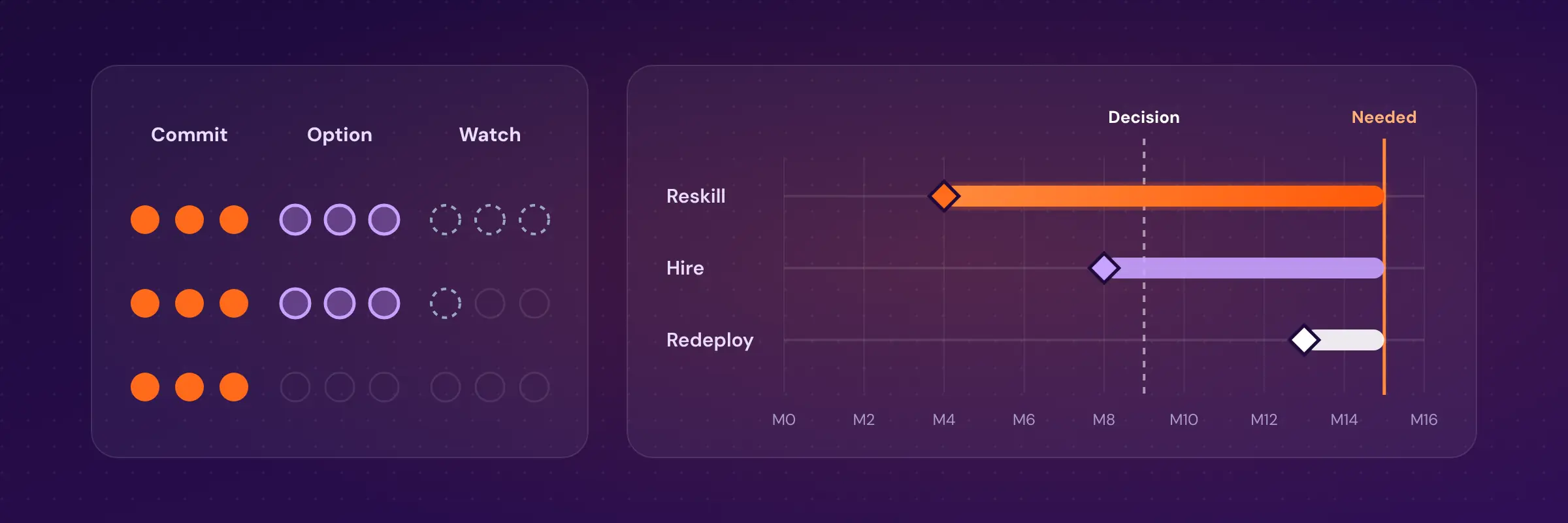
Sort capabilities into commit, option, and watch tiers so only the talent moves every scenario needs start right away.
Talent lead time sets the real deadline, which often falls before the business makes its decision.
Why three-year talent plans break when the business plan changes
Business plans now get revised every quarter, while most talent strategies are still a single projection to year three, so the two drift apart within months. Only 30% of CEOs are very or extremely confident about revenue growth over the next 12 months, down from 56% in 2022, according to PwC’s 29th Global CEO Survey (2026). Workforce planning hasn’t kept up: only a small fraction of CHROs say their workforce planning is agile enough to respond to geopolitical, economic policy, and technology shifts, according to Gartner (2026).
US HR leaders feel it directly. In a 2026 survey of 409 US HR leaders by OrgChart, 46% said economic uncertainty was making workforce planning harder. In practice, when a market-entry date slips by two quarters, the hires approved for it are either frozen mid-process or onboarded into teams with no work for them yet.
Freezing everything isn’t a safe default either. PwC found that companies whose CEOs held back large investments because of geopolitical uncertainty grew about two percentage points more slowly than their peers. For talent, a freeze means losing a year of lead time on skills the business will need under almost any version of its plan.
What it means to align talent strategy with business strategy under uncertainty
A three-year plan contains targets (revenue, margin, cost), bets (enter a market, launch a service), and capability assumptions about what the workforce will be able to do. Targets and bets move with each reforecast, but capability assumptions move more slowly, which makes them the steadier anchor for talent strategy. A revenue target for a new region may be revised twice in a year, for example, while the need for people who can sell and support customers there holds through both revisions.
The payoff is measurable. Organizations with effective workforce planning are 1.4 times more likely to exceed revenue goals and 1.5 times more likely to exceed cost goals, according to Gartner (2026).
| Planning dimension | Fixed three-year plan | Capability-and-trigger plan |
|---|---|---|
| What the plan counts | Headcount by role and year | Capabilities, grouped by how certain the need is |
| Time horizon | One endpoint, usually year three | 12-month commitments plus one- to three-year options |
| Update rhythm | Annual planning cycle | Quarterly, alongside the finance reforecast |
| Response to a plan change | Rebuild the plan | Act on triggers agreed in advance |
How to align talent strategy with business strategy in six steps
Steps 1–4 are done once a year with the business and finance leaders who own the plan. Steps 5 and 6 keep the talent strategy current between planning cycles.
1. Pull the capability assumptions out of the business plan
For each major initiative, ask its business owner what the workforce must be able to do in years one, two, and three. A plan to move client servicing to digital channels, for example, assumes skills in digital product management, customer data analysis, and frontline change management. Leaders often answer in headcount (“we need 25 more people”), so ask what those people would spend their time on and translate the answer into skills.
2. Sort capabilities into commit, option, and watch
Test each capability against the scenarios finance already models, usually a base, downside, and upside case. This applies a method BCG recommends: stress-test the talent strategy against several scenarios to find the “no-regrets” moves that pay off in all of them.
| Tier | What qualifies | Talent action |
|---|---|---|
| Commit | Needed in every scenario | Fund now and start the slowest sourcing route first |
| Option | Needed in some scenarios | Keep a route open cheaply, such as a small reskilling cohort or a standby contractor agreement |
| Watch | Needed only if a specific bet is approved | Track supply and lead time with no spending |
Most capabilities belong in the option tier, which is also where talent budgets get cut first because no single leader defends it. To keep the commit tier honest, ask whether each capability would still be funded in the downside case.
3. Map talent lead times against the plan’s decision points
Talent lead time is the time between deciding to get a capability and having people who can do the work. Comparing it with the date the business will decide shows when the talent decision has to be made.
Worked example (illustrative numbers). The board will decide on a new advisory service at month 9. If approved, the service needs 20 skilled people by month 15, which leaves six months.
| Sourcing route | Time to fill or train | Time to productivity | Total lead time |
|---|---|---|---|
| External hire | 4 months | 3 months | 7 months |
| Reskill employees in adjacent roles | 9 months | 2 months | 11 months |
| Redeploy people who already have the skills | 1 month | 1 month | 2 months |
If HR waits for the decision, only redeployment can deliver on time, and only if 20 qualified people exist. Keeping the reskilling route open means starting a small cohort by month 4, five months before the board decides. That early, limited cost is what the option tier pays for.
4. Set business triggers for each talent move
A trigger is a measurable business event, agreed in advance with the business owner and finance, that moves a capability between tiers. Because the decision is made before the trigger fires, the talent response takes weeks, and HR doesn’t wait for the next planning round.
| Business signal | Talent move |
|---|---|
| The board approves the new service | Redeploy qualified people, assign the month-4 reskilling cohort to the service, and open requisitions for any gap left after both |
| A product line misses bookings for two consecutive quarters | Pause hiring for that line and offer its people redeployment into commit-tier roles |
| The cost target is cut mid-year | Protect commit-tier development spending and reduce watch-tier activity first |
Each trigger needs a threshold, a named business owner, and a date when it will be checked. Vague triggers such as “if demand improves” never clearly fire.
5. Review talent decisions alongside the finance reforecast
Hold the talent review in the same quarterly cycle as the financial reforecast, and cover three questions: which triggers fired, which capabilities changed tier, and which lead times are now at risk. Rebuild the scenarios once a year. This pace fits how leaders describe their strategy: 7 in 10 told Deloitte (2026) that being fast and nimble is their primary competitive strategy for the next three years.
Bring capability risk to the meeting, not just headcount cost. An update such as “the reskilling route closes next month unless the cohort starts” gives the CFO a decision to make. This is an agile approach to workforce planning applied to a changing business plan.
6. Keep a current view of skills supply
The redeployment route only works if HR can find people with the right skills, and job titles rarely show that. The person with the right skills may sit in a finance or operations role with an unrelated title. Skills intelligence maintains this view by combining skills assessments, work data, and HR system records into a continuously updated map of what people can do. It also shortens lead times, because employees who already hold most of the required skills need a shorter reskilling program, making moving employees into high-priority roles a route HR can plan around.
Common mistakes when aligning talent strategy with a changing plan
Replanning headcount after every reforecast. This consumes planning time and produces numbers that change again next quarter. Recalculate headcount from the capability tiers, which change far less often.
Cutting the option tier first. It looks discretionary, but cutting it closes the slower sourcing routes, leaving only expensive external hiring when a trigger fires.
Building scenarios that only HR uses. HR’s scenarios won’t match the ones finance reforecasts against. Start from finance’s scenarios and add talent assumptions to them.
How to measure whether talent strategy is staying aligned
| Measure | How to calculate it |
|---|---|
| Trigger response time | Days from a trigger firing to the first talent action it was meant to start |
| Lead-time coverage | Share of commit- and option-tier capabilities where at least one sourcing route can deliver on time |
| Internal fill rate for commit-tier roles | Commit-tier roles filled by redeployment or reskilling, divided by all commit-tier roles filled |
If trigger response time is measured in months, the triggers are probably too vague or lack business owners.
What this approach doesn’t solve
Tiers and triggers make a talent strategy easier to adjust, but they don’t predict which scenario will happen or make strategic choices leadership hasn’t made. For some scarce skills, early planning won’t shorten external hiring much. A skills intelligence platform such as iMocha’s provides the current view of skills supply and gaps that feeds these decisions, but it doesn’t model financial scenarios, so it works alongside FP&A tools and the HRIS.
FAQ
How often should a CHRO update a three-year talent plan?
Review capability tiers and triggers every quarter alongside the finance reforecast, and rebuild the scenarios once a year or after a major strategy change.
What is a no-regrets talent move?
A no-regrets talent move is an investment in a capability the business needs under every scenario it’s planning for, so it can start before the plan settles.
Should workforce planning start with headcount or skills?
Start with the skills the business plan depends on and calculate headcount from them, because headcount figures change with every reforecast while capability needs change more slowly.
What if leadership won’t commit to a three-year plan?
Plan against the scenarios finance already models and keep most talent spending in the option tier until leadership decides, while still funding commit-tier capabilities.
Keeping talent strategy and business strategy in step
A talent strategy can stay aligned with a business plan that changes every quarter if it’s anchored to capability assumptions and decision dates. Capability tiers, lead times, and triggers agreed with finance mean each reforecast updates the talent plan without rewriting it. A good next step is to fit them into your workforce planning framework.

