

The annual workforce plan was designed for a world where the skills behind a role held steady for years. That world is gone. Employers surveyed by the World Economic Forum expect 39% of workers' core skills to change by 2030, and LinkedIn's Economic Graph puts the shift even higher, projecting that 70% of the skills used in most jobs will change by 2030, with AI as the catalyst.
Meanwhile, most planning is still short-range. McKinsey's HR Monitor 2025 found that 73% of organizations run full operational workforce planning, yet only 12% of US HR leaders do strategic workforce planning with a horizon of three years or more. So the question most CHROs and heads of workforce planning are asking is no longer whether to plan. It is how often to look again, and at what.
This guide answers that with a practical cadence model, the events that should force an unscheduled review, and the reason most review cycles stall: the skills data underneath them is older than the plan.
Key takeaways
- No single review frequency fits a workforce plan. Strategy, headcount, skills, and shocks move at different speeds, so each needs its own clock.
- Quarterly is the minimum for the operating plan in most enterprises with 1,000+ employees, because it matches the finance forecast and the budget decisions that follow.
- The binding constraint is data freshness. A quarterly review built on a once-a-year skills inventory is a quarterly review of old information.
- Use the Two-Reads Rule: look at every planning assumption at least twice within the time it takes that assumption to go stale.
Why does an annual workforce plan break down under constant disruption?
An annual plan fails because its assumptions expire faster than its review date. The plan itself may be sound in January. By July, the AI roadmap has changed, two business units have reorganized, attrition in a critical job family has doubled, and the skills profile the plan was built on is half a year old.
Three things drift between annual reviews:
- Demand assumptions: which roles, projects, and capabilities the business needs, and when. These move with strategy, product launches, M&A, and AI adoption decisions.
- Supply assumptions: who you have and what they can do. Attrition, internal moves, and learning all change supply every month.
- The skills inside roles: even when headcount holds steady, the work changes. A data analyst role in 2026 asks for different skills than the same title did in 2023.
The third kind of drift is the one most plans miss, because job titles and headcount reports don't show it.
To put rough numbers on it (an illustration, not a forecast): LinkedIn projects that 70% of the skills in most jobs will change between 2025 and 2030. Spread evenly, that is about 14 percentage points a year. A plan built on a skills snapshot from January is used, on average, about six months later. By then roughly 7% of the skill requirements in a typical job may have moved, and by the end of the plan year about 14%. Real change is lumpier than this, and concentrated in AI-exposed job families, which makes the gap larger where it matters most.
Horizon and cadence are separate decisions. Bain recommends a strategic plan that looks about six years out, with annual refreshes and a full rebuild every three years. A long horizon does not require infrequent review. It requires the opposite: the further out you plan, the more often you need to check whether the path still holds.
What is the right cadence for reviewing workforce plans?
The right cadence runs four clocks at once, each matched to how fast its assumptions change. We call this the four-clock cadence: an annual strategic refresh, a quarterly reforecast, a monthly signal review, and trigger reviews. Only two of them, the quarterly reforecast and the trigger review, should routinely change the plan.
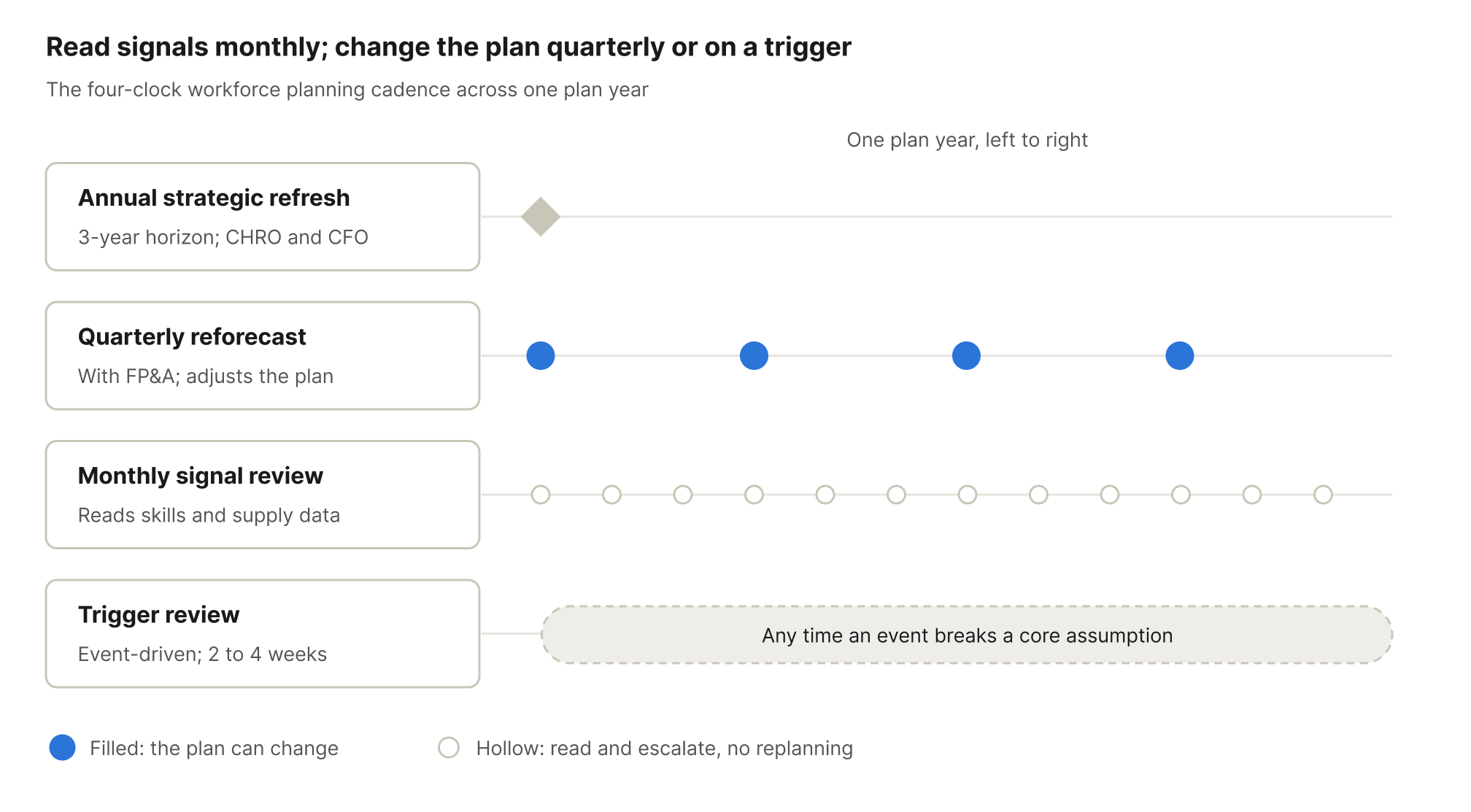
The annual refresh revisits the three-year capability strategy alongside the business strategy and budget. It answers which capabilities the company must build, buy, or borrow, and it should rebuild the forecast from new assumptions every two to three years.
The quarterly reforecast is where the plan actually moves. Running it in the same cycle as the FP&A forecast means requisitions, internal mobility targets, and L&D budgets shift together instead of in separate conversations weeks apart.
The monthly signal review is short and narrow: a look at skills supply and demand, attrition, and time-to-fill for critical job families, with one job. It decides whether anything has crossed a trigger threshold. If nothing has, the plan stays as is.
Trigger reviews sit outside the calendar. They exist so a reorganization in March doesn't wait for a June meeting.
Which events should trigger an off-cycle workforce plan review?
Any event that invalidates a demand or supply assumption in the current plan should trigger a review within 30 days, regardless of where you are in the calendar. Waiting for the next quarterly meeting means approving requisitions, training budgets, and reorganizations against a plan everyone knows is wrong.
| Trigger | Assumption it breaks | Suggested response window |
|---|---|---|
| Acquisition, divestiture, or major reorganization | Supply and demand both shift at once | Within 2 weeks of announcement |
| Enterprise AI deployment moving from pilot to scale | Task content and skills in affected job families | Before the rollout reaches production |
| New strategic priority or market entry | Demand for specific capabilities | Within 30 days |
| Budget cut or hiring freeze over roughly 5% of spend | Build-versus-buy mix; external hiring capacity | Within 2 weeks |
| Attrition in a critical job family running well above plan for two straight months | Internal supply and succession coverage | Within 30 days |
| Regulatory change affecting required certifications | Compliance-critical skills | Before the effective date |
| Time-to-fill for critical roles climbing past plan | External supply assumptions | At the next monthly signal review, then escalate |
The thresholds above are starting points, not benchmarks. Set your own with finance and the business, write them into the planning governance, and decide in advance who can call a trigger review. If nobody owns the call, triggers get noticed and then discussed at the next quarterly meeting anyway.
What should you review at each cadence layer?
Each layer answers a different question, so each needs different people in the room and different metrics on the table. Mixing them is the fastest way to turn a monthly check-in into a strategy debate nobody has time for.
| Layer | Core question | Owners | Metrics to bring | Typical output |
|---|---|---|---|---|
| Annual strategic refresh | Does our three-year capability plan still match the business strategy? | CHRO, CFO, business unit leaders | Critical capability gaps by job family, build/buy/borrow mix, skills-based scenario results | Updated three-year plan and annual talent budget |
| Quarterly reforecast | Are headcount and skills demand on track for the next 12 months? | Head of workforce planning, HRBPs, FP&A | Headcount vs. plan, open critical roles, internal fill rate, attrition by job family, L&D spend against priority gaps | Reforecast, reallocated requisitions and L&D budget |
| Monthly signal review | What has moved since last month, and does any of it cross a trigger threshold? | Workforce planning or people analytics lead | Skills supply vs. demand for critical roles, time-to-fill, skill adjacency of internal candidates, attrition alerts | Short exception report; trigger calls if needed |
| Trigger review | Which assumptions did this event break, and what changes now? | CHRO plus affected business leaders | Impact scenarios for affected job families, redeployment candidates | Revised plan for affected units within the response window |
Two metrics deserve a place at every layer: internal fill rate for critical roles and L&D spend mapped to verified skill gaps. Together they show whether the plan is changing decisions about mobility and development, or just producing reports.
Why does skills data freshness set the real review cadence?
You can only review a plan as often as the data under it changes. Many organizations already hold skills data; per UNLEASH's analysis of McKinsey's HR Monitor 2025, most have a skills taxonomy and document skills in their HR systems, yet only about three in ten of those organizations feed that data into strategic workforce planning. When skills profiles come from an annual self-assessment or a manager survey, a monthly review simply re-reads the same numbers.
This is why we propose the Two-Reads Rule: review every planning assumption at least twice within the period it takes that assumption to go stale. The logic is borrowed from signal sampling. If you check something only once per change cycle, you can miss the change entirely; checking twice means you catch it while there is still time to respond.
| Planning assumption | Typical shelf life (estimate) | Minimum review frequency under Two-Reads |
|---|---|---|
| Three-year capability strategy | 12 to 24 months | Every 6 to 12 months |
| Headcount and budget for the year | About 6 months | Quarterly |
| Skills profile of an AI-exposed job family | 3 to 6 months | Monthly to every 6 weeks |
| Attrition and internal supply in critical roles | 2 to 3 months | Monthly |
Shelf lives above are working estimates for illustration. Calibrate them against how often your own assumptions have been wrong in past cycles.
Applying the rule usually shows that the strategic plan doesn't need more meetings. The skills and supply data needs to refresh more often, and that only works if it updates without a survey campaign. Skills intelligence platforms such as iMocha address this by inferring and validating skills continuously from sources like HRIS records, project and learning data, and assessments, so the monthly signal review reads current data instead of last year's snapshot.
What skills intelligence doesn't do. It doesn't set your business strategy or forecast product demand; those inputs still come from the business and finance. It doesn't replace the headcount budget in your FP&A tools, and it isn't a scheduling system for hourly or shift-based workforces. Its job in the cadence is narrower: keeping the supply side of the plan, who can do what today, current enough that each review reflects reality.
How do you choose the right cadence for your organization?
Start from the four-clock default, then speed up the layers where your assumptions move fastest. Volatility, not company size, should drive the adjustment.
- List your critical job families. These are the 10 to 20 role groups where a gap would delay revenue, compliance, or a strategic program. Cadence decisions apply here first.
- Estimate how fast each one changes. Look at how much the skills in job postings, project staffing requests, and certifications for each family have shifted over the last 12 to 24 months.
- Apply the Two-Reads Rule. Set the monthly or quarterly review frequency for each family from its shelf life, not from the corporate calendar.
- Align with finance. Tie the quarterly reforecast to the FP&A cycle so workforce changes land in the same budget conversation.
- Write down your triggers. Agree on thresholds and who calls an off-cycle review.
- Check data refresh rates. Confirm the skills and supply data for each layer actually updates at least as often as the layer meets. If it doesn't, fix the data before adding meetings.
In practice, the adjustments tend to follow industry patterns. Technology and consulting firms with large engineering or delivery workforces often need monthly skills reviews for AI-exposed families, because client demand and tooling change quickly. BFSI organizations usually add regulatory and certification triggers and run tighter reviews on risk, data, and technology roles. Professional services firms that staff by project can often read utilization and bench data weekly, which makes a monthly skills review the natural floor.
One position worth stating plainly: for most enterprises, monthly replanning is a mistake. It creates churn in requisitions and training commitments, and managers stop trusting the plan. Read signals monthly. Change the plan quarterly, or when a trigger fires.
What are the most common workforce plan review mistakes?
The most common mistake is adding review meetings without changing the data or the decision rights behind them. Others we see often:
- Reviewing headcount only. Headcount can be on plan while the skills inside the headcount drift away from what the business needs.
- Running HR's cycle apart from finance's. If the workforce reforecast lands a month after the FP&A forecast, budget decisions are already made.
- Treating every role the same. Reviewing payroll administrators and machine learning engineers on the same schedule wastes attention on stable roles and starves the volatile ones.
- Having no exit from the calendar. Without agreed triggers, a reorganization in March waits until the June review.
- Measuring activity instead of decisions. A review that never changes a requisition, an internal move, or a training budget is a reporting ritual.
- Treating the plan as HR-owned. Business leaders who don't co-own the assumptions won't act on the revisions.
FAQs
How often should a strategic workforce plan be updated?
Refresh the strategic workforce plan once a year against a horizon of at least three years, and rebuild it from new assumptions every two to three years. Check progress against it quarterly.
Is quarterly workforce planning enough?
Quarterly is enough for changing the operating plan in most enterprises, but not for monitoring it. Skills supply, attrition, and time-to-fill in critical roles should be read monthly so problems surface before the next quarterly reforecast.
What is continuous workforce planning?
Continuous workforce planning means the data and signals behind the plan update continuously, while the plan itself changes on a set cadence or when a trigger event occurs. It does not mean replanning every week.
What should trigger an unscheduled workforce plan review?
An acquisition or reorganization, an enterprise AI rollout reaching scale, a new strategic priority, a significant budget cut, or sustained attrition in a critical job family should each trigger a review, typically within two to four weeks.
How does skills intelligence support workforce plan reviews?
Skills intelligence keeps the supply side of the plan current by maintaining an up-to-date view of employee skills, so monthly and quarterly reviews reflect what people can do today rather than last year's assessment.
Who should own the workforce plan review cadence?
The CHRO typically owns the overall cadence, with the head of workforce planning or people analytics running monthly signal reviews and FP&A co-owning the quarterly reforecast.
Conclusion: match the review cadence to the speed of change
The right workforce plan review cadence is not one date on the calendar. It is four clocks running together: an annual strategic refresh, a quarterly reforecast tied to finance, a monthly read of skills and supply signals, and trigger reviews when an event breaks the plan's assumptions. Most organizations already have the first two. The gains come from the last two, and both depend on skills data that stays current between reviews.
If your monthly review would be reading last year's skills inventory, start there. Next, read our guide on how to conduct a skill gap analysis to build the supply baseline your cadence depends on, or see how iMocha Skills Intelligence keeps that baseline current.
Sources
- World Economic Forum, Future of Jobs Report 2025, Chapter 3: Skills outlook (January 2025)
- LinkedIn, Work Change Report 2025
- McKinsey & Company, HR Monitor 2025
- UNLEASH, 3 things HR needs to know from McKinsey's HR Monitor 2025 (July 29, 2025)
- Bain & Company, What is Strategic Workforce Planning?

