

Skill gap analysis and skills intelligence platforms both aim to answer the same question: what skills does the organization have, and what does it need in the future? However, they often get mixed together because both surface capability shortages.
The real difference is not whether they find gaps. It is the depth, scale, and continuity of the intelligence behind them. According to Workday's 2025 Global State of Skills report, only 54% of business leaders say they have a clear view of the skills within their workforce today.
This gap in visibility shapes workforce decisions, skills architecture, and talent analytics decisions across the enterprise. As a result, understanding the correct approach to a problem is the first step to closing it.
Key Takeaways
- A skills gap is a starting point, not the full workforce picture.
- Static skills data can quickly become a liability in a fast-changing business.
- Hidden talent and transferable skills can unlock workforce capacity that hiring alone might have missed.
- Skills intelligence turns workforce visibility into a strategic advantage.
What is Skill Gap Analysis?
Skill gap analysis compares the skills and proficiency levels a workforce currently has against the skills a role or business goal requires.
It answers one core question: what skills are missing, and where?
The process typically covers four things.
- Measuring current skills measured against required skills for a role
- Identifying gaps at the role or team level
- Assessing proficiency against a defined benchmark
- Setting training and development priorities from the results
Skill gap analysis works well for a defined, bounded question. It is less suited to tracking capability across a large, changing workforce over time.
What is a Skills Intelligence Platform?
A Skills Intelligence platform creates a continuously updated view of workforce skills, proficiency, roles, and capability requirements across the enterprise.
It answers a broader question: what capabilities do we have, what do we need, and how do we close the gap?
iMocha's Skills Intelligence platform revolves around the same three questions.
A Skills Intelligence platform typically combines several capabilities that a standalone gap analysis platform does not.
- Skills data enrichment from multiple sources
- AI-powered skills inference
- Skills validation through assessments and manager input
- Dynamic role-to-skill mapping
- A skills ontology or taxonomy that evolves with the business
- Proficiency benchmarking
- Visibility into adjacent and transferable skills
- Workforce-wide skills analytics
Skill gap analysis measures a defined shortage. Skills Intelligence maintains an ongoing picture of workforce capabilities that further help draw important talent decisions.
Skill Gap Analysis vs Skills Intelligence Platforms: What Are the Key Differences?
The table below breaks down where each approach fits.
A Shared Example: Preparing for AI Adoption
The same scenario looks different depending on the approach a team uses.
Skill Gap Analysis Approach
An organization defines the AI skills required for selected roles. It assesses employees against those requirements, identifies what is missing, and builds training plans for the gaps found.
Skills Intelligence Platform Approach
The same organization maps AI skills across every role, not just selected ones. It infers existing capability, validates proficiency, and identifies adjacent skills employees already hold.
It then measures gaps across teams and locations, recommends internal talent for AI-related work, and tracks how workforce readiness changes over time.
Skill gap analysis identifies the shortage. Skills Intelligence provides a broader context, and the data needed to act on it.
Why the Difference Matters for HR and L&D Leaders
The difference between both platforms is highly critical as any choice made can affect workforce planning, reskilling investment, internal mobility, and succession decisions, not just how a single gap gets closed.
As per the World Economic Forum's Future of Jobs Report 2025 found that employers expect 39% of workers' core skills to change by 2030. The same report claims that 63% of employers see skills gaps as the top barrier to business transformation.
However, identifying a gap is only one part of the problem. The main objective of HR leaders should be to know who holds adjacent capabilities, how reliable the underlying data is, and which intervention fits the situation: training, mobility, or hiring.
A one-time gap analysis identifies adjacent capabilities but doesn’t help workforce planning teams identify internal talent to fill future gaps.
To increase the complexity, complements the fragmented skills data across HRIS, LMS, and assessment tools. Further, manually reconciling this data against role requirements is a slow process, and it goes stale as roles and priorities shift.
What Are the Use Cases of Skill Gap Analysis and Skills Intelligence Platforms?
Skills Gap Analysis and Skills Intelligence platforms have highly beneficial use cases. Each approach fits a different set of workforce questions.
Let us understand how organizations can implement it appropriately to get the best resolutions for their challenges.
Skill Gap Analysis Use Cases
- Identification of role-specific skill shortages: Compares what a role requires against what employees currently in that role can do.
- Prioritization of training needs: Ranks the gaps accordingly, prioritizing closing the ones based on business urgency or impact.
- Comparison of current and required proficiency: Measures how far employees are positioned at present from the proficiency level that a role demands.
- Supports team-level capability assessments: Gives managers a clear view of where one specific team stands.
- Evaluation of readiness for a specific initiative: Checks whether a team has the skills needed before a project initiates.
Skills Intelligence Platform Use Cases
- Enterprise-wide workforce capability mapping: Builds a single view of skills across every function, not just one team.
- Skills-based workforce planning: Uses validated skills data to plan hiring, redeployment, and development investment.
- Internal talent and project matching: Surfaces employees with the right skills for open roles before looking externally.
- Personalized reskilling and upskilling: Targets development recommendations to the specific gaps an individual possess.
- Tracking workforce readiness over time: Shows whether capability gaps are closing or widening as the business changes.
Skill gap analysis suits a focused, well-defined question but is limited to a scope. Skills Intelligence supports several connected workforce decisions from the same underlying data but under a broader context.
What Are the Benefits and Limitations?
Skills Gap Analysis and Skill Intelligence platforms have their own limitations. Neither approach is universally better. The right choice depends on whether the business needs a focused view of specific skill gaps or continuous visibility into workforce capabilities.
Skill Gap Analysis Benefits
- Easier to implement for a focused need: Requires less setup than building enterprise-wide skills infrastructure.
- Provides clear visibility into specific gaps: Answers a narrow question without a platform rollout.
- Supports targeted training decisions: Gives L&D teams a direct list of what to address first.
- Can be exercised at the role, team, or function level: Scales down as per the scope/demand of the business question.
Skill Gap Analysis Limitations
- Often reflects a single point in time: Uses the previous data that can turn stale as soon as roles or priorities shift.
- Requires manual updates as roles change: Manual effort has to be put to rerun the analysis to keep it current.
- Limited visibility into adjacent skills: Rarely shows hidden talent who could fill a gap internally.
- Reliance on incomplete or self-reported data: Accuracy depends heavily on the assessment method used.
Skills Intelligence Platform Benefits
- Creates continuous skills visibility: The system updates as skills data changes, not just once a year.
- Combines multiple skills data sources: Pulls from HRIS, LMS, assessments, and other systems into a unified view.
- Supports skills validation and proficiency insight: Adds confidence to the data behind each gap finding.
- Identifies adjacent and transferable skills: Surfaces capabilities that a narrow gap analysis could have missed.
- Connects skills data to workforce decisions: Feeds internal mobility, planning, and succession from one source/data.
- Scales across functions and geographies: Supports enterprise-wide use rather than limiting it to one team for a specific period.
Skills Intelligence Platform Limitations
- Requires strong skills data and governance: Needs clear ownership and quality standards to stay reliable.
- Needs integration with existing HR systems: The ultimate value depends on how well it integrates with HRIS and LMS platforms.
- Requires a defined skills architecture: Needs a taxonomy and role-mapping structure to organize the data.
- More complex than a single gap analysis: Requires a longer period to be implemented than a usual one-time assessment.
Skill Gap Analysis vs. Skills Intelligence Platforms: Which Is Ideal?
The ideal platform amongst Skills Gap Analysis and Skills Intelligence can be chosen depending on the scope and how often the underlying skills change, not solely on which approach sounds more advanced.
Let us understand their usage as per requirement to make it easier to identify the platform ideal for your organization.
Use Skill Gap Analysis When
- The objective is narrow and clearly defined: A single, specific question needs an answer, not an ongoing system.
- A specific team, role, or initiative needs analysis: The scope is small enough to assess directly.
- The goal is prioritizing immediate training needs: The output feeds a near-term learning plan.
- Skills requirements are relatively stable: The role or function is not very dynamic for continuous tracking.
- Enterprise-wide skills infrastructure is not yet needed: Business level requirement is minimal, and a shared skills data layer is not needed yet.
Use a Skills Intelligence Platform When
- Workforce skills change frequently: A point-in-time analysis would turn stale faster, losing its usefulness.
- Multiple talent processes need shared skills data: Mobility, planning, and L&D all require information from the same source.
- The organization needs enterprise-wide visibility: The requirement exceeds a single team or function.
- Internal mobility and workforce planning are priorities: These processes need adjacency and proficiency data that a gap analysis cannot provide.
- Skills data needs continuous enrichment and validation: The organization needs continuously updated data to keep the workforce current, not rebuilt each time.
However, enterprises do not have to choose one platform permanently. Since iMocha's offering enables skill gap analysis to operate as one capability within a broader Skills Intelligence strategy.
A platform with unified capabilities reduces extra manual effort required to manage both, increasing business productivity and facilitating faster decisions.
How Does Skill Gap Analysis Fit into a Skills Intelligence Platform?
Skills Intelligence platform works on a collectively larger workforce data to contribute to any issues that involve rehiring through internal mobilization, redeployment through upskilling and reskilling.
All these processes involve implementation of Skill gap analysis, as a result, it is not replaced by Skills Intelligence, rather it becomes one stage within a larger, continuous process. And iMocha's Skills Intelligence works exactly like this.
A typical flow of unified view of platforms is as follows:
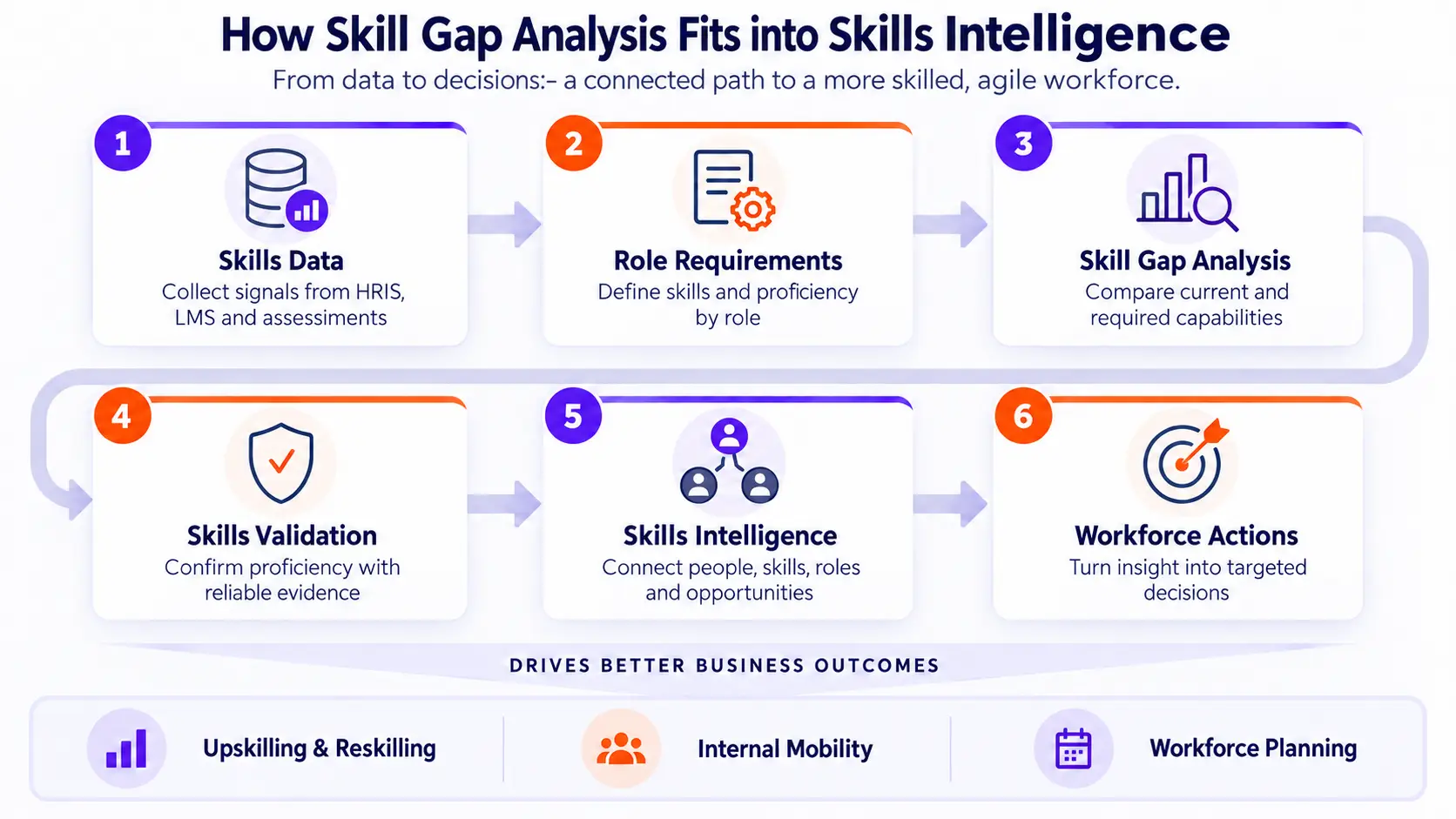
Each stage builds on the one preceding it. The following pointers define how:
- Skills data collection gathers information from sources such as HRIS, LMS, assessments, and employee profiles.
- Role requirements define what each job needs, and at what proficiency level.
- Skill gap analysis then compares the two and identifies where capability shortages exist.
- Skills validation adds confidence to that finding. It confirms proficiency through assessments, AI-powered interviews, or manager input, rather than relying on self-reported data alone.
- Skills Intelligence then connects the validated gap to people, roles, adjacent skills, and workforce priorities, turning a static finding into a continuous workforce decision that enables reskilling, internal mobility, or succession planning.
Hence, when organizations gain a system with unified capabilities of both platforms, it eases workforce decision making and reduces any additional manual efforts.
How iMocha Supports Skills Intelligence and Gap Analysis?
iMocha's Skills Intelligence Platform gives enterprises a current, AI-powered view of workforce skills, including available skills, employees and teams possessing them, proficiency levels, and capability gaps.
This view draws on several documented capabilities working together. iMocha provides features which help organizations make workforce decisions smartly.
Features:
- AI Skills Inference: It helps infer skills and proficiency signals from sources such as resumes, certificates, learning history, and work data.
- Skills Assessments: It helps validate proficiency through assessments and AI-powered interviews across technical, functional, and leadership areas.
- Skills Architecture: It defines role-level skills profiles and maintains a taxonomy that can evolve as roles change.
Together, these capabilities help HR and L&D teams move from one-time gap identification toward continuous, skills-based workforce planning.
Conclusion
A Skill gap analysis platform informs an organization where capabilities are missing. A Skills Intelligence platform provides the broader infrastructure to understand why those gaps exist, who can close them, and how workforce capabilities change over time.
Some organizations with a focused initiative may only need a gap analysis. However, an enterprise managing continuous workforce transformation typically needs the broader visibility a Skills Intelligence platform provides.
FAQs
1. Can a Skills Intelligence Platform Replace Traditional Skill Gap Analysis?
Skill gap analysis typically becomes one stage within a Skills Intelligence platform rather than being replaced outright. The platform adds validation, adjacency mapping, and continuous tracking around the same gap-identification step.
2. How Often Should Organizations Conduct a Skill Gap Analysis?
This depends on how quickly roles and priorities change in a given function. Fast-changing roles, such as those affected by AI adoption, need more frequent review than stable, well-defined roles.
3. What Often Should Organizations Conduct a Skill Gap Analysis?
A Skills Intelligence platform typically draws on multiple data sources rather than a single input. iMocha's AI Skills Inference feature within the platform infers skills and proficiency signals from sources such as resumes, certificates, learning history, and work data. This can be combined with assessment results and manager input for further validation.
4. How Do Skills Intelligence Platforms Validate Employee Skills?
Validation typically combines methods such as assessments, AI-powered interviews, and manager or peer input, rather than relying on self-reported data alone. iMocha's Skills Assessment platform supports this through assessments and AI-powered interviews.
5. What is the Difference Between Skill Gap Analysis and Skills Assessment?
A skill gap analysis compares current and required skills to find shortages. Skills assessment is one method used to measure an individual's actual proficiency and can be easily integrated into a gap analysis or a broader Skills Intelligence platform.
6. Do Small Organizations Need a Skills Intelligence Platform?
Not necessarily. Organizations with stable roles and a narrow set of workforce questions may find a focused skill gap analysis sufficient.

