You've probably presented a skill gap analysis that looked solid on the day and felt out of date by the next planning cycle. It was built from self-ratings, manager reviews, and job titles, so it showed what people said about their skills at one point in time. Agentic AI skill gap analysis changes how that evidence is gathered and checked. This post explains where it improves accuracy, where it doesn't, and how to test a vendor's claims before you rely on the numbers.
Agentic AI skill gap analysis is a workflow in which AI agents gather skills evidence from several systems, match it to your skills taxonomy, assign a proficiency level to each skill, check their own output, and route uncertain results to a person, so human resources and learning and development (L&D) leaders can compare workforce skills with role requirements more accurately.
Teams that invest in skills intelligence usually find the hard part is keeping the data accurate, which is why the workflow matters as much as the model. The same accuracy problem runs through workforce planning, internal mobility, and competency mapping, because all three depend on the same skills records.
Key takeaways
- Agentic AI improves skill gap accuracy mainly by grounding results in your own taxonomy and by treating proficiency level as a separate decision.
- In published tests, removing taxonomy retrieval and reranking caused the largest drop in skill classification accuracy.
- A 2026 study found that adding more agents didn't improve skill matching and made proficiency estimates worse.
- Test vendors on level accuracy, confidence routing, and audit trails, using roles your own experts have already mapped.
Why skill gap analysis loses accuracy
Most skill gap analyses lose accuracy at the evidence stage, well before anyone compares skills with role requirements. Self-ratings reflect each person's own idea of what a skill level means, and manager ratings favor the work a manager sees most often. Two engineers with similar ability can end up a full level apart, and the gap report treats that difference as real. Teams that compare ratings with project records usually find the errors are concentrated in the middle of the scale, where "intermediate" and "advanced" blur together.
The requirement side moves too. LinkedIn expects 70% of the skills used in most jobs to change by 2030, and a LinkedIn executive said in April 2026 that the skills needed for the average job had already shifted about 25% in recent years (LinkedIn Work Change Report; TechCrunch). A competency model approved two years ago describes a role that has partly changed, so a gap measured against it can be accurate on paper and wrong in practice.
Even published frameworks change underneath you. In a 2026 study that mapped European information and communications technology (ICT) role profiles to the Skills Framework for the Information Age (SFIA), 31% of the expert-assigned skill and level pairs used skill names that had been renamed or retired by SFIA version 9 (Disansa et al., 2026). Any gap analysis built on the older mapping would report gaps against skills that no longer exist in the current framework.
Deloitte's 2026 Global Human Capital Trends report argues that organizations are losing trust in workforce data just as they come to depend on it (Deloitte). For skill gap analysis, that makes accuracy a maintenance problem, so the useful question about any AI approach is how it keeps evidence and requirements current.
How agentic AI skill gap analysis differs from single-pass AI
An AI system is agentic when it works toward a goal across several steps, chooses which tools to use, and checks its results before handing them over. Gartner describes agentic AI in HR as solutions built from one or more AI agents that perceive, make decisions, take actions, and pursue goals with some degree of autonomy (Gartner). A single-pass model, by contrast, reads a profile once and returns a list of skills.
In skill gap analysis, the difference shows up in what happens between input and output. An agent can search your taxonomy for the closest entry, pull project or certification records to support a proficiency rating, and compare the result with the role's requirements. A competency map built for each role starts aging the day it's approved, so an agent that checks requirements against current evidence catches drift a one-time model would miss.
| Step | Rules-based matching | Single-pass AI model | Agentic workflow |
|---|---|---|---|
| Reading evidence | Keyword matches in profiles | Reads one source per request | Pulls and timestamps evidence from several connected systems |
| Mapping to the taxonomy | Exact or fuzzy label match | Relies on what the model already knows | Retrieves candidate entries from your taxonomy and reranks them |
| Setting proficiency | Copies the self-rating | Often implied by wording | Assigns a level as a separate decision, with a rationale |
| Handling uncertainty | None | Returns an answer either way | Scores confidence and routes low-confidence results to a reviewer |
| Staying current | Manual updates | Re-run on request | Re-checks when new evidence or framework versions arrive |
The table shows why the label matters less than the steps. A tool can call itself agentic and still behave like the middle column, so the steps are what you're buying.
Gartner estimated in 2025 that only about 130 of the thousands of vendors marketing agentic AI offer real agentic capabilities, and it described many products as rebranded assistants, chatbots, and robotic process automation (Gartner). Before accepting the label, ask the vendor to run the agent on a real profile and show each tool call it makes.
Five places competency mapping breaks, and what an agent does at each
Errors enter a skill gap analysis at five points, and each one needs a different fix. Treating accuracy as a single score hides which step is failing, which is why the error map below separates them.
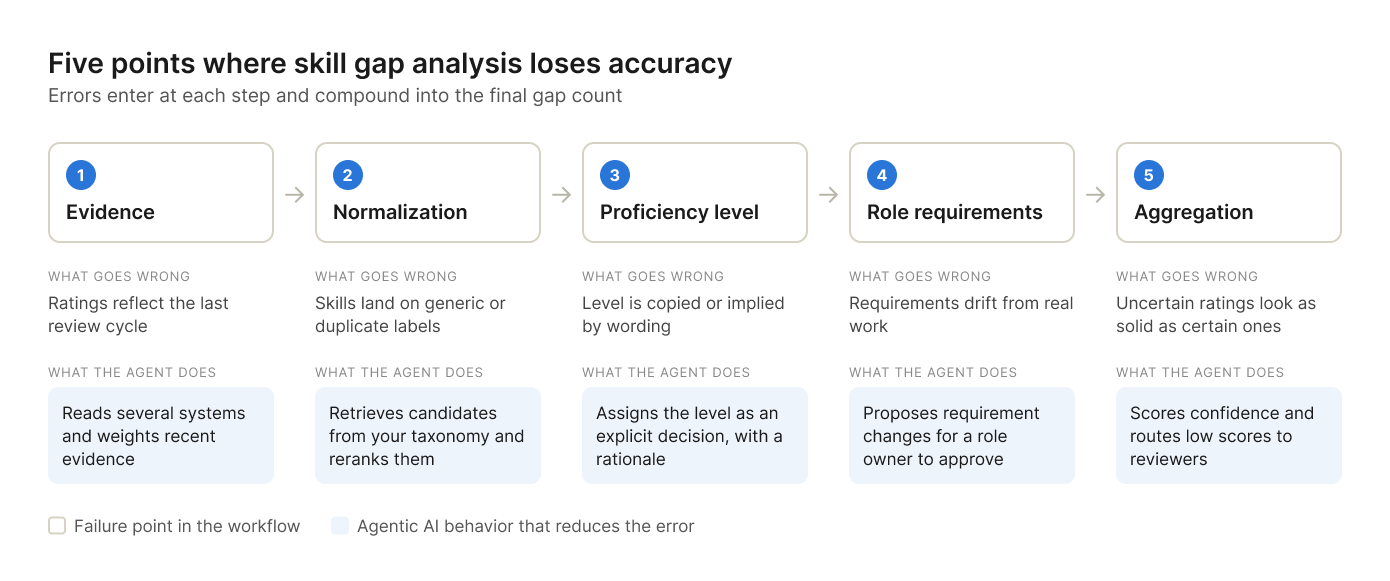
1. Evidence collection and freshness
A skills profile is only as current as its last update, and most profiles are updated during review season. An agent can read several systems, such as the human resources information system (HRIS), the learning platform, project tools, and certification records, and weight newer evidence more heavily. A cloud engineer who rated AWS as intermediate two years ago and has since led two migrations should not stay at intermediate because nobody reopened the form. In practice, this step usually stalls on access, because privacy and security reviews for each connected system often take longer than the integration itself.
2. Skill normalization to your taxonomy
Grounding each skill in your own taxonomy produces the most consistent accuracy gains in the research, while explicit level decisions, covered below, produce the largest single improvement. The agent matches each skill it finds against your organization's skills taxonomy instead of relying on the model's general vocabulary. In an ICWSM 2026 paper, a pipeline that retrieved candidate skills from the European Skills, Competences, Qualifications and Occupations (ESCO) taxonomy and had the model rerank them reached an RP@10 (a ranking accuracy score from 0 to 1) of about 0.70, compared with 0.02–0.16 for model-only inference, and accuracy held steady across different language models (Achananuparp and Lim, 2026).
Normalization is also where accuracy quietly leaks. One transformer pipeline measured 91% precision for extracting skills and 80% for standardizing them, for a combined precision of 79% (Malandri et al., 2025). A profile that says "built executive dashboards in Power BI" has to land on your data visualization entry, and a generic "reporting" label would make the employee look weaker than they are.
3. Proficiency level
Proficiency level is where the most accuracy is lost and where agentic designs show their clearest gain. Skills and competencies diverge at this point, because a level describes how independently and at what scope someone applies a skill. In the SFIA study, approaches that inherited the level from the closest matching text got the exact level right 18% of the time, while a single agent that assigned the level as an explicit decision got it right 53% of the time and within one level 82% of the time (Disansa et al., 2026).
The practical difference is large. A level-3 rating in a cloud skill might mean following established runbooks, while level 5 means designing the architecture other teams follow. Ask any vendor whether proficiency is a separate output with its own rationale, or a by-product of which skill description matched.
4. Role requirement upkeep
A gap is the distance between two records, so a stale requirement produces a wrong gap even when the employee's data is perfect. An agent can compare stored competency maps with current project staffing, internal job postings, and new framework releases, then propose changes for a role owner to approve. The common failure is letting the agent apply those changes automatically, because gap counts then shift overnight, and nobody can explain why to the business. Keep a person as the approver and version every change.
5. Aggregation and confidence
Organization-level reports add thousands of individual judgments, so uncertainty has to stay visible after the roll-up. An agent can attach a confidence score to each skill rating and send the lowest confidence ratings to a manager for review. If a heatmap shows 40% of a platform team lacking Kubernetes skills, and half of those ratings carry low confidence, the real gap could be much smaller. Ask for confidence to appear next to every gap figure in the report itself.
| Failure point | What usually goes wrong | What the agent does | What to ask a vendor |
|---|---|---|---|
| 1. Evidence collection and freshness | Ratings reflect the last review cycle | Reads several systems and weights recent evidence | Which systems can it read, and how is evidence age handled? |
| 2. Skill normalization to your taxonomy | Skills land on generic or duplicate labels | Retrieves candidates from your taxonomy and reranks them | Is matching grounded in our taxonomy or the model’s own vocabulary? |
| 3. Proficiency level | Level is copied or implied by wording | Assigns the level as an explicit decision | How accurate are levels, measured separately from skill matches? |
| 4. Role requirement upkeep | Requirements drift from real work | Proposes requirement changes for approval | Who approves changes, and are versions logged? |
| 5. Aggregation and confidence | Uncertain ratings look as solid as certain ones | Scores confidence and routes low scores to reviewers | Is confidence shown next to every gap figure? |
Read across each row and you have a short evaluation script. Most vendor demos cover the first two rows well, so spend your time on rows three to five.
Worked example: how small errors become wrong gap counts
Illustrative example. The rates below are assumptions chosen to show the math, not benchmark data. Consider an organization assessing 1,500 engineering and data employees against eight required skills each, which produces 12,000 skill-and-level judgments. Each judgment is fully correct only if the skill is identified, mapped to the right taxonomy entry, and assigned the right level.
| Scenario | Skill found | Mapped correctly | Level correct | Fully correct judgments |
|---|---|---|---|---|
| Baseline | 90% | 85% | 70% | 6,426 of 12,000 (54%) |
| Better taxonomy mapping | 90% | 95% | 70% | 7,182 of 12,000 (60%) |
| Level as an explicit decision | 90% | 85% | 80% | 7,344 of 12,000 (61%) |
The baseline multiplies out to 0.90 × 0.85 × 0.70, or about 54% fully correct, which leaves roughly 5,570 judgments wrong somewhere. Raising mapping accuracy by 10 points fixes about 760 of them, while raising level accuracy by the same 10 points fixes about 920. In this example the level decision is the bigger lever, which matches what the research found.
Real errors aren't independent, and some cancel out when you roll up to a department, so the aggregate picture is usually better than these numbers suggest. Individual decisions don't get that benefit. When gap data feeds skills-based workforce planning at the role or person level, a wrong level becomes a wrong development plan or a missed internal candidate.
What agentic AI doesn't fix
Agentic AI improves the workflow around skills data, but it can't make a weak taxonomy or an unclear role definition accurate. Four limits are worth stating plainly.
More agents don't mean more accuracy. In the SFIA study, a three-agent crew matched the single agent on skill matching (an F1 score, which combines precision and recall, of 0.212 against 0.213) while doubling processing time and producing worse level estimates (a mean error of 1.16 levels against 0.68) (Disansa et al., 2026). We'd treat agent count as a cost to justify, so a vendor that leads with how many agents it runs is answering the wrong question.
Absolute accuracy is still modest. The best skill-matching F1 score in the SFIA study was about 0.23, measured on 30 one-sentence role summaries. Richer internal data may perform better or worse, which is why the testing steps below use your own roles.
The taxonomy sets the ceiling. If your taxonomy has overlapping entries or missing levels, grounding the agent in it spreads those problems more consistently. Clean the taxonomy before you measure the agent.
Governance still applies. Gartner predicts that over 40% of agentic AI projects will be canceled by the end of 2027 because of escalating costs, unclear business value, or inadequate risk controls (Gartner). If you employ people in the EU, systems used for promotion, task allocation, or evaluating performance are high-risk under the EU AI Act, and a provisional May 2026 agreement would move those obligations to December 2, 2027 (Ogletree Deakins). Once gap data starts driving internal mobility decisions, a person needs to review every match the agent flags as low confidence.
How to test accuracy claims before you buy
You can test a vendor's accuracy claims in a few weeks with data you already have. The six steps below assume you have a small group of subject matter experts and one or two job families to work with.
1. Build a gold set from your own roles
Ask your experts to map 20–30 roles to your taxonomy at both skill and level, with evidence for each rating. Experts often disagree on levels, so record where they disagree before you test anything, because that disagreement is the realistic ceiling for any tool.
2. Score skill matches and levels separately
Ask for precision and recall on skill matches, then exact and within-one accuracy on levels for the skills it matched correctly. A single blended score hides the level problem, which is the error that matters most for development and mobility decisions.
3. Check how the agent handles uncertainty
Look at what the agent does with a thin profile, such as a new hire with one project and no certifications. A good result is a low-confidence flag routed to a reviewer, and a poor one is a confident rating built on almost nothing.
4. Run the same profiles twice
Agentic systems can produce different results on identical inputs. In the SFIA study, the same configuration moved between runs by more than several of the reported differences between methods, so ask the vendor to run your gold set twice and show you how much the results move.
5. Ask for the audit trail
For any rating, you should be able to see which evidence the agent read, which taxonomy entries it considered, and why it chose the level it did. Without that trail, managers can't challenge a rating, and you can't defend a decision built on it.
6. Compare cost and time against the accuracy gain
More steps mean more processing time and cost per profile. In the SFIA study, the three-agent design took about 327 seconds per record against 167 for the single agent, with no accuracy gain, so ask what each extra step buys you in measured accuracy.
How iMocha approaches agentic AI skill gap analysis
iMocha Skills Intelligence gathers skills evidence from resumes and profiles, certifications, learning activity, project work, manager ratings, and AI Interviews, with each organization choosing which sources are active. Every signal is mapped to the organization’s skills taxonomy and ontology, and the engine combines weighted source signals into a confidence score that sets a proficiency level of Beginner, Intermediate, Experienced, or Proficient. Each inferred skill shows its contributing sources and confidence breakdown, and managers, HR administrators, and employees can review, endorse, override, or dispute it through a human review workflow. You can see how this works in practice in iMocha's skill gap analysis.
FAQs
Is agentic AI more accurate than a skills matrix for skill gap analysis?
It can be, when the agent grounds ratings in your taxonomy, uses current evidence, and assigns levels as explicit decisions, because a skills matrix depends on whoever last filled it in. Test it on roles your experts have mapped before assuming the gain.
Does agentic AI replace manager validation of skills?
No, it changes where managers spend their time, because the agent can handle clear cases and send low-confidence ratings to managers for review. Managers remain the approvers for ratings that affect development or mobility decisions.
How often should a competency map be updated when using agentic AI?
An agent can check requirements whenever new evidence or a new framework version arrives, but changes should go to a role owner for approval. Most teams review proposed changes monthly or quarterly so gap counts stay explainable.
What data does agentic AI use to infer employee skills?
It typically reads profiles, learning records, certifications, and project or work records from the systems it's connected to, and weights newer evidence more heavily. What it can read depends on the integrations and permissions your security and privacy teams approve.
How do you measure the accuracy of AI skills inference?
Compare the AI's ratings with a gold set of expert-mapped roles, scoring skill matches and proficiency levels separately. Run the test more than once, since agentic systems can vary between runs.
Conclusion
Agentic AI skill gap analysis earns its accuracy through specific steps: current evidence, grounding in your taxonomy, explicit proficiency decisions, and visible confidence. The research so far favors simple, well-grounded designs over stacks of agents, and it still shows modest absolute accuracy, so your own testing matters more than any vendor benchmark. As a next step, pick one job family and have your experts map 20–30 roles at skill and level, because that gold set is what every accuracy claim should be measured against.